Fort Darnet: A Victorian River-Defence Fort on the Medway


Site at a Glance
- Rating
- 4.8
- Popularity
- Very Low
- Country
- United Kingdom
- Primary era
- Modern
- Eras represented
- Modern
- Civilizations
- British
- Site type
- Military
- Remains
- Fort
On this page6 sections
History
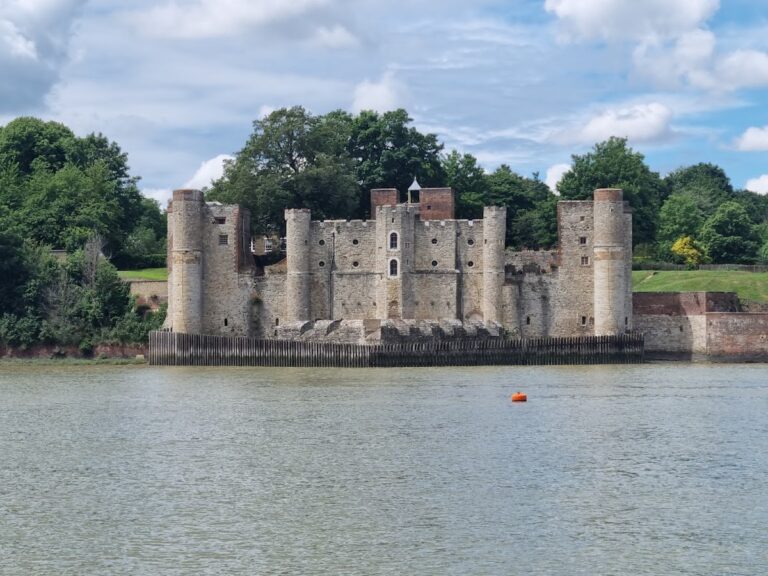
Fort Darnet is a nineteenth-century military installation on an island in the River Medway, Kent, in the United Kingdom. Built between 1870 and 1872 as a Palmerston fort, it formed part of the defences of Chatham Naval Dockyard, a major Royal Navy shipbuilding and maintenance establishment on the river.
Construction and river defence
The fort was built on the recommendations of the 1859 Royal Commission, a British government investigation into the country’s coastal and naval defences. Captain Siborne of the Royal Engineers, the British Army corps responsible for military engineering and fortification, oversaw its construction. Fort Darnet and its twin, Hoo Fort, were positioned about 1 kilometre apart to defend Pinup Reach, the inner navigable channel of the River Medway, with Hoo Fort upstream.
The original plan called for two circular tiers of guns and a boom, meaning a floating or fixed barrier designed to obstruct ships, stretched between the forts. Subsidence and substantial cost overruns resulted in a smaller completed scheme with only one gun tier. The boom was abandoned, although plans provided for mining the channel if necessary. The finished fort could accommodate a garrison of up to 100 men and was completed in the early 1870s.
Military use and later history
Fort Darnet was used for gunnery practice rather than active warfare. On 25 January 1879, one of its guns cracked inside its casemate, a fortified chamber from which artillery could be fired. The fort never saw combat and was decommissioned before the First World War.
During the Second World War, Fort Darnet was brought into use as an observation post. Platforms and pillboxes, small fortified concrete structures used for observation and defensive fire, were added to its upper surface. These alterations remain part of the fort’s later history and physical form.
Fort Darnet was designated as Fort Darnet, Darnet Ness, on 1 November 1963. It is a scheduled monument under the Ancient Monuments and Archaeological Areas Act 1979, giving it legal protection as an archaeological and historic site.
Remains
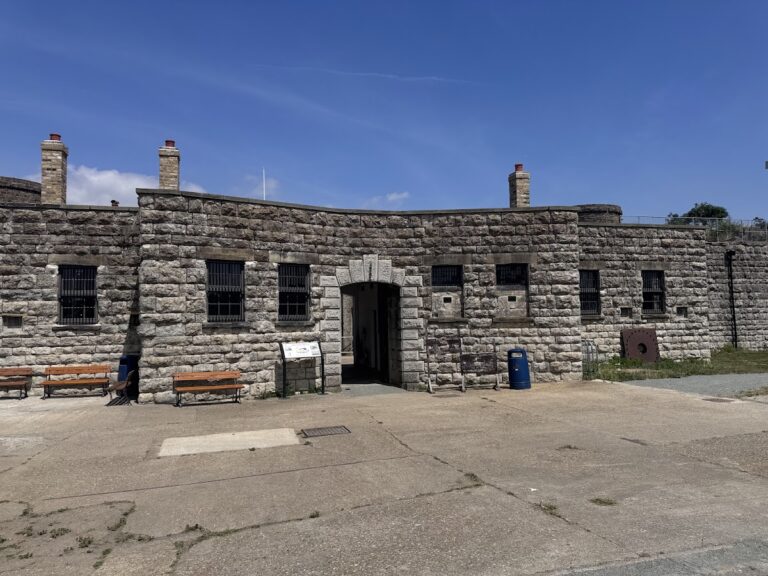
The fort occupies an island in Pinup Reach and is built in brickwork with concrete skirts. Its principal defensive arrangement is a single circular tier of eleven rifled muzzle-loading guns. These were heavy artillery pieces loaded from the front and fitted with rifled barrels to improve range and accuracy. The guns were mounted in casemates around the fort.
Gun tier and ammunition level
The surviving gun tier contained eight 9-inch guns and three 7-inch guns. Their casemates formed the fort’s completed artillery level after the intended two-tier design was reduced. One gun later cracked during practice, an event that affected the fort’s use for gunnery.
The magazine level, the part of the fort used to store ammunition, is flooded. The flooding has been reported as a measure intended to deter unauthorised entry and vandalism. The fort is in fair condition, although it has also been described as a ruin.
Second World War additions
Platforms and pillboxes survive on the upper surface from the fort’s Second World War service as an observation post. These concrete additions sit above the earlier brick and concrete defensive structure and represent the adaptation of the Victorian installation for a later conflict.
Nearby sites