Cromwell’s Castle: A Seventeenth-Century Artillery Fort on Tresco


Site at a Glance
- Rating
- 4.7
- Popularity
- Very Low
- Country
- United Kingdom
- Primary era
- Early Modern
- External website
- Open
- Eras represented
- Early Modern
- Civilizations
- British, English
- Site type
- Military
- Remains
- Fort
On this page7 sections
History
Cromwell’s Castle is a seventeenth-century artillery fort on Tresco in the United Kingdom, built by Parliament between 1651 and 1652 after its forces retook the Isles of Scilly. The Isles of Scilly are an archipelago off southwestern England, and the castle was intended to protect the deep-water entrance to New Grimsby Harbour and the channel leading towards the other islands. It was named for Oliver Cromwell, Parliament’s leading military and political figure during the republican Interregnum.
Parliamentary conquest and construction
During the English Civil War, the conflict between supporters of the monarchy and Parliament, the islanders supported King Charles I. Tresco rebelled against Parliament in 1648 and became a base for Royalist privateers. Parliament feared that the Dutch or Royalist forces from Ireland could use the islands as a position from which to attack England. After establishing Parliamentary control, Sir Robert Blake ordered the construction of Cromwell’s Castle to command the harbour entrance and the passage between Tresco and Bryher.
The fort occupied an earlier defensive position. King Charles’s Castle, a principal fort built in the 1550s, stood on a poor site and was blown up by its defenders when Blake’s forces captured the island. A small sixteenth-century blockhouse, a compact defensive building protecting a strategic position, also occupied the area. Cromwell’s Castle was built on this pre-existing site, and stone from the ruins of King Charles’s Castle was incorporated into its massive walls.
Eighteenth-century alterations and decline
Following the restoration of Charles II in 1660, a survey recommended repairs. A later survey at the end of the 1730s counted ten artillery positions but noted that the island did not possess enough usable guns to arm both Cromwell’s Castle and its other defences. During the War of Jenkins’ Ear, an eighteenth-century conflict between Britain and Spain that began in 1739, Master Gunner Abraham Tovey constructed a large six-gun platform on the tower’s south-west side in 1739. The work may have replaced or covered an earlier sixteenth-century platform and also included a protective parapet and a new entrance through the main tower.
By 1752 the castle was unmanned and decaying. William Borlase recorded nine-pounder cannons on the platform and four-pounder guns on the tower roof. By the end of the eighteenth century, the site remained ungarrisoned and in disrepair, although old iron artillery guns were still present.
Guardianship and protection
The Crown leased the Isles of Scilly through the Duchy of Cornwall, the hereditary estate associated with the heir apparent to the British throne. The lease passed to the Godolphin family in 1687 and to Augustus Smith in 1834. In 1922 it passed to Arthur Dorrien-Smith, who agreed to place several properties on Tresco, including Cromwell’s Castle, under the guardianship of the Ministry of Works. That former government body was responsible for public buildings and historic properties before its heritage functions passed to later organisations, including English Heritage. The castle is now managed by English Heritage. It is protected as a Grade II* listed building and as a scheduled monument, with the latter protection also covering the mid-seventeenth-century blockhouse and the eighteenth-century gun platform on the western coast of Castle Down.
Remains
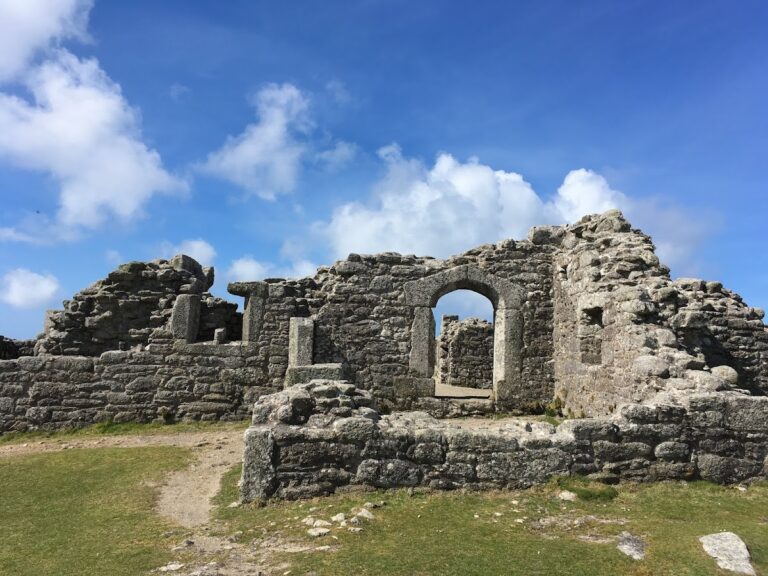
Cromwell’s Castle stands on the western coast of Castle Down overlooking New Grimsby Harbour. Its surviving fortification consists of a three-storey circular gun tower and the large gun platform attached to its south-west side. The tower is built from massive stone rubble, including material taken from King Charles’s Castle, and its position allowed the artillery to command the harbour entrance and the channel between Tresco and Bryher.
Circular gun tower
The principal tower measures 13.45 metres across and rises 15.1 metres high. Its walls are almost 4 metres thick, forming a massive masonry structure designed to withstand attack and mount artillery. Six gun ports with broad external splays are arranged around the roof, giving the guns a wide field of fire across the channel. The design was considered old-fashioned in the seventeenth century and resembled the circular keeps built under Henry VIII during the mid-sixteenth century.
The tower roof was described as specially bomb-proof and was edged by parapets about 1.8 metres high. The interior wooden floors have been lost, but the spiral staircase and stone-vaulted roof remain intact and accessible. These surviving elements preserve the tower’s defensive arrangement and its substantial masonry construction.
South-west gun platform
A large gun platform adjoins the tower on its south-west side. Designed for a battery of six guns, it provided a level firing surface and was protected by a parapet, a wall shielding defenders and artillery. The platform was constructed by Abraham Tovey in 1739, during the renewed defensive preparations associated with the War of Jenkins’ Ear. An earlier sixteenth-century platform may have occupied the same area beneath or beside it.
Nearby sites