Almudaina d’Artà: A Historic Defensive Complex and Pilgrimage Church in Mallorca


Site at a Glance
- Rating
- 4.7
- Popularity
- Very Low
- Country
- Spain
- Primary era
- Medieval
- Eras represented
- Medieval, Modern
- Civilizations
- Spanish
- Site type
- Military
- Remains
- Wall
On this page8 sections
History
Almudaina d’Artà, also known as Sant Salvador d’Artà, is a defensive complex in Spain associated with Mallorca’s Islamic-Arabic, or Moorish, period. It occupies Puig de Sant Salvador de s’Almudaina d’Artà, a hill in the geographic center of the Artà Peninsula in northeastern Mallorca. The name Almudaina comes from the Arabic al-mudayna, meaning “fortress” or “citadel.”
Islamic origins and the Christian reconquest
The fortress is believed to have origins before the Arab occupation of Mallorca, although no surviving records describe that earlier phase. The first references connected with the complex date from the Christian reconquest in 1232. During Islamic rule, the surrounding area was called Yartan, an Arabic term meaning “garden.”
After the reconquest, s’Almudaina served to protect the local population. Premonstratensian canons from Bellpuig Monastery, south of Artà, also used the enclosure and maintained the Sant Salvador shrine there. The Premonstratensians were a Christian canonical order whose members combined communal religious life with pastoral and institutional work. References from the mid-fourteenth century mention the construction of the first church inside the fortified enclosure.
Plague, destruction, and rebuilding
In 1820, a severe plague affected Artà, Capdepera, and Son Servera. An isolation facility, known as a lazaretto, was established within the complex to contain people suspected of carrying the disease. The buildings and church were then burned as a measure intended to prevent the epidemic from spreading.
The present pilgrimage church of Sant Salvador was rebuilt within the surviving fortification walls between 1825 and 1832. A pilgrimage church is associated with devotion to a shrine or sacred image and is visited by pilgrims. The church is also called the Santuari d’Artà, and La Mare de Déu de Sant Salvador is the patroness of Artà.
Remains
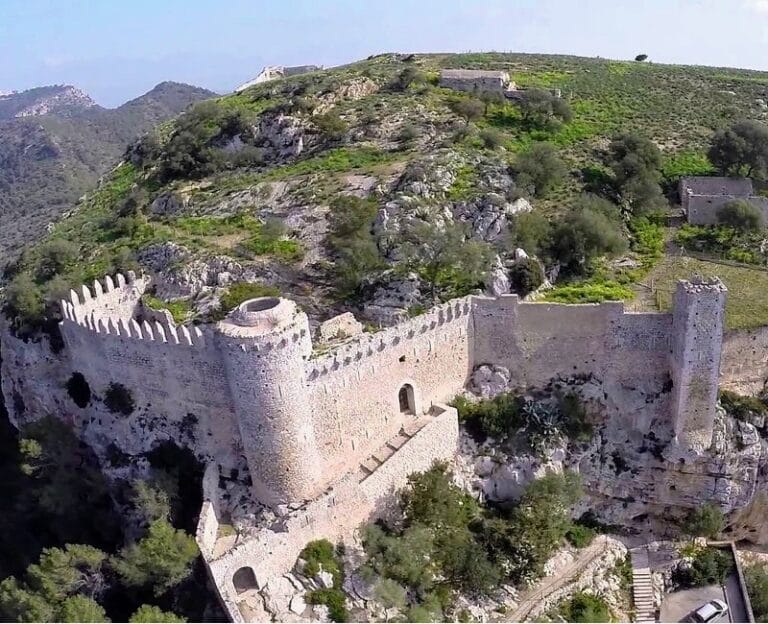
The surviving complex occupies the summit of Puig de Sant Salvador de s’Almudaina d’Artà. Its physical layout is defined by fieldstone fortification walls enclosing the pilgrimage church and associated buildings. The walls continue around the church, preserving the defensive boundary of the earlier complex.
Enclosing fortifications
Fieldstone walls
The enclosure walls are built of fieldstone masonry and remain as the principal surviving elements of the defensive complex. They surround the church and retain the fortified character of the hilltop site.
Pilgrimage church
Sant Salvador
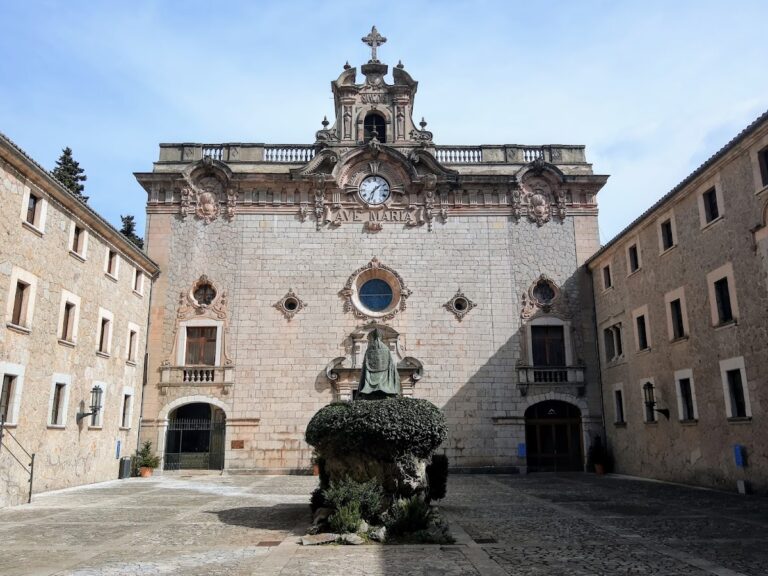
The church of Sant Salvador, also known as the Santuari d’Artà, stands inside the enclosure and forms the center of Artà. Its present building belongs to the rebuilding carried out after the 1820 fire, while the surviving walls preserve the setting of the earlier fortified sanctuary.
Nearby sites