Walzin Castle: A Medieval Fortress and River Stronghold in Belgium
Site at a Glance
- Rating
- 4.6
- Popularity
- Very Low
- Country
- Belgium
- Primary era
- Medieval
- Eras represented
- Medieval, Early Modern, Modern
- Civilizations
- Holy Roman Empire
- Site type
- Domestic
- Remains
- Castle
On this page12 sections
History
Walzin Castle is a medieval fortress in Belgium, near Dinant, established in the eleventh century to watch routes along the Lesse and protect access to Dinant. Its later appearance combines medieval and Renaissance elements with Gothic Revival work. The castle occupied a strategic position where the Lesse provided a river-trading route toward the Meuse, a road from Dinant toward France passed nearby, and the only southern approach to Dinant crossed a ford at Walzin.
Foundation and medieval control
A first stone castle was established in the eleventh century, probably on the initiative of Theodwin of Bavaria, prince-bishop of Liège, or Conon of Montaigu, count of Rochefort and a companion of Godfrey of Bouillon during the First Crusade. A prince-bishop combined the religious office of bishop with territorial and political authority. In Liège, the prince-bishops governed a substantial principality and maintained feudal relationships with local castellans.
Walzin served as a surveillance post, an advanced defensive position for Dinant, and a means of controlling movement along the river and roads. The first written references to the ruins of Cavrenne date from 1235. On 16 September 1237, Henry IV, Duke of Limburg, and the prince-bishop of Liège concluded a treaty concerning Walzin.
Sieges, destruction, and rebuilding
Walzin’s castellans were vassals of the prince-bishops of Liège and became involved in their conflicts with opposing powers. During the fifteenth century, the castle endured repeated sieges, destruction, and rapid rebuilding. Particularly severe attacks occurred in 1466 during the war with Burgundy and in 1489, when an imperial army invaded the area. In that year, the prince-bishopric of Liège ordered the castle’s destruction.
A popular tradition holds that Walzin was given to Catherine of Croÿ-Chimay in 1468 and entered the family of Robert de La Marck, Duke of Bouillon, through her marriage. The tradition is considered unlikely because Catherine was born around 1471, whereas Robert was born in 1468.
Around 1480, Guillaume de La Marck, known as the “Boar of the Ardennes,” took control of Walzin. His rebellions contributed to renewed destructive conflicts. The surrounding region was also devastated during the prolonged wars between Emperor Charles V, ruler of a wide Habsburg empire, and Henry II, King of France.
In 1554, François I de Clèves, Duke of Nevers, seized Walzin, stationed a garrison there, and established his headquarters within the fortress. The French army also burned the castle during this period. In 1581, Adrienne de Brandenbourg-Berlaymont became its owner. She rebuilt damaged sections, enlarged the complex considerably, and strengthened its outer defenses.
From fortress to residence
Walzin retained its strategic position in the Meuse valley on the route to Dinant. The passage of Louis XIV’s armies in 1675 and 1692 brought further sieges and devastation to the surrounding lands. Over time, restoration changed the former fortress into a more luxurious residence. French Revolutionary armies caused extensive damage in 1793, and a fire destroyed the castle archives, which contained documents accumulated over several centuries.
The property belonged to the family of Alfred Brugmann de Walzin from 1850. Alfred Brugmann financed extensive restoration, including work directed by the architect Émile Janlet in 1881. Baron Frédéric Brugmann de Walzin initiated another major campaign in 1930–1932 under the direction of the architect Octave Flanneau. These two campaigns gave the river-facing façade much of its imposing and romantic appearance.
Mireille Brugmann de Walzin, Frédéric’s daughter, became owner of the castle and estate in 1945. Her husband, Baron Albert de Radzitzky d’Ostrowick, contributed to the estate’s development and restored the gardens. The property later passed to Count Alexis de Limburg Stirum. His family traces its lineage to the ninth century and is described as directly descended from Henry IV, Duke of Limburg, and Guillaume de La Marck.
Walzin was legally protected as classified heritage in 1997 and recognized as exceptional heritage in 2013. The castle remains privately owned.
Remains
Rocky setting and defensive structures
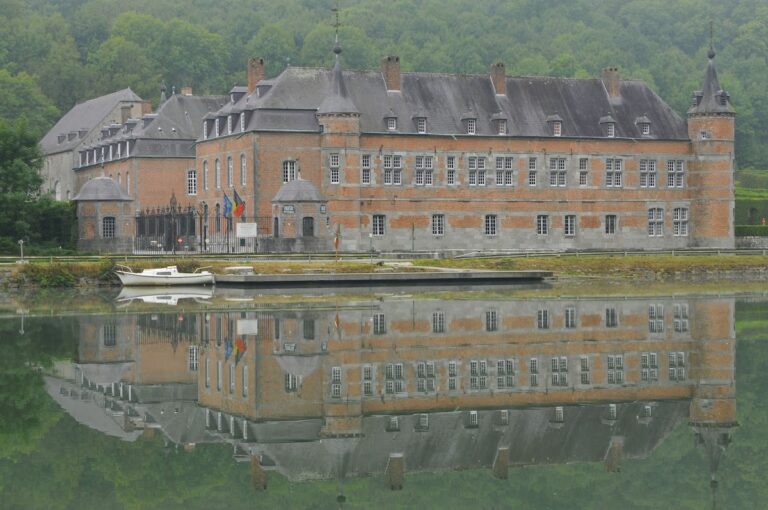
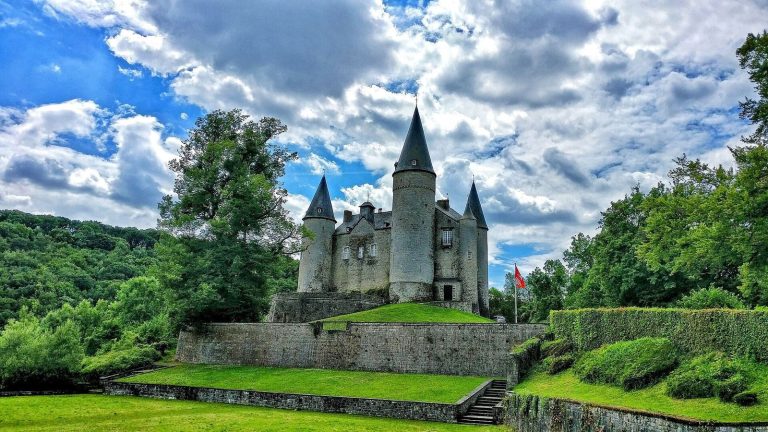
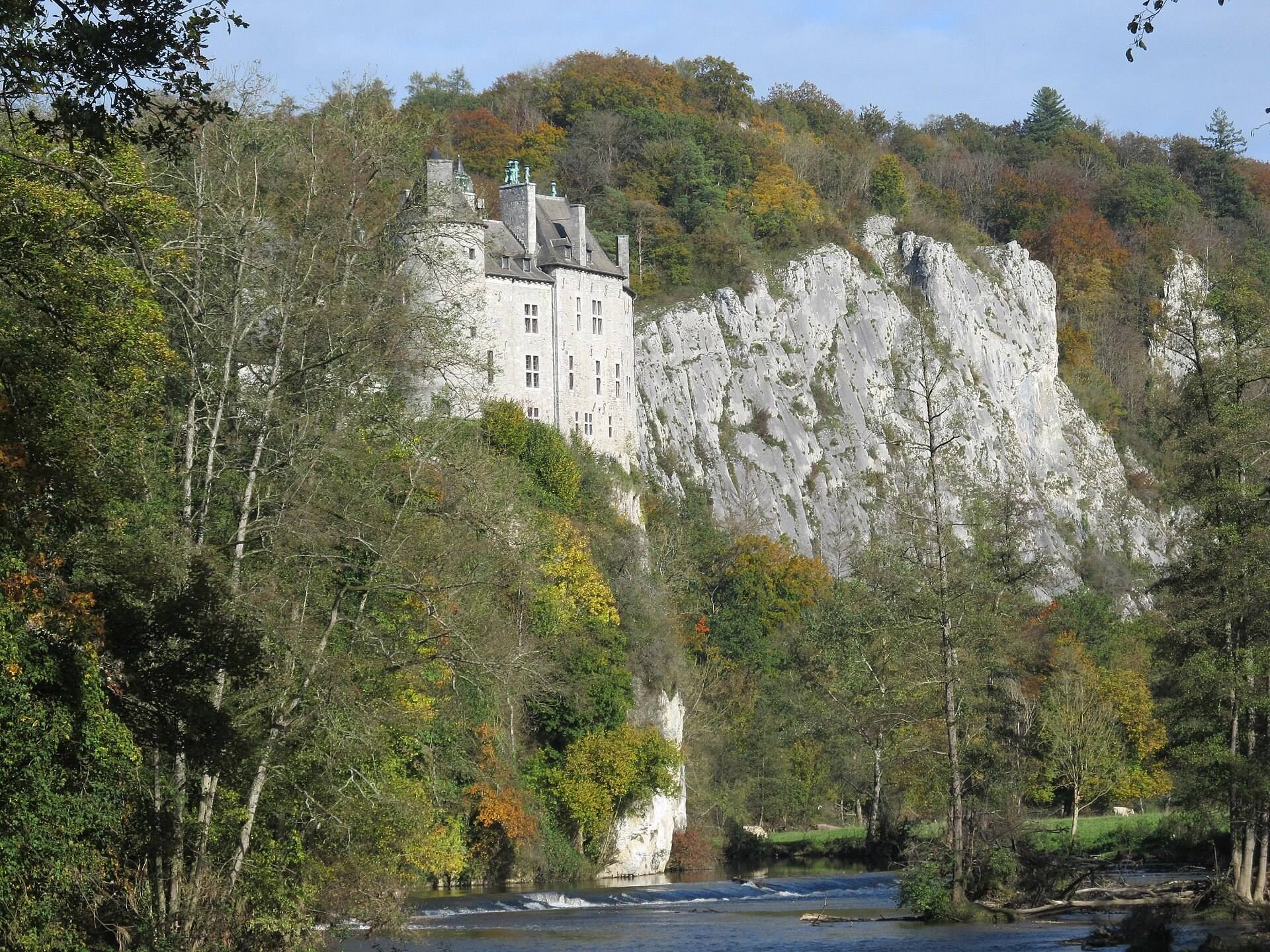
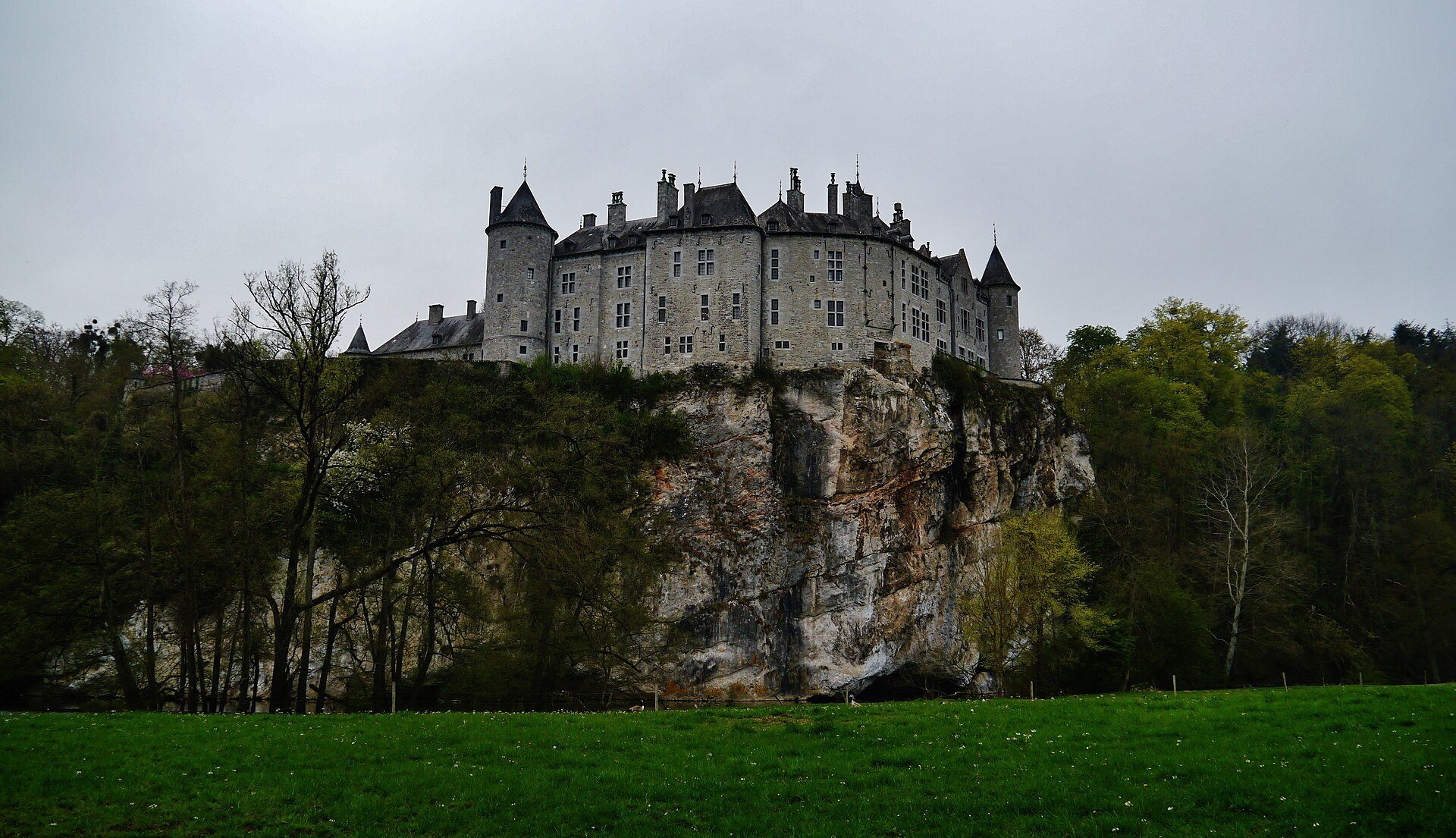
Walzin Castle occupies a steep rocky spur more than 50 metres above a bend of the Lesse. It stands on the river’s right bank, about 5 kilometres before the Lesse reaches the Meuse, within the wooded area known as the Bois du Chaleux. Built of stone and brick, the complex appears to extend directly from the near-vertical rock. Its principal building is formed by two wings that meet at almost a right angle.
Keep and medieval wall
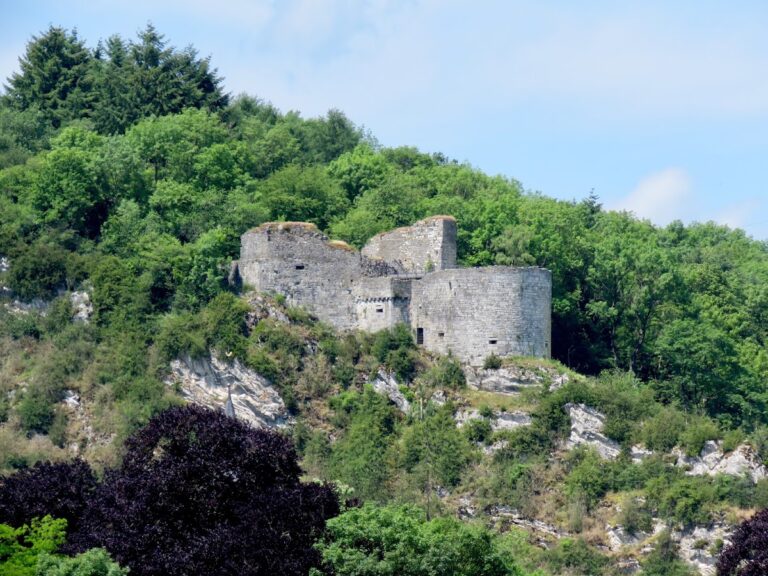
The earlier military remains include an eleventh-century keep, the principal fortified tower of a castle, which served as a stronghold and residence. Approximately 13 metres of an associated wall survive. This masonry is between 1.70 and 3.30 metres thick, while the earlier defensive works survive in fragmentary form.
Horseshoe tower
A fifteenth-century Renaissance horseshoe tower projects from the fortifications. This curved defensive tower contains four cannon ports, reflecting the changing requirements of castle warfare. Its survival provides a physical link between Walzin’s medieval defensive role and the later development of gunpowder fortifications.
Residential architecture and landscape
River-facing façade
The river-facing façade extends for more than 100 metres and preserves the romantic appearance created by the rebuilding of 1930–1932. Walzin incorporates medieval, Renaissance, and Gothic Revival elements, the latter belonging to the nineteenth-century movement that revived medieval Gothic forms. The 1881 restoration gave parts of the castle a Spanish-Flemish character, while the later rebuilding employed the regional Mosan, or Meuse-style, tradition that developed in the Meuse valley.
Gardens and park
The gardens and park were designed by Louis Julien Breydel, who also designed the Botanical Garden of Brussels. Albert de Radzitzky d’Ostrowick later restored the gardens, adding another phase to the estate’s transformation from fortified stronghold to residence.
Artistic representations
Walzin’s dramatic form has also shaped its artistic history. Remacle Leloup depicted the castle in 1744, and Gustave Courbet represented it in 1846. Victor Hugo drew Walzin after visiting on 19 August 1863. The castle is popularly called the “Belgian Neuschwanstein.”