Alt Rued Ruins: A Medieval Tower Castle in Switzerland


Site at a Glance
- Rating
- 4.8
- Popularity
- Very Low
- Country
- Switzerland
- Primary era
- Medieval
- External website
- Open
- Eras represented
- Medieval
- Civilizations
- Holy Roman Empire
- Site type
- Military
- Remains
- Castle
On this page9 sections
History
Alt Rued is a medieval tower castle ruin in Schlossrued, Switzerland, probably established during the eleventh or twelfth century. The castle was associated with the Lords of Ruoda, a family that held a manorial lordship in the Rued Valley and served successive powerful rulers.
Origins and the Lords of Ruoda
The Lords of Ruoda are first mentioned in the Acta Murensia in 1160, and their name gave Alt Rued its identity. It derives from the Old High German term Ruoderahuab, meaning “by the Ruderbach,” a watercourse that could be crossed by rowing. The family was a ministerial lineage, meaning that its members performed administrative, military, or other services for a higher-ranking lord. They served the Counts of Kyburg and, from 1273, the Habsburgs.
The Lords of Ruoda were probably originally members of the free nobility, but they later held a consolidated manorial lordship across the valley. Their ancestral castle occupied a small hill opposite the later Rued Castle. A new stronghold had already been built on the other side of the valley while the family still occupied Alt Rued. By the twelfth century at the latest, the move had become permanent, and the older castle was left to decay. The newer Rued Castle now stands about 600 metres from the ruins.
Decline and rediscovery
The Lords of Ruoda died out during the second half of the fourteenth century. Centuries later, in the eighteenth century, stone and other building materials from Alt Rued were reused in the expansion of the settlement in the valley. The castle was not entirely dismantled, however, so its original dimensions could later be reconstructed with considerable accuracy.
The Suhrental Local History Association partially excavated the remains in 1949 and conserved them in the years that followed. Excavation results were compared with a detailed eighteenth-century drawing of the castle and corresponded closely with it. The ruins were renovated again in 2008. Alt Rued is classified as a Swiss cultural property of regional significance, a Class B property.
Remains
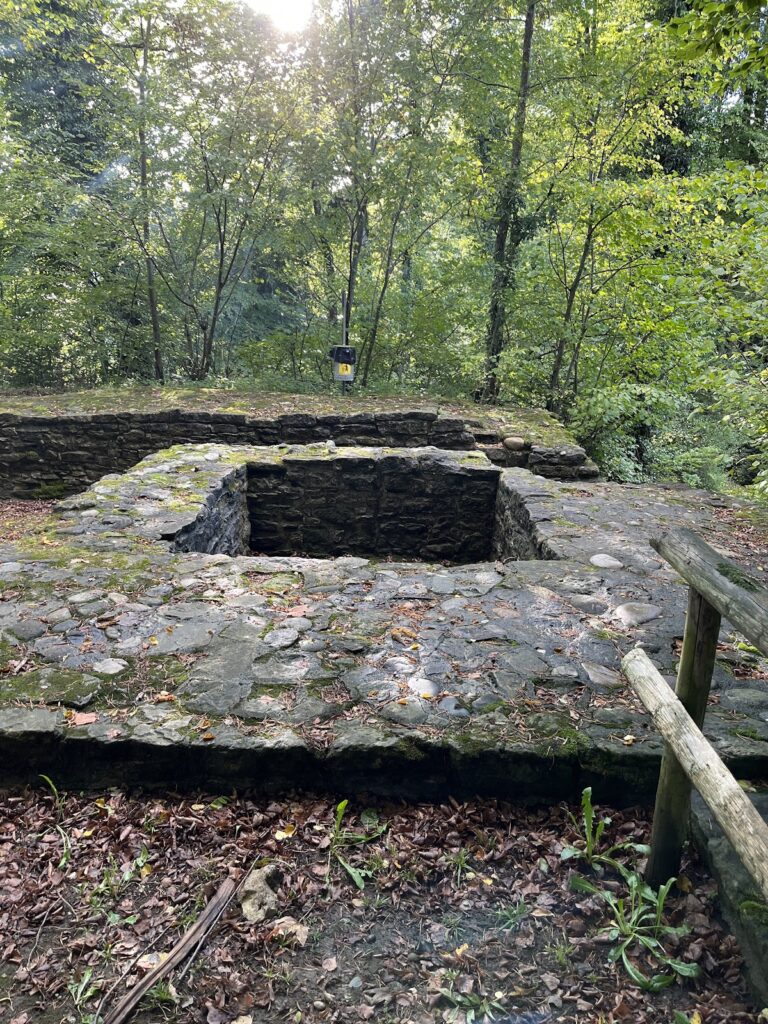
Alt Rued occupies a small hilltop opposite the newer Rued Castle. Built primarily of stone, the castle consisted chiefly of a residential tower with an adjoining chapel. Only parts of the foundation walls survive, but they preserve the site’s original dimensions and the arrangement of its principal buildings.
Earlier enclosure and stone castle
A first enclosure probably occupied the hilltop before the stone tower castle was built. It was probably constructed of wood during the eleventh or twelfth century. Artificially embanked edges in the terrain still indicate the extent of this earlier enclosure, providing physical evidence for the castle’s initial form.
Principal structures
Residential tower
The residential tower probably measured between 11.2 and 12.5 metres on each side. Its walls were approximately 1.85 metres thick. The western side was destroyed and dismantled, preventing a fully precise reconstruction of its original form. No roof-tile fragments were found, so the tower probably carried a shingle roof.
Chapel
A small mountain chapel adjoined the eastern wall of the tower at an oblique angle. It ended in an apse, a rounded or polygonal termination at the end of a chapel. The chapel was certainly older than the tower and probably also had a shingle roof.
Stone shaft
Within the tower was an artificially constructed stone shaft nine metres deep. It narrows toward the bottom and certainly did not serve as a well. Together with the surviving foundations, the shaft contributes to the reconstruction of the tower’s internal arrangement.
Nearby sites