Christ Catholic Collegiate Church of St. Leodegar: A Medieval Collegiate Church in Switzerland


Site at a Glance
- Rating
- 4.8
- Popularity
- Very Low
- Country
- Switzerland
- Primary era
- Medieval
- External website
- Open
- Eras represented
- Medieval, Early Modern
- Civilizations
- Holy Roman Empire, Swiss
- Site type
- Religious
- Remains
- Basilica
On this page8 sections
History
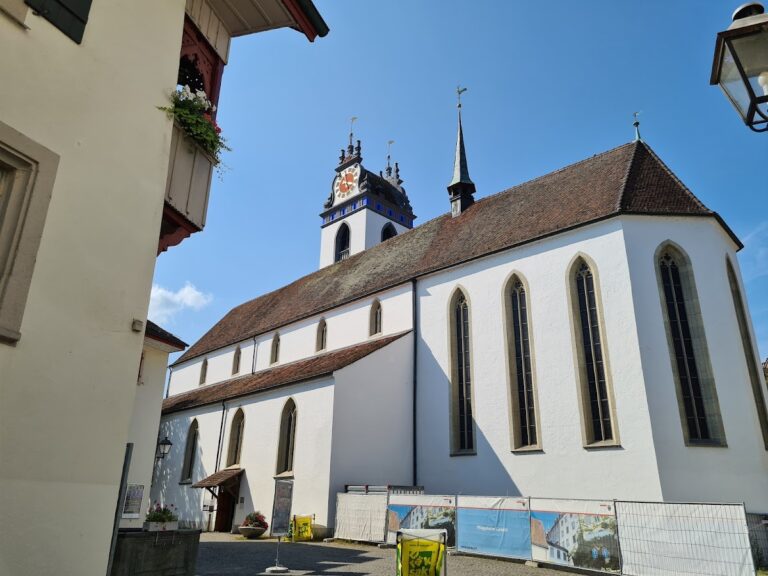
Christ Catholic Collegiate Church of St. Leodegar is a medieval church in Schönenwerd, Switzerland, most of whose present building was erected between 1025 and 1050 in the Romanesque style. It belonged to the monastery of the former collegiate foundation of St. Leodegar, established in the eighth century in the Niederamt east of Olten. The church is regarded as the oldest significant medieval building in the canton of Solothurn that has remained relatively unchanged.
Medieval foundation and rebuilding
The collegiate foundation shaped the church’s early religious role, while the main building belongs to the High Middle Ages, the period broadly covering the eleventh to thirteenth centuries. In 1388, the church burned out. Reconstruction followed, and the building was reconsecrated in 1491.
Early modern transformations
A cloister was constructed along the south wall from 1610. During the seventeenth century, the church’s original two late Gothic towers were dismantled. A new front tower was then built between 1676 and 1679.
The interior gradually acquired a Baroque character during the seventeenth and eighteenth centuries. In 1759, the collegiate provost Leonz Gugger donated the high altar and began a refurbishment in the Rococo style. The Marian altar on the gallery and two further altars also belong to this eighteenth-century phase.
Dissolution and later religious use
The collegiate foundation was dissolved in 1874 as a consequence of the Kulturkampf, a nineteenth-century conflict between secular governments and the Roman Catholic Church, especially in German-speaking Europe. With the approval of the Solothurn government, Schönenwerd’s Christian Catholic congregation began holding services in the church in 1876. Christian Catholicism is an independent Catholic tradition that emerged in opposition to the First Vatican Council’s definition of papal infallibility.
The church now belongs to the Christian Catholic parish. The Evangelical Reformed parish retained the right to use it jointly for more than a century and held regular services there until 2019.
Remains
The surviving complex centers on a three-aisled Romanesque pier basilica, a longitudinal church with a higher central nave beside lower aisles, whose arcades and upper walls rest on substantial masonry piers. The church has no transept, the cross-arm found in some cruciform plans. Its oldest sections belong to the eleventh-century construction, while the south side, front tower, interior furnishings, bells, and organ reflect later phases.
Church and cloister
The cloister is attached to the church’s south wall. Because the complex stands on the steeply sloping Bühl rock, the cloister has a rectangular plan rather than a square one. Its position and form remain tied to the medieval church fabric while reflecting the conditions of the rocky site.
Front tower and bells
The front tower, built between 1676 and 1679 after the late Gothic towers were removed, contains six bells cast by the H. Rüetschi foundry in Aarau. Two smaller bells date from 1856, while the other four were made in 1904. Their striking notes are c’, e’, g’, a’, c”, and f”, and the largest bell sounds C1.
Altars and organ
The high altar presents the Virgin Mary within a radiant aureole. The church also preserves a Marian altar on the gallery and two additional altars from the eighteenth-century Rococo refurbishment.
Kuhn Organ Builders made the church organ in 1980. It is a mechanical slider-chest instrument with 25 stops, two manuals, and a pedal.