Fort de Hollogne: A Brialmont Fort of the Fortified Position of Liège


Site at a Glance
- Rating
- 4.4
- Popularity
- Very Low
- Country
- Belgium
- Primary era
- Modern
- External website
- Open
- Eras represented
- Modern
- Civilizations
- Belgian, German
- Site type
- Military
- Remains
- Fort
On this page11 sections
History
Fort de Hollogne is a Belgian fort at Grâce-Hollogne, beside Liège Airport, built between 1888 and 1892 as part of the late-19th-century Fortified Position of Liège. Designed by General Henri Alexis Brialmont, a Belgian military engineer, it formed one of twelve forts in the National Redoubt, Belgium’s strategic defensive system and intended refuge for the army during an invasion. The fort helped secure Liège and guard against a renewed occupation by French forces.
Construction and Belgian service
After its completion, Fort de Hollogne was occupied by Belgian troops. It was one of the smallest forts in the Liège region and stood between Fort de Flémalle and Fort de Loncin. Its position formed part of the defensive network protecting the approaches to Liège, while its design reflected Brialmont’s use of large concrete fortifications around major Belgian cities.
The First World War
When the First World War began, the garrison consisted of 230 artillerymen and 120 infantrymen under Captain-Commandant Cuisinier. German forces attacked Liège on 6 August 1914. The forts resisted more strongly than the Germans had expected, prompting the attackers to bring forward siege artillery heavier than the fortifications had been designed to withstand.
Fort de Hollogne came under heavy bombardment from 13 August. After Fort de Loncin exploded on 15 August, German representatives approached Hollogne and Flémalle, the last two Liège forts still resisting. The garrison considered a plan to sabotage the fort before evacuating, but abandoned it after discovering that German forces had surrounded the position. Hollogne surrendered at 07:30 on 16 August 1914.
German alterations and later military use
During the German occupation, the fort was repaired and adapted as an infantry position. The entrances received new concrete coverings, metal ceilings were installed beneath the original concrete roofs, ventilation was improved, and two air intakes were added on the glacis, the gently sloping ground outside a fortification. An underground passage connected these intakes with the fort, while a ventilation fan and a replacement electrical installation addressed practical deficiencies.
The German air forces built an airfield directly beside Fort de Hollogne during the occupation. That airfield later developed into Liège Airport. After the First World War, the fort returned to Belgian control. During the interwar period, the Belgian Army used it as a munitions depot. Unlike most of the other Liège forts, it was not modernized, so it retained much of its original character apart from the German modifications.
In May 1940, no Belgian troops occupied the fort when Germany invaded. German Stuka dive-bombers attacked it after mistakenly identifying it as Fort de Flémalle, and German infantry subsequently captured it without a fight. A proposal to convert the fort into a launching site for V-2 long-range ballistic missiles was not carried out. Following the liberation of the area in 1944, American forces used the fort as a hospital.
After the Second World War, Fort de Hollogne again served as a Belgian military depot and later became a Belgian Air Force command post, a role it retained until the early 1990s. It remained under the Ministry of Defence until 1997, when it was transferred to the Ministry of Transport and incorporated into Liège Airport. The Comité de Sauvegarde du Patrimoine Historique du Fort de Hollogne now preserves and maintains the fort, which functions as a museum open to the public on designated occasions.
Remains
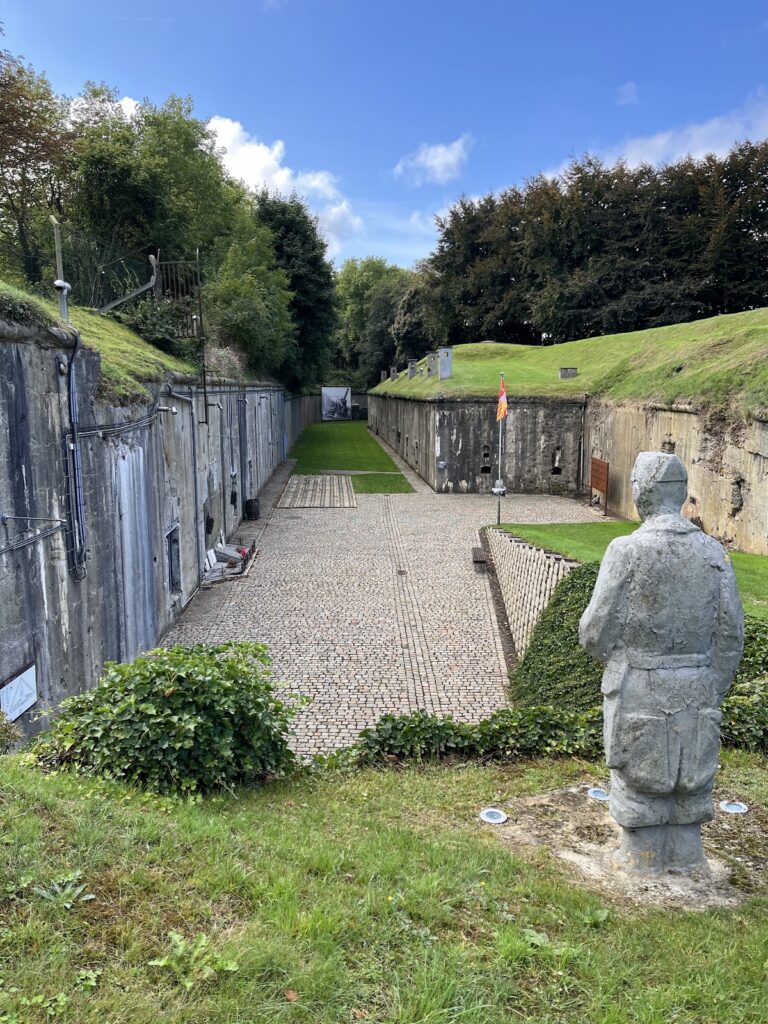
Fort de Hollogne is a semi-buried, isosceles-triangular fort located about 7 to 8 kilometres west of Liège city centre, directly beside the Liège Airport runway and west of Grâce-Hollogne. Its base measures 200 metres and its two sides measure 225 metres. A defensive ditch, 6 metres deep and 8 metres wide, encircles the entire fort. The position also lies near the railway line between Aachen and Brussels, between the neighboring forts of Flémalle and Loncin.
Concrete fortification and internal arrangement
Massif and protective structure
The fort was built entirely of unreinforced concrete rather than masonry, an unusual and innovative choice for its period. The central massif, which contains the principal gun turrets, has concrete up to 4 metres thick. The less exposed walls of the barracks are 1.5 metres thick. The fort was designed to withstand artillery firing shells from weapons with calibres of up to 21 centimetres. Its rear side, facing Liège, was more lightly protected than the salient sides, allowing Belgian forces the possibility of recapturing it from the rear.
Barracks and service area
The barracks opened toward the rear ditch. Opposite them, service facilities in the counterscarp, the outer side of the defensive ditch, included latrines, showers, a kitchen, and a morgue. This service area was more exposed than other parts of the fort, leaving its rooms vulnerable during a prolonged bombardment. The German entrance coverings, metal ceilings, air intakes, underground ventilation passage, and fan remain part of the fort’s later physical history, while the wider structure retains the character of a Brialmont fort.
Armament and observation systems
Central gun turrets
The principal armament was concentrated in the central massif. A Grusonwerke turret carried a single 21-centimetre Krupp howitzer, while a Creusot turret held two 15-centimetre guns. Two additional turrets each contained a Krupp 12-centimetre gun. Three retractable corner turrets carried 57-millimetre Maxim-Nordenfelt rapid-fire guns. The heavy guns were generally German-made, although the turret mechanisms came from different manufacturers.
Ditch defenses and communications
Seven further 57-millimetre rapid-fire guns were installed in counterscarp casemates, protected chambers used for guns and other military purposes. They defended the ditches and rear entrance with enfilading fire, meaning fire directed along the length of a ditch or other linear target. An observation turret equipped with a searchlight supported surveillance and night operations.
The guns used black powder rather than smokeless powder. Their firing gases could create choking conditions in the chambers and spread through the enclosed fort. Signal lights connected Fort de Hollogne with Fort de Loncin and Fort de Liers. Observation personnel also watched nearby bell towers, crossroads, and elevated points, transmitting information by telephone. Together, these systems linked the fort’s weapons, observation posts, and neighboring positions within the defensive network.
Nearby sites