Palazzo Scotti: A Historic Palace in Bergamo Alta


Site at a Glance
- Rating
- 4.9
- Popularity
- Very Low
- Country
- Italy
- Primary era
- Early Modern
- Eras represented
- Early Modern
- Civilizations
- Venetian
- Site type
- Domestic
- Remains
- Palace
On this page12 sections
History
Palazzo Scotti is a historic palace in Bergamo, Italy, standing in Bergamo Alta on Gromo Hill, in the area once occupied by the San Cassiano vicinia, a neighborhood-based civic community. Its construction date is uncertain, but it was built over the residence of Giovanni Agostino della Torre, son of the physician Giacomo della Torre. The della Torre family combined local prominence with commercial activity and legal scholarship, and traded iron vitriol made at a forge in Gandellino in the Seriana Valley.
From the della Torre family to the Terzi
The property passed from the heirs of the della Torre family to Ludovico Terzi, who became its proprietor in 1582. The earlier residence beneath the palace points to a longer history of settlement on Gromo Hill, before the city’s walls enclosed and separated the lower part of Bergamo from the upper city.
The Scotti family and nineteenth-century associations
The Scotti family later succeeded the Terzi family as owners, giving the palace the name it retains today. Giovanmaria Scotti received the hereditary title of baron from Vittorio Emanuele II, the first king of unified Italy, on 4 April 1861. He had married Giovannina Rota Basoni on 9 March 1850.
Giovannina and her mother, Rosa Rota Basoni, cared for Gaetano Donizetti, a major nineteenth-century Italian opera composer, during the final months of his life. Donizetti stayed at the palace from October 1847 until April 1848 while suffering from serious illness. The rooms associated with this period preserve the memory of that episode through a painting by Giuseppe Rilossi placed on one of the musician’s pianos.
Another distinguished visitor was Giovanni Roncalli, an Italian Catholic churchman who later became Pope John XXIII. He returned to his native city while serving either as an apostolic nuncio or as cardinal of Venice. Maddalena Guffanti, Baroness Scotti, later donated the Cà Maitino residence in Sotto il Monte as an act of devotion and friendship.
Later ownership
Palazzo Scotti remains in use and is owned by the heirs of the Scotti barons. Its history therefore joins an earlier mercantile residence, the ownership of the Terzi and Scotti families, and the palace’s later associations with music, religion, and Bergamo’s civic elite.
Remains
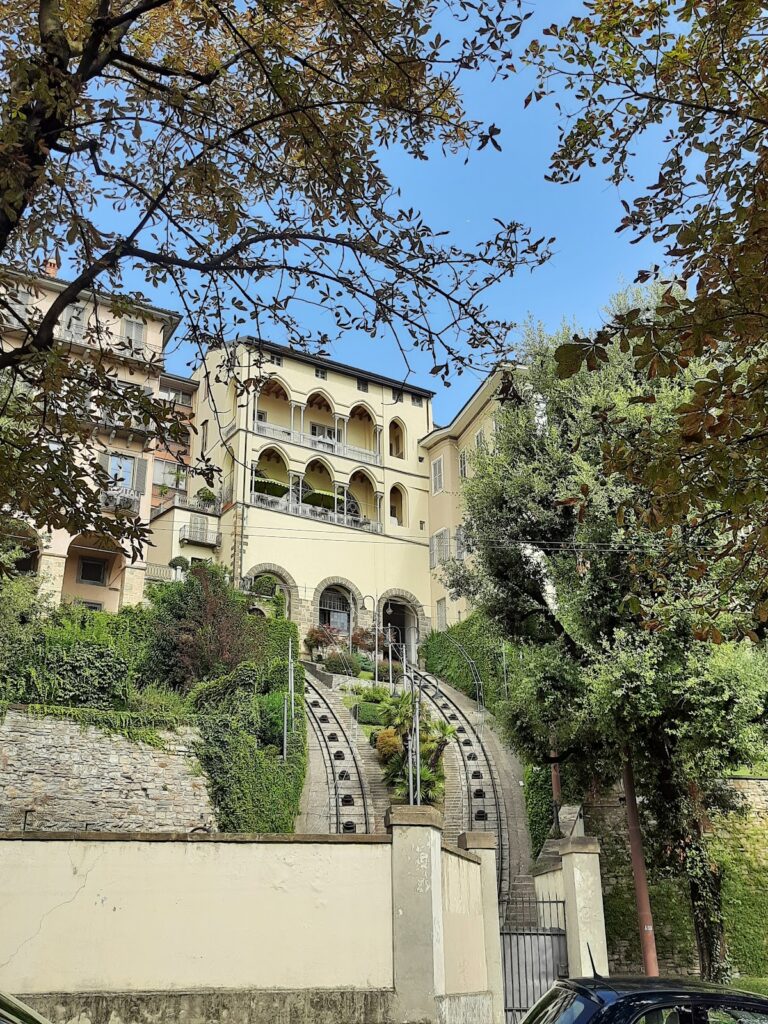
Palazzo Scotti combines substantial earlier foundations with a later palace organized around decorated rooms, terraces, and a steep garden. Its construction uses plastered brick and stone masonry, while the surviving exterior and interiors preserve alterations associated with the eighteenth century and later family ownership.
Foundations and underground rooms
The foundations contain superimposed underground rooms covered by sail vaults, which are formed by curved surfaces rising from the corners of a room. These spaces indicate that earlier civil dwellings extended toward the lower part of Bergamo before the city walls enclosed and cut off that area. Similar underground arrangements occur beneath other palaces in the upper city.
Facade and entrances
The facade on Via Gaetano Donizetti rises through four levels and is divided by three sandstone pilasters, shallow wall-attached members resembling columns. On the first floor, the pilasters have capitals and frame two small balconies with wrought-iron railings. Square windows are connected by Sarnico-stone frames and intermediate panels, while the attic has seven windows, each paired with a wrought-iron balcony that echoes those on the main floor. The building is completed by a hipped roof, which slopes downward on all sides.
Two entrances serve the palace. The smaller doorway opens into the entrance hall and continues toward the terrace facing the garden. The larger entrance is defined by shaped forms outlined in Sarnico stone.
Interior rooms
First-floor decorations
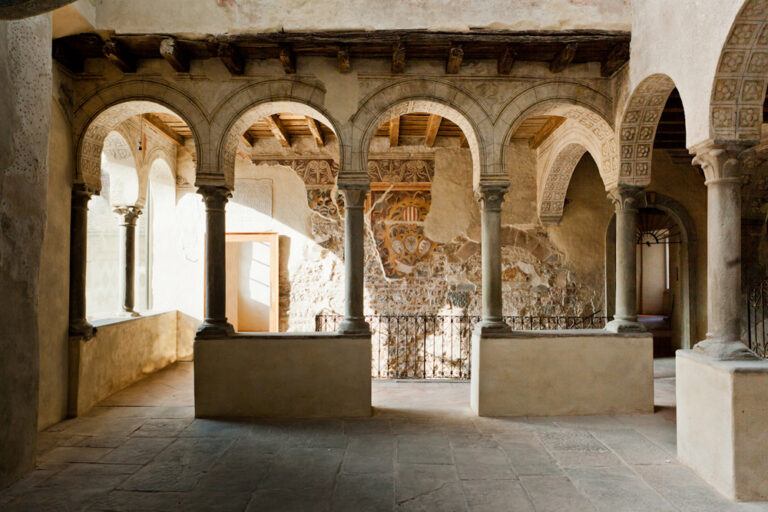
The first-floor rooms contain Neoclassical frescoes by Eugenio and Muzio Camuzio and Vincenzo Bonomini. Their arrangement reflects the fashion of Bergamo’s eighteenth-century noble palaces. Painted scenes occupy the curved wall sections that connect with the central parts of stucco-decorated ceilings. The stucco, molded plaster used for architectural decoration, includes shell motifs, symmetrical figures supporting ornamental vases, and birds at the corners where the walls meet.
Donizetti memorial
These first-floor rooms accommodated Donizetti during his final illness. A painting by Giuseppe Rilossi, set on a piano belonging to the composer, commemorates his stay and the tragic circumstances of that period.
Second-floor decorations
The second-floor rooms retain eighteenth-century decorations by Carlo Carloni. Mythological figures, putti and amorini, decorative childlike figures associated with classical and Renaissance art, appear with female forms in the ornamental scheme.
Terrace and garden
An exterior terrace enclosed by a stone balustrade connects with a steeply sloping English-style garden below. The garden contains a bust dated 1760 of Giovanmaria Scotti, who served on the Civic Council, Bergamo’s municipal governing body, from 1744 to 1792. The bust helps place the renovation of the palace as a whole in that period.
Nearby sites