Castello delle Rocche: The Este Fortress of Finale Emilia


Site at a Glance
- Rating
- 4.2
- Popularity
- Very Low
- Country
- Italy
- Primary era
- Medieval
- External website
- Open
- Eras represented
- Medieval
- Civilizations
- Unclassified
- Site type
- Military
- Remains
- Castle
On this page8 sections
History
Castello delle Rocche, also known as Rocca Estense, is a medieval castle in Finale Emilia, Italy, whose main fortress was built in 1402 for the Este dynasty. The site has a recorded 13th-century inception, and the later castle probably rose on the foundations of an earlier fortification. Commissioned by Niccolò III d’Este, Marquis of Ferrara, the construction was directed by Bartolino Pioti da Novara, an architect and master builder.
Early fortification and Este construction
Before the 1402 castle was built, Bonifacio di Canossa had constructed the principal keep, known as the mastio. The fortress occupied a strategic position beside the Panaro River and helped defend both the waterway and the city. In 1425, part of the battlemented curtain wall on the Panaro side was demolished. During the same period, the interiors and exteriors were enriched with frescoes. Giovanni da Siena completed the alterations by creating an elegant water entrance on the eastern side and adding Este eagles to the castle.
Este residence and municipal ownership
Toward the end of the 15th century, Castello delle Rocche became an Este residence. The Este, or d’Este, were a powerful Italian ruling dynasty associated particularly with Ferrara. The castle remained in use as an Este residence until the end of the 18th century. In the mid-19th century, it became municipal property. Its defensive relationship with the Panaro changed in 1890, when the river was diverted around Finale Emilia and the castle moat dried up. That year also marked the end of the fortress’s strategic defensive function.
Prison, restoration, and earthquake damage
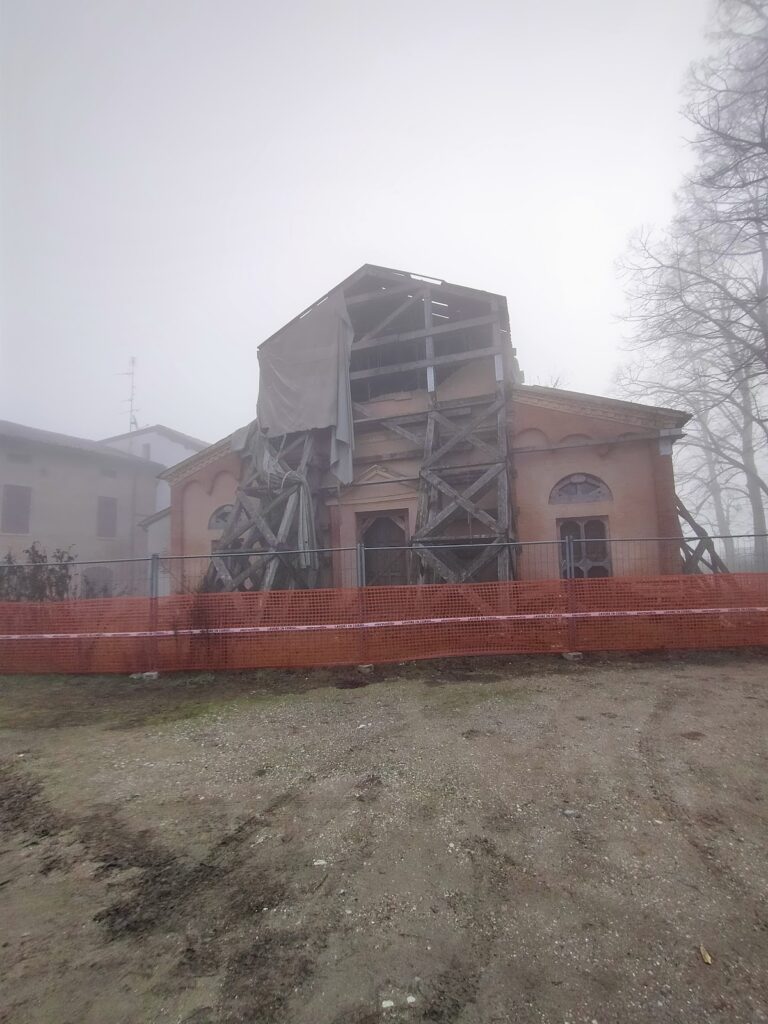
A programme of consolidation and restoration began in 1896. The castle continued to have a public institutional role, housing the district prison until the middle of the 20th century. In the early 1980s, a project was undertaken to give the complex a new public function. The earthquake of 20 May 2012 seriously damaged the castle. It was secured during the spring and first months of 2013, while the archaeological section of the Civic Museums was reopened. In 2014, 11.7 million euros were allocated for reconstruction and restoration. Castello delle Rocche is designated as Italian national heritage.
Remains
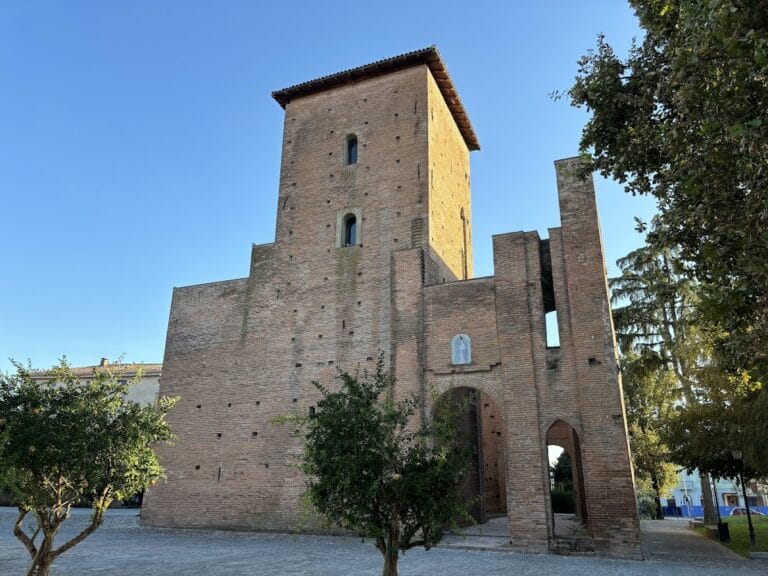
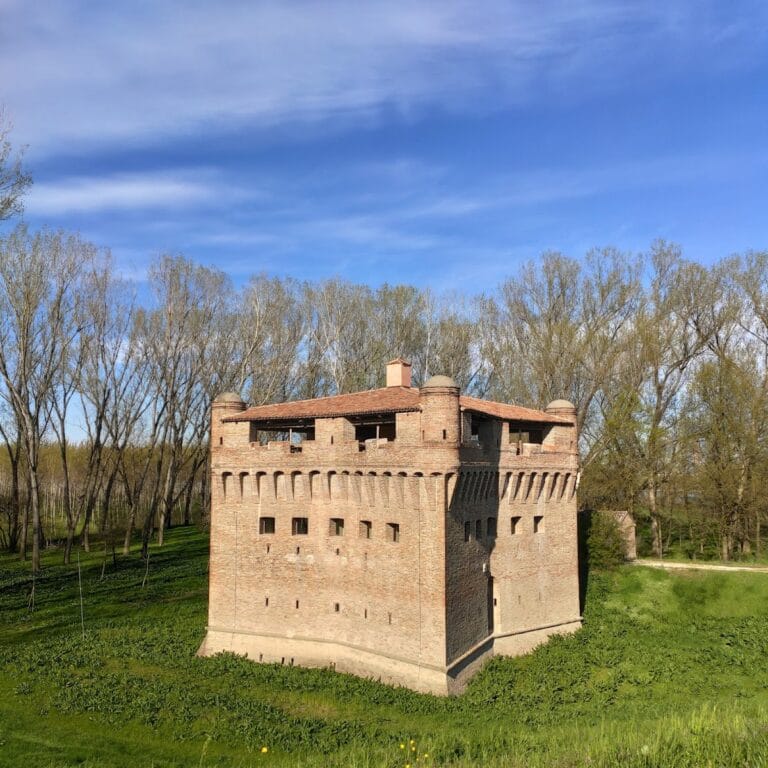
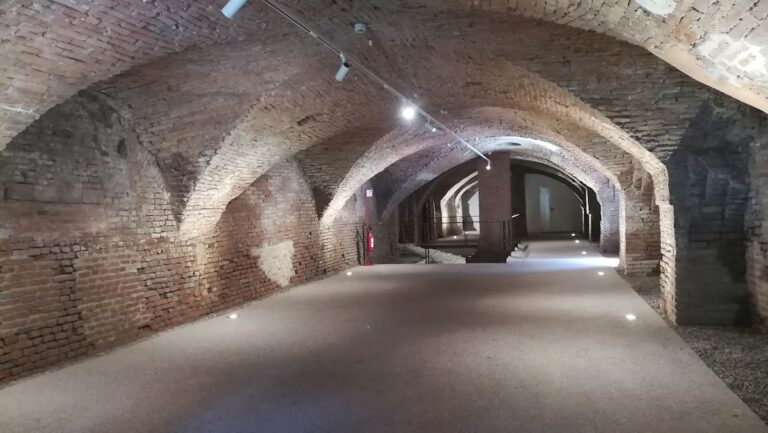
Castello delle Rocche stands in the historic center of Finale Emilia as a lowland castle built mainly of brick masonry. Its fortified layout was organized around a quadrilateral main body, with a keep and towers enclosing an inner courtyard. Water formed an essential part of this arrangement, with the Panaro passing beneath the keep and feeding a moat along the other three sides.
Fortified enclosure and courtyard
The keep and towers protected the quadrilateral castle body, while the moat surrounded the inner courtyard. The courtyard contained a triple loggia, an open-sided gallery or arcade. On the Panaro side, the battlemented curtain walls were partly demolished in 1425, altering the defensive enclosure. Frescoes decorated both the interior and exterior during the same phase of changes.
Water entrance and Este emblems
An eastern water entrance allowed access to the castle from the river. Este eagles were installed at the entrance and displayed on the towers. One terracotta eagle is now held by the Civic Museum, while another, carved in sandstone, remains on the keep.
Surviving condition
The 2012 earthquake left the masonry castle seriously damaged. Subsequent work placed the structure in a secured condition, while reconstruction and restoration funding was allocated in 2014.
Nearby sites