Drutsk Castle: A Medieval Defensive Center in Belarus


Site at a Glance
- Rating
- 4.4
- Popularity
- Very Low
- Country
- Belarus
- Primary era
- Medieval
- Eras represented
- Medieval
- Civilizations
- Unclassified
- Site type
- Military
- Remains
- Fortified Town
On this page9 sections
History
Drutsk Castle is a medieval defensive site in Drutsk, Belarus, founded by the Krivichi, an East Slavic tribal and political community, in the early 11th century on a high hill beside the right bank of the Drut River. Its chronology remains uncertain, although the castle may have continued in use until the middle of the 17th century. Drutsk became the center of the Principality of Drutsk and a fortress defending the southeastern frontier of the Polotsk Land, the territory governed from the medieval political center of Polotsk.
Early references and the Principality of Drutsk
Drutsk was first mentioned in 1078 in connection with Vladimir Monomakh’s Instruction, and it appeared again in chronicles under 1092. In 1180, several princes reportedly gathered to besiege the town. Among them was Igor Svyatoslavich of Novgorod-Seversk, the central historical figure of The Tale of Igor’s Campaign.
The territory associated with Drutsk extended across the courses of the Bober, Usvizh-Buk, and Obolyanka rivers, the upper Dnieper, and areas reaching the left bank of the Berezina. After the death of Vseslav of Polotsk in 1101, his sons divided his hereditary lands. Boris Vseslavich became ruler of Drutsk, and his descendants, known as the Borisovichi, remained politically important in the region.
A tradition recorded by the historian V. M. Tatishchev states that Boris campaigned against the Yatvingians in 1102. The Yatvingians were a Baltic people who lived north of the upper Dnieper and between the Nemunas and upper Bug rivers. According to this tradition, Boris also founded Borisov to strengthen the western frontier of his principality.
Drutsk under Lithuanian and Muscovite influence
During the period of the Grand Duchy of Lithuania, the medieval and early-modern state that incorporated much of present-day Belarus and Lithuania, the princes of Drutsk followed different political paths. Some entered the service of the Principality of Moscow, while others remained loyal to Lithuania and its rulers, including Casimir IV, who was both grand duke of Lithuania and king of Poland.
In 1508, Drutsk boyars swore allegiance to the Moscow prince during the rebellion associated with Mikhail Glinsky, a Lithuanian-Ruthenian prince and military leader whose revolt sought to transfer Ukrainian and Belarusian lands to Moscow. Many Drutsk princes nevertheless retained their loyalty to the Grand Duchy of Lithuania. The town was also connected with prominent princely families. Drutsk was associated with Boris Vseslavich and Sophia Drutskaya-Golshanskaya, who later became a queen. The Drutsk-Sokolinsky branch included ancestors of important figures such as the mother of Leo Sapieha, chancellor of the Grand Duchy of Lithuania.
Later history and archaeological interpretation
The castle was mentioned in records dated 1544, 1545, and 1549, and in Alexander Guagnini’s Chronicles of European Sarmatia, dated 1578 and 1581. European maps marked Drutsk in 1562, 1589, 1595, and 1613. The site declined, possibly in the middle of the 17th century. Its absence from documents concerning the Russo-Polish War of 1654–1667 suggests that the castle had ceased to function by that period.
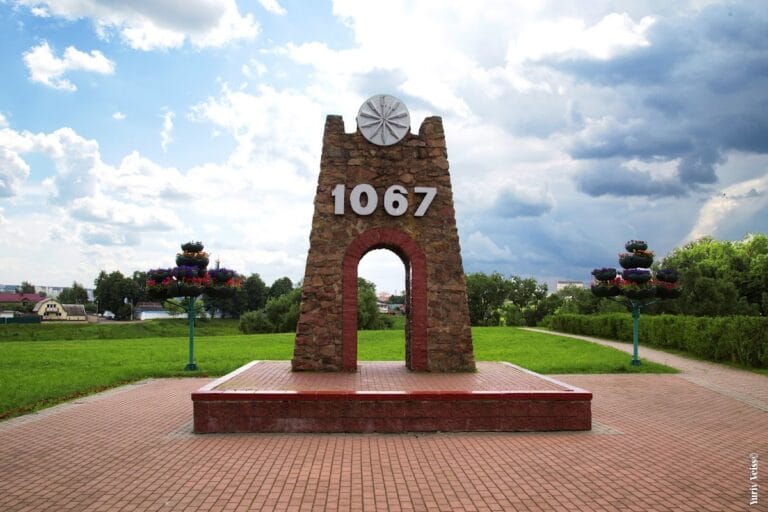
Drutsk was also home to one of the region’s earliest Christian churches, the Church of the Blessed Virgin Mary. The church was restored for Drutsk’s millennium in 2001 and consecrated by Archbishop Dmitry. Today, the Drutsk hillfort functions as an open-air archaeological museum, presenting the former princely citadel and its surrounding fortified settlement as a historical monument and museum landscape.
Remains
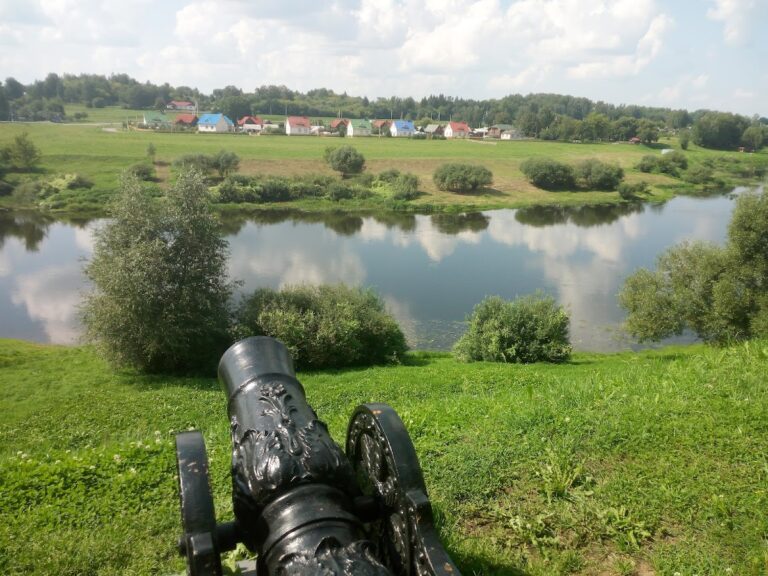
The fortified site occupied a high hill above the right bank of the Drut River. Its castle platform measured approximately 140 by 80 metres and rose about 20 metres above the surrounding terrain. The surviving landscape includes the principal rampart, the former citadel, the area of the fortified outer settlement, and the restored Church of the Blessed Virgin Mary.
Fortifications and settlement layout
Rampart and defensive works
The defenses were built over decades through repeated layers of clay and timber. Workers transported and compacted clay, fired it with bonfires, laid timber logs, and covered them with further clay. Massive wooden walls made from oak logs filled with earth strengthened the rampart, while loopholes, narrow openings through which defenders could use weapons, allowed the walls to be defended. A watchtower and two entrance towers formed part of the defensive system. Outside the rampart, a water-filled ditch reached depths of approximately 10 to 12 metres in places.
The principal rampart survives to a height of approximately 10 metres. The remainder of the castle is characterized as a castle mound or fortified-site ruin. From the former citadel, the ground rises above the surrounding landscape toward views of the winding Drut River and nearby forests.
Citadel and outer town
The eastern part of the citadel, beneath the highest rampart, contained the princely court, while a town square occupied the center. As the population increased, the citadel became too small. A second rampart was built around adjoining ground, creating an outer town, the settlement beside a principal fortified enclosure that was protected by its own defenses. This expanded area housed the prince, his retinue, boyars, and ordinary townspeople. The resulting plan joined the citadel to a fortified outer settlement.
Church of the Blessed Virgin Mary
The Church of the Blessed Virgin Mary is the religious feature associated with the site. It belongs to Drutsk’s early Christian history and was restored in 2001. Its consecration followed the restoration, linking the surviving religious feature with the modern presentation of the hillfort as an archaeological museum.