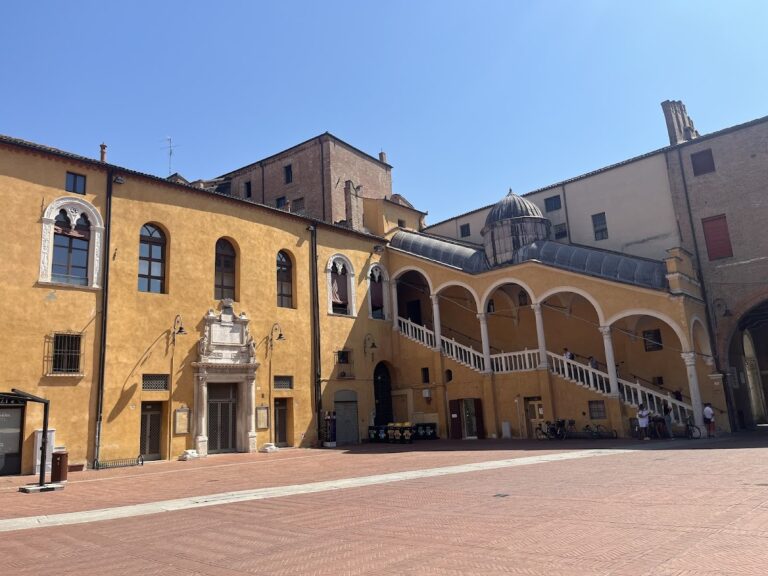
Castello Lambertini: A Medieval Castle-Palace in Poggio Renatico, Italy


Site at a Glance
- Rating
- 4.4
- Popularity
- Very Low
- Country
- Italy
- Primary era
- Modern
- External website
- Open
- Eras represented
- Medieval, Early Modern, Modern
- Civilizations
- Italian, Papal States
- Site type
- Domestic
- Remains
- Castle
On this page6 sections
History
Castello Lambertini is a medieval lowland castle in Poggio Renatico, Italy, built by the Guastavillani family as a defensive structure during the fourteenth or fifteenth century. Its later transformation into an aristocratic residence and its subsequent reconstruction reflect the changing functions of the complex over several centuries.
From fortress to aristocratic residence
The castle passed to the Lambertini family during the fifteenth century. Egano Lambertini altered it in 1475, while a drawing made by an anonymous author in 1578 preserves evidence of the original arrangement, which consisted of numerous separate buildings. In 1600, the complex was substantially transformed into an aristocratic palace and lost its strictly military character.
A major rebuilding followed in 1660. During this phase, the castle temporarily served as the residence of Queen Christina of Sweden, who ruled Sweden from 1632 until her abdication in 1654 and later lived in Rome. The separate buildings were eventually consolidated into a single structure.
Municipal ownership and Neo-Gothic rebuilding
After the male line of the Lambertini dynasty became extinct, ownership passed in 1822 to the municipality of “Poggio et Uniti.” Further partial alterations preceded a fundamental restoration directed by the engineer Ruggero Carini in 1887. Carini completely redefined the complex as a Neo-Gothic castle-palace, using a nineteenth-century style that revived medieval Gothic forms. Only vague traces of the medieval and Renaissance appearance remained.
Castello Lambertini later housed the municipality of Poggio Renatico and public services including the public library and an outpatient medical clinic. The earthquake of 20 May 2012 destroyed its imposing clock tower and damaged the entire complex. Reconstruction began in summer 2020, and restoration was completed in 2024. The work included rebuilding the clock tower and restoring frescoes discovered during the reconstruction.
Remains
Layout and construction
Castello Lambertini is a lowland fortification built in brick masonry. Its first arrangement comprised numerous separate buildings, whose positions are preserved in the 1578 drawing. These elements were later grouped into a single construction. The surviving complex includes an entrance, underground spaces, and a frieze decorated with grotesques, ornamental designs combining fantastic, distorted, or hybrid figures.
Clock tower and frescoes
The clock tower collapsed in the 2012 earthquake and was reconstructed during the post-earthquake works in weathering steel, an alloy that develops a stable protective layer of rust. Previously unknown frescoes were also found during the reconstruction and restored as part of the work completed in 2024.
Nearby sites