Chiesa di San Leonardo Limosino: The Parish Church of Mortizzuolo
Site at a Glance
- Rating
- 4.6
- Popularity
- Very Low
- Country
- Italy
- Primary era
- Early Modern
- External website
- Open
- Eras represented
- Medieval, Early Modern, Modern
- Civilizations
- Holy Roman Empire
- Site type
- Religious
- Remains
- Church
On this page12 sections
History
Chiesa di San Leonardo Limosino is a Roman Catholic parish church in Mortizzuolo, Italy, built around the fourteenth century and dedicated to Saint Leonard of Limoges, a Christian saint traditionally associated with the protection of prisoners and captives. Its history reaches back to the former medieval settlement of Montirone, where a church was first recorded in 963. The first document to mention Mortizzuolo and its church dates from 1222.
Medieval origins and rebuilding
The church was established during the fourteenth century. A stone on the exterior of the apse bears the date 1444, probably marking a major rebuilding campaign that included the enlargement of a chapel dating from 1318. The building was reconstructed again about two centuries after its initial construction, during the period when Luigi Pico della Mirandola was bishop of Limoges. A sacred stone set into the high altar carries the date 1586 and survives as evidence of this phase.
Seventeenth- and eighteenth-century expansion
The church underwent further renovation in 1604. In 1681, the central nave was extended to twice its previous length and two side aisles were added, giving the interior its three-nave arrangement. Eight years later, the coffered ceiling of the central nave was replaced by a vault.
The apse was rebuilt in 1752, changing its plan from rectangular to semicircular. Between 1756 and 1765, five altars and the pulpit were made in polychrome marble, reflecting the church’s major Baroque reorganization. The rectory was constructed in 1774 at the initiative of Canon Possidonio Senesi. Its decoration and formal rooms were intended to accommodate the summer pastoral visits of the bishop of Reggio Emilia.
Nineteenth- and twentieth-century changes
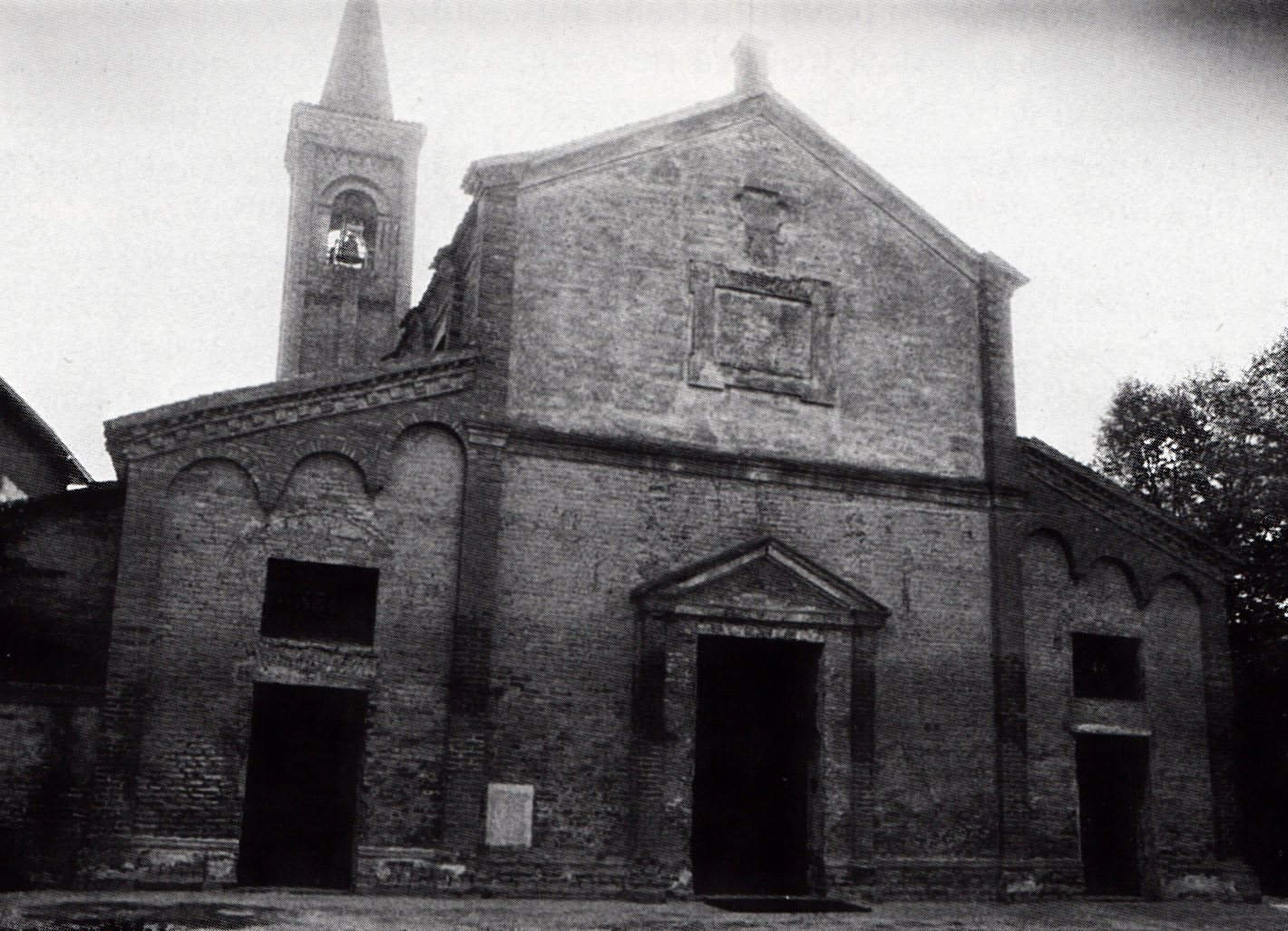
After the parish passed from the Diocese of Reggio Emilia to the Diocese of Carpi, the campanile, or bell tower, was altered in 1822. Its two-part windows, known as biforas, were replaced with larger openings so that new bells could move through them. That same year, an old carved wooden altar at the end of the nave was removed. The painting of the Madonna del Buon Consiglio that had stood on it was preserved and placed near the exit.
In 1952, two marble altars dedicated to Saint Aloysius Gonzaga and the altar of Saint Anthony of Padua were transferred to the church of San Martino Spino. They were installed in chapels dedicated to the Sacred Heart of Jesus and Saint Rita of Cascia. A painting of Saint Julia, formerly kept on the Saint Anthony altar, had drawn many private and public pilgrimages. Those pilgrimages ended after the painting was moved.
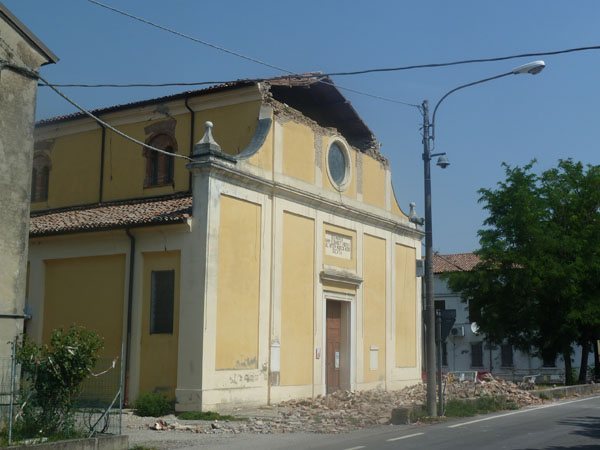
Between 1960 and 1970, restoration and decorative work added marble coverings to the nave columns, biforas in the apse, frescoes, and new stained-glass windows. The 2012 Emilia earthquake then caused severe damage. Part of the facade and roof collapsed, and the campanile fell. The rectory, parish theater, and nursery school also became unusable. The nursery school was restored between 2014 and 2016. The parish church remains dedicated to Saint Leonard and belongs to Pastoral Zone 6 of the Diocese of Carpi, following the Roman Catholic rite.
Remains
The parish complex brings together the fourteenth-century church, a campanile built in the following century, an eighteenth-century rectory, and a twentieth-century theater. The church has a three-nave interior formed by the lengthening of the central nave and the addition of the side aisles in 1681. Its surviving furnishings and later decoration combine medieval origins with Baroque remodeling and twentieth-century artistic work.
Church interior
Nave and marble altars
The central nave and two lateral naves organize the church’s interior. Three Baroque altars in polychrome marble remain inside: the high altar, dated 1756, and two side altars dedicated to the Sacred Heart of Jesus and the Madonna of the Rosary. The high altar incorporates the sacred stone dated 1586. A wooden choir from the eighteenth century stands behind it, while two elegant eighteenth-century confessionals, originally from the church of San Francesco in Mirandola, are also preserved in the church.
Crucifix and Madonna del Buon Consiglio
A sacred papier-mache crucifix hangs near the triumphal arch. Tradition regards it as miraculous because processions carrying it were believed to have brought the plague epidemic of 1630 to an end. Near the exit is the painting of the Madonna del Buon Consiglio, dated 1611. It was originally placed on the carved wooden altar removed in 1822.
Frescoes and stained glass
Between 1960 and 1970, Romano Pelloni painted frescoes showing the symbols of the eight Beatitudes, teachings attributed to Jesus in the Christian Gospels that describe spiritual conditions considered blessed. His work also includes the four Evangelists, Saint Francis, Saint Catherine, episodes from the life of Saint Leonard, the baptismal font, and the Baptism of Jesus.
Pelloni created two stained-glass windows during the same period. One represents Saints Peter and Paul. The other depicts Saint Aloysius Gonzaga with Saint Anthony of Padua and commemorates the two altars dated 1760 and 1762 that were transferred to San Martino Spino in 1952.
Rectory and bell tower
Eighteenth-century rectory
The rectory built in 1774 contains frescoes by the Modenese painter Giuseppe Puttini. The decoration includes small views, landscapes, and imaginary perspectives. Its interior also had a ceremonial staircase and a large frescoed reception hall with lateral service rooms, spaces associated with the summer pastoral visits of the bishop of Reggio Emilia.
Campanile and parish complex
The campanile was built in a style similar to that of the church of San Francesco in Mirandola. Its biforas were enlarged in 1822 to accommodate the movement of new bells, but the tower collapsed in May 2012 during the earthquake. The wider complex also includes the twentieth-century parish theater and the nursery school, which was restored after earthquake damage between 2014 and 2016.