Château de Brassac: A Medieval Fortified Castle in France


Site at a Glance
- Rating
- 3.7
- Popularity
- Very Low
- Country
- France
- Primary era
- Medieval
- External website
- Open
- Eras represented
- Medieval
- Civilizations
- County of Toulouse, Duchy of Aquitaine, French
- Site type
- Military
- Remains
- Castle
On this page13 sections
History
Château de Brassac is a medieval fortified castle in Brassac, France, whose origins reach back to the twelfth century. It was the seat of a barony held by the Planels family, vassals of the Duke of Aquitaine, while the surrounding territory lay under the authority of the Count of Toulouse. The fortress later became involved in the rival claims of the counts of Toulouse, the English kings, and the French monarchy.
The Planels and the counts of Toulouse
In 1190, Raymond V, Count of Toulouse, bought the castle from Raymond de Planels, possibly in order to remove lords who were not his own vassals. At that time, the site consisted of a keep protected by a ditch. Raymond V entrusted it to Durand Mercader, a routier captain, meaning a medieval military commander who led a company of armed men.
Henry II of England controlled much of southwestern France during this period, and Raymond V paid homage to him for the fortress. Château de Brassac was occupied for a time by Richard the Lionheart. Raymond V’s son, Raymond VI, later rejected English authority after French successes against the English in Aquitaine.
Changing lordship in the thirteenth century
After the Albigensian Crusade, a thirteenth-century campaign against Cathar communities and their supporters in southern France, the lordship of Brassac was attached first to the Bishop of Cahors and then to Alphonse of Poitiers, the new Count of Toulouse. When Alphonse died without an heir, the lords of Brassac were required to pay homage to the King of France.
Bertrand de Galard, head of the Galard family and owner of the castle, nevertheless paid homage to the English kings Henry III in 1266 and Edward I in 1291. During the thirteenth century, the fortress was strengthened with a well, an enclosure around the hill, and a wooden palisade.
War, religious conflict, and the county
During the Hundred Years’ War, the prolonged series of conflicts between the English and French monarchies from the fourteenth into the fifteenth century, the Galard family initially supported the English before joining the French side. The castle was captured by the English in 1346 and again in 1356, during a raid through Languedoc led by the English captain John Chandos.
Following the marriage of François de Galard de Brassac and Jeanne de Béarn in 1508, the family adopted the name Galard de Béarn de Brassac. In the sixteenth-century Wars of Religion, Huguenot soldiers, who were French Protestants associated mainly with the Reformed tradition, seized the castle while Jean III de Galard was responsible for defending Lauzerte.
In 1609, Henry IV raised the lordship of Brassac to a county, allowing its lords to bear the title of counts.
Revolutionary damage and later preservation
During the French Revolution, the Galard family lost its seigneurial rights and the castle was set on fire. The family later bought the property back and restored it. After the owners suffered financial ruin, Château de Brassac was sold in 1891 to Pierre Chabrié, a member of parliament who died in 1899. His son Adrien Chabrié, also a member of parliament, inherited the castle and died in 1926. The Chabrié family saved the building from ruin.
The castle has been registered as a French historic monument since the order of 9 December 1926 and classified as a historic monument since the order of 9 October 1979. In 1997, Madame de La Baume gave it to Gilles de Galard de Béarn de Brassac, a direct descendant of its former owners. It is now used as a private residence.
Remains
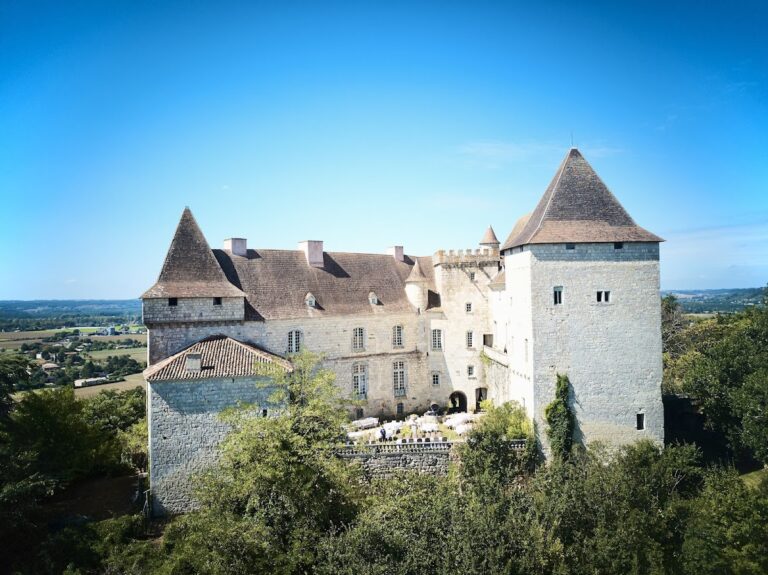
Château de Brassac occupies a large quadrilateral, approximately 40 metres on each side, originally defended by four circular towers. The enclosure and towers belong to the twelfth and thirteenth centuries. Although the towers and curtain walls were demolished to ground level during the French Revolution, their foundations preserve the outline of the earlier fortress. Surviving masonry includes walls between 2 and 3 metres thick and approximately 10 metres high, together with numerous loopholes and gun ports.
Fortified enclosure
Quadrilateral and towers
The quadrilateral formed the principal defensive body of the castle. Its four circular towers projected from the enclosure, but the Revolutionary demolition reduced them to their foundations. These remains preserve the ground plan of the twelfth- and thirteenth-century fortification and show the scale of its enclosing walls.
Guardrooms and defensive walls
Within the surviving foundations are three vaulted guardrooms, reached through galleries and stairways. The thick walls retain loopholes and gun ports, features that reflect the castle’s defensive function and its continued adaptation as military architecture developed.
Residential building and access
Fourteenth-century residence
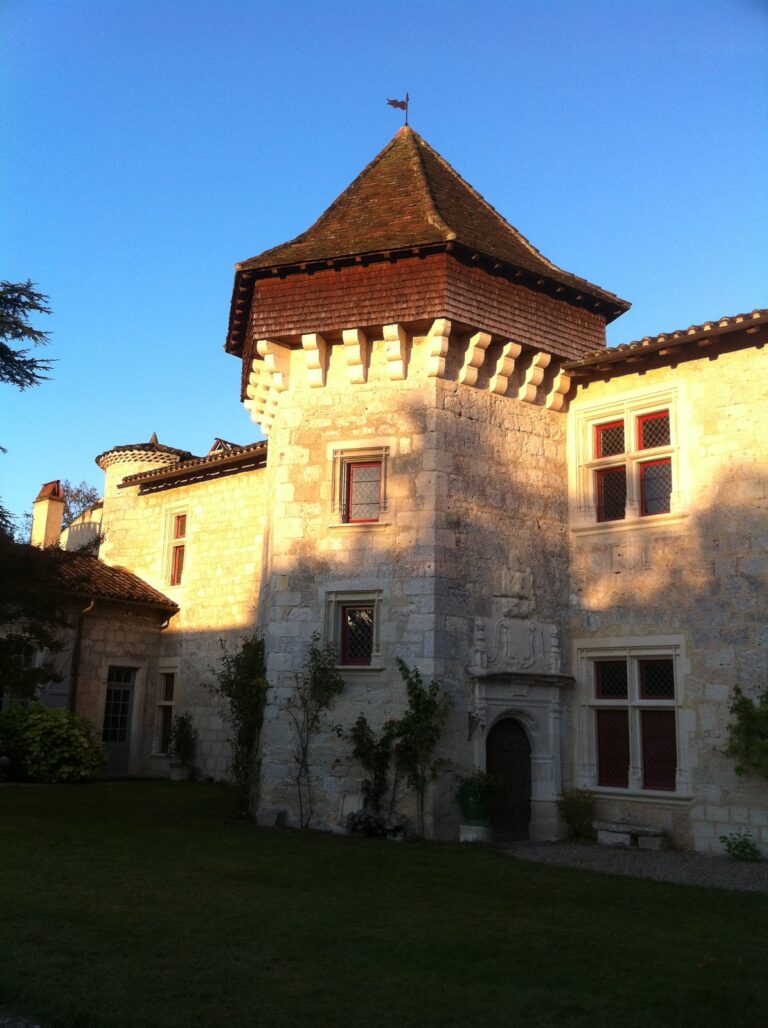
A residential building from the beginning of the fourteenth century was constructed over the site of the twelfth-century keep. It survived the Revolutionary demolition, although it had been burned. Numerous additions from the fifteenth century remain in the building, including various windows and a polygonal tower containing a spiral staircase.
Bridge and former drawbridge
The present entrance is approached by a stone bridge that replaced an earlier drawbridge. The drawbridge crossed dry moats, much of which has since been filled in. The bridge and entrance therefore preserve part of the castle’s former approach system while connecting it with the later surviving building.
Earlier fortifications
Near the castle are the motte of an earlier castle and traces of fortifications. A motte is a raised earthen mound used as the base of a medieval defensive structure, usually supporting a tower. These nearby remains add an earlier layer to the fortified landscape around Château de Brassac.