Château de Goudourville: A Fortified Castle in France


Site at a Glance
- Rating
- 4.7
- Popularity
- Low
- Country
- France
- Primary era
- Medieval
- External website
- Open
- Eras represented
- Medieval, Early Modern, Modern
- Civilizations
- French
- Site type
- Military
- Remains
- Castle
On this page11 sections
History
Château de Goudourville is a fortified castle in France, built by the Gasques family during the twelfth and thirteenth centuries. The Gasques presence in Goudourville is documented from the eleventh century, and the castle became the center of a seigneurial estate overlooking the village and the Garonne Valley.
The Gasques Lords and the Hundred Years’ War
In 1278, Ségui and Pierre de Gasques, lords of Goudourville and vassals of the Durforts of Clermont-Soubiran, granted the inhabitants a charter. The document defined their obligations while protecting their rights under seigneurial authority. The Gasques family retained the castle and lordship until the end of the fourteenth century, when they passed to the Boville, Bouville, or Beauville family.
During the Hundred Years’ War, a prolonged conflict chiefly between the English and French crowns, Goudourville was occupied, pillaged, and damaged. The castle may already have been in ruins by the middle of the fourteenth century, reflecting the effects of the conflict on fortified sites in France.
The Lustrac Reconstruction
Around 1460, Naudonnet de Lustrac, captain of Lauzerte and a prominent fifteenth-century military commander, restored the castle. Goudourville came under Lustrac authority during the second half of the fifteenth century. Between 1480 and 1500, Antoine I de Lustrac, his brother Jean, bishop of Périgueux, and their uncle Bertrand, abbot of Saint-Maurin Abbey, undertook major works. They enlarged the residential buildings and reorganized the castle, creating a substantial late-Gothic achievement in Aquitaine.
In 1544, Marguerite de Lustrac, daughter of Antoine II de Lustrac, became the sole heiress of the lordship. Her marriages and inheritance connected Goudourville with the Caumont family. King Charles IX visited the castle with his mother, Catherine de Medici, in 1562. After Marguerite’s husband, Geoffroy de Caumont, died in 1574, her estates were seized. Henri IV then entrusted the Huguenot captain Geoffroy de Vivans with recovering them, and he retook Marguerite’s domains one by one.
From the Affis Purchase to the Fronde
Marguerite’s daughter, Anne de Caumont, gradually sold the family estates. In 1598, Guillaume d’Affis, first president of the Parliament of Bordeaux, acquired Goudourville together with Lalande and Saint-Vincent. He restored the castle and developed its agricultural estate.
In January 1652, during the Fronde, a series of rebellions against the authority of the young Louis XIV and his ministers, royal troops commanded by the Count of Harcourt besieged Goudourville while pursuing the Prince of Condé. The rebels surrendered and paid a substantial ransom. Royal troops then occupied the castle for six months and sacked it.
Eighteenth-Century Residence and Revolution
Goudourville passed to Jean-Baptiste Lecomte, Marquis of Latresne, in 1676. After the military occupation, the castle was difficult to inhabit, fell into disuse, and threatened to become ruinous. The marquis sold it in 1745.
On 18 May 1745, Louis Bailet de Berdolle, a magistrate and capitoul of Toulouse, purchased the estate. A capitoul was a member of Toulouse’s municipal governing body. The Berdolle family made Goudourville a comfortable summer residence for parliamentarians and held secret political meetings there, intended to rally the Parliament of Toulouse to the royal cause.
During the French Revolution, the castle’s towers were lowered. Their stone was sold first to private individuals and later requisitioned for road repairs. Mathilde de Berdolle subsequently brought the castle into the Lary de Latour family through marriage. The family sold it in 1876 to Count Emmanuel Marraud des Grottes. His daughter, Marie des Grottes, and her husband, Gonzague de Cianelli de Sérans, held the castle and its lands until 1939.
Twentieth-Century Preservation
Léon Bernier bought Goudourville in 1939. During the Second World War, the Vidaillan family, who occupied the castle farm, sheltered young Jewish people and concealed the identity of Joseph Brenig. Brenig later contributed to the liberation of Valence d’Agen in 1944. The Vidaillan family was recognized as Righteous Among the Nations, a distinction honoring non-Jews who risked their lives to save Jews during the Holocaust.
The Tocqueville family acquired the castle in 1952. Count Grouard de Tocqueville undertook major restorations, including the raising of the towers lowered during the Revolution. In 1974, he had Goudourville entered on the supplementary inventory of historic monuments, a form of French state heritage protection for buildings and sites of historical or architectural interest. His descendants sold the castle in 1992. Since 1999, its owners have continued maintenance, restoration, and reconstruction while researching the estate and the families connected with it.
Remains
Overall Form and Setting
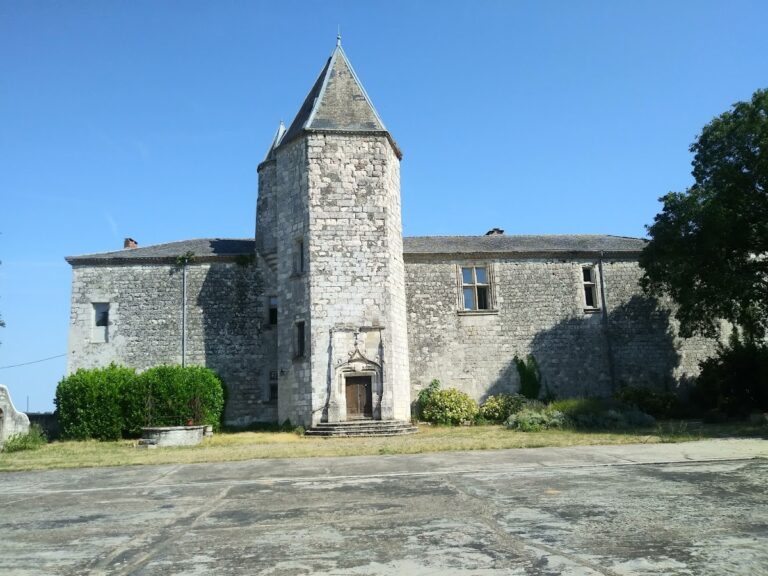
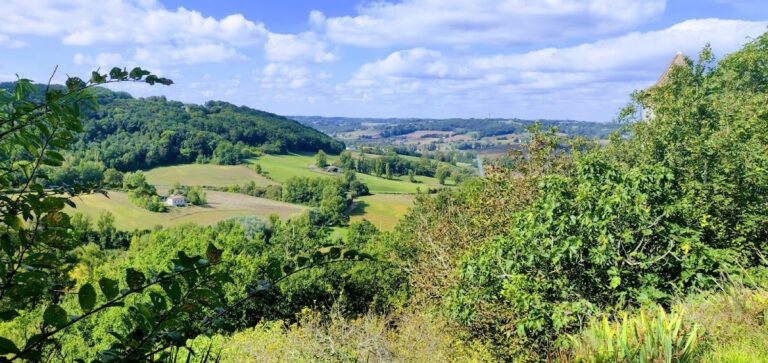
Château de Goudourville stands on a rocky plateau in the foothills of Quercy. Originally a fortified castle, it is now a composite building shaped by numerous construction and alteration campaigns, principally from the thirteenth to the twentieth century. Its position overlooks the village of Goudourville on one side and the Garonne Valley on the other.
Medieval and Late-Gothic Fabric
An intermediate building phase doubled the thickness of the original walls and may have brought the towers forward from the main building volume. A twin window in the northeast tower and doors with segmental pointed arches suggest a date in the second half of the fourteenth century or, more probably, the fifteenth century.
A major campaign at the end of the fifteenth century or the beginning of the sixteenth reorganized the interior distribution. It added a stair tower linked to galleries around the courtyard, altered the floor levels, required new fireplaces and windows, and reconfigured the entrance. Similarities between these changes and the abbey residence at Saint-Maurin place the work within this period.
Eighteenth- and Nineteenth-Century Alterations
The eighteenth-century work reorganized the apartments, removed the courtyard galleries, and renewed the interior decoration. New arched windows with projecting surrounds were arranged in bays. The floors of the west wing were lowered through substantial underpinning work to create space for vaulted kitchens. Broad French-style windows were added, and the guardroom was opened.
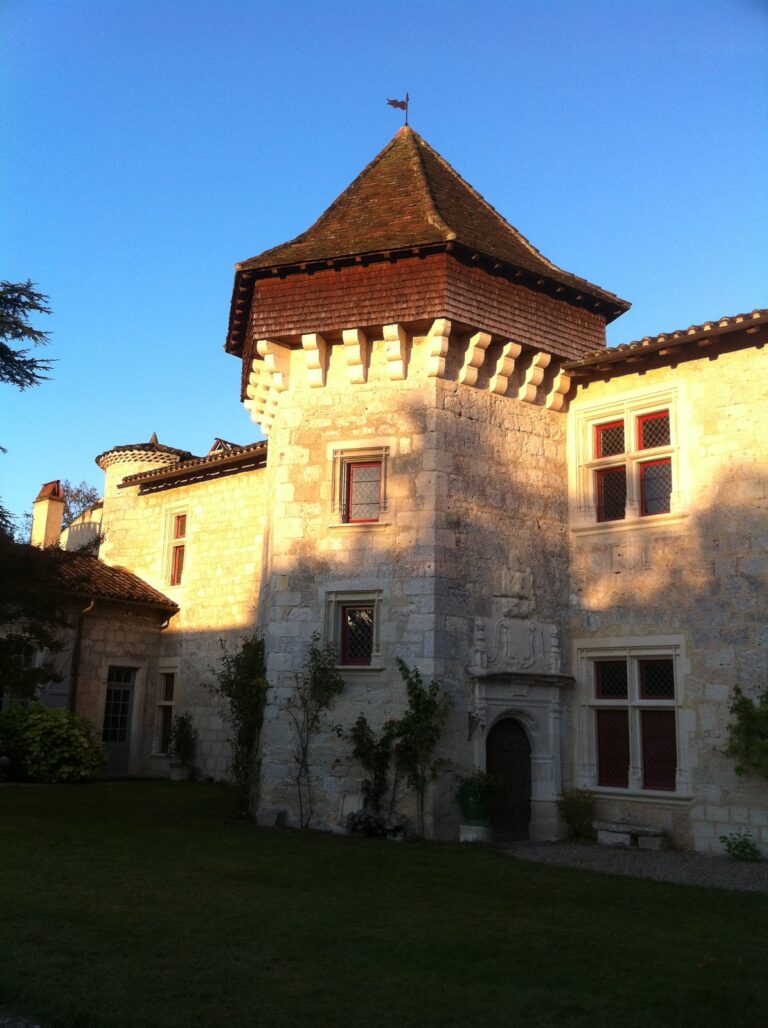
The entrance portal was rebuilt in the nineteenth century, possibly by the Lary de Latour family, at the same time as the kitchens. Restoration campaigns in the 1970s altered the internal distribution again. They recreated an entrance door at the center of the north front, added cross windows and fireplaces, and restored the tower volumes with wall-walk galleries supported by machicolations. These projecting defensive structures had openings through which missiles could be dropped onto attackers below.
Agricultural Estate
The historic agricultural estate included a windmill now called the Pepper Mill, the Lalande watermill, and the Cabos and Borio farms. Together, these properties formed part of the landholding associated with the castle.