Château de Castelnoubel: A Fortified Castle in France
Site at a Glance
- Rating
- 4.8
- Popularity
- Very Low
- Country
- France
- Primary era
- Medieval
- Eras represented
- Medieval, Early Modern, Modern
- Civilizations
- English, French
- Site type
- Military
- Remains
- Castle
On this page11 sections
History
Château de Castelnoubel is a fortified castle in France, built on a promontory above the Mondot valley near Bon-Encontre. The promontory had been inhabited since the tenth or eleventh century, while construction of the present fortified castle began at the end of the thirteenth century. It may have replaced an earlier fortified settlement, or castrum, whose wooden palisades followed the cliffs. The castle was mentioned in the 1270 oath of loyalty sworn by the Puymirol bailiwick, a territorial jurisdiction administered by a royal or seigneurial official, to the lieutenant of the king of France. This placed it within the jurisdiction of Agen.
Origins and the Marmande lordship
The first known lord associated with Castelnoubel was Arnaud de Marmande, recorded in 1268 with his son Raymond de Bouglon after they attacked and plundered Castelgaillard. Arnaud paid homage in 1271 to the representative of the king of France for Escassefort, Virazeil, and the land of Longueville. He used an Agen custom that allowed bourgeois residents to build towered houses within the city’s territory, and this privilege helped him begin the construction of Castelnoubel.
The original thirteenth-century castle was largely replaced by a building constructed from the fourteenth century onward. By the early fourteenth century, the site belonged to the Marmande family, whose fortunes were closely tied to the struggle between the English and French crowns for control of Agenais. After Philippe the Bold released the towns and barons of Agenais from their oaths in 1279, rival lords competed to enlarge their territories.
In 1306, Arnaud de Castelnoubel, identified as the son of an earlier Arnaud de Castelnoubel, claimed high and low justice. High justice concerned serious crimes, while low justice covered lesser civil and criminal cases. His claim followed an expansion of his domain at the expense of Agen’s jurisdiction. The English king ordered an inquiry in 1311, and Arnaud de Marmande supported the English monarchy.
Pierre de Marmande served as seneschal of Agenais for the English king from 1316 to 1323. A seneschal was a senior royal or princely administrator who could also exercise judicial and military authority. Around 1321, Arnaud de Marmande was summoned with arms and horses, and in 1324 Edward II called on the lords of Agenais to fight France during the conflict over Guyenne. An Arnaud de Marmande, probably the same man and then identified as lord of Taillecavat, later received letters of remission from Charles IV for offenses committed during his rebellion against France. Raymond Bernard de Marmande, lord of Lusignan and Virazeil, petitioned the French king over castles destroyed by French forces.
The Durfort succession and the Hundred Years War
The Marmandes’ continuing loyalty to the English kings led to the loss of their castles, and Castelnoubel passed to the Durfort family. On 29 August 1351, Charles the Bad, king of Navarre and lieutenant of the French king in Gascony, granted Arnaud de Durfort high and low jurisdiction at Bajamont and Castelnoubel while retaining royal sovereignty.
Arnaud de Durfort had earlier fought alongside the English, and the French king seized his property in 1338. From 1341 he strengthened the fortifications of Bajamont and resisted enforcement of the seizure. During the wider Anglo-French conflicts, he changed allegiance more than once. After the Treaty of Brétigny returned Agenais to English influence in 1360, he enlarged his domains near Castelnoubel. The consuls of Agen protested, and although the Black Prince ordered action in their favour in 1364, the order was not carried out.
Arnaud de Durfort died in 1360 or 1361 and was succeeded by his son, also named Arnaud. The younger Arnaud served both the English and French crowns. He submitted to Charles V in 1370, received confirmation of a rent granted by Charles the Bad, and in 1379 obtained properties and revenues confiscated from rebels in Durfort territory. His testament of 1384 favoured Rainfroid de Durfort. By the end of the fourteenth century, the lord of Castelnoubel enjoyed the confidence of the count of Armagnac.
Inheritance and marriage connected the Durfort family with several neighbouring lordships, including Laroque-Timbaut and Gavaudun. Jean de Durfort, known as “the Red,” was lord of Castelnoubel and served as an equerry in the royal household in 1419 and 1423. An equerry was an official responsible for a ruler’s horses and stable. Jean appeared in the seneschal’s military company in 1425, became captain of Puymirol in 1426, and was described as a banneret knight in 1435, a high-ranking knight entitled to command a banner and troops. He took part in campaigns at Marmande, Castelmoron, Lusignan, Monségur, Clairac, and Damazan.
In 1437, Jean granted rights in the lordship of Castelnoubel to Raymond Bernard de Montpezat, probably in connection with debts. The grant was initially ineffective, but it transferred claims over the lordship to the Montpezat family. Jean continued to enjoy Castelnoubel, while the consuls of Agen held hearings near the castle in 1467 and sought oaths from the surrounding population to reassert the city’s jurisdiction.
Destruction and rebuilding
Royal troops were stationed in Agenais in 1472 after successive revolts by the counts of Armagnac. Jean de Durfort had remained loyal to Jean V of Armagnac, and the castle may have been ruined during this period. Jean ratified the 1437 donation in favour of Charles de Montpezat in 1473 and died soon afterward, reportedly at nearly one hundred years of age and without issue.
His brother Bertrand nevertheless continued to claim the lordship. Bertrand’s son, Arnaud de Durfort, was a chamberlain of Louis XI and received royal permission in 1476 to rebuild the castle and mill of Gimat and Esparsac. He died in June 1478 while serving with the French royal army in Picardy.
François de Durfort restored, enlarged, and fortified Lafox and rebuilt Castelnoubel, which had remained in ruins since 1472. People from the surrounding area actively contributed to the work. When the consuls of Agen later demanded labour from nearby villages for the rebuilding of Agen’s walls, the inhabitants refused, arguing that they sought refuge at Castelnoubel during wartime. The Parlement of Bordeaux, a high judicial court of the French ancien regime, ruled for Agen at the beginning of the sixteenth century.
Inheritance, religious conflict, and the seventeenth century
Étienne de Durfort inherited Castelnoubel and Mérens, but Guy de Montpezat disputed the inheritance on the basis of the 1437 donation. The conflict was settled through Étienne’s marriage to Guy’s sister, Françoise de Montpezat, under a contract dated 25 March 1498. Guy renounced his claims. In 1500, Jean de Durfort transferred his rights to Étienne in exchange for the baronies of Gimat and Esparsac.
After his marriage contract of 9 July 1535, Alain de Durfort undertook work at Castelnoubel. He added two galleries, one above the other, to the late-fifteenth-century castle and linked them with a monumental staircase. A legal dispute over Castelnoubel and Mérens was finally resolved in Alain’s favour in 1554, when the Grand Council confirmed that the lordships had entered his inheritance through the settlement with the Montpezat family.
François de Durfort became seneschal of Agenais in 1572 and strongly supported the Catholic cause in the Agenais during the Wars of Religion, the sixteenth-century conflicts between Catholics and Protestants in France. He acted alongside Bishop Janus Frégose, the merchant and several-times consul Martial de Nort, and Blaise de Monluc. Around 1570, François sold Castelnoubel and Mérens to Hermann de Raffin with an option to redeem them. In February 1573, he repaid the principal of 2,000 livres and recovered Castelnoubel.
François died without issue in February 1585. His concealed testament, eventually found in a tower at Castelnoubel, named his brother René as heir, followed by his sister Philippe if René died without descendants. Both later died without issue. After competing claims by Anne d’Ornezan and Amanieu de Durfort, Anne transferred her rights to Jeanne d’Antin, and a succession judgment awarded Castelnoubel and Mérens to Jeanne.
On 10 August 1589, troops of the Catholic League, a Catholic political and military coalition active during the Wars of Religion, occupied, plundered, and devastated Castelnoubel. Jeanne d’Antin’s possession was confirmed by a judgment at the end of the sixteenth century, but she sold Castelnoubel and Mérens to Arnaud de Gasq on 9 October 1608.
Arnaud de Gasq probably sold Castelnoubel to Jacob de Secondat, who adopted the title lord of Castelnoubel in 1619. Jacob’s elder son, Jean-Baptiste-Gaston de Secondat, became his universal heir. Later inheritance carried the lordship among members of the Secondat family, including Jean-Baptiste de Secondat, president of a chamber of the Parlement of Bordeaux, and his brother Henri. When Henri died without an heir, the lordship returned to Jean-Baptiste, who died at Bordeaux on 2 August 1678. His son, also named Jean-Baptiste de Secondat, succeeded him.
From the eighteenth century to the present
Jean-Baptiste de Secondat sold Castelnoubel to Louis Pascault de Poléon around 1700. Louis, a knight and lord of Chaban and Castelnoubel, died at the castle on 1 August 1711. His testament of 1710 named his nephew Jean César Pascault de Poléon as heir, with further substitutions in favour of other relatives if Jean César died without issue.
The lordship was later divided among four members of the Pascault de Poléon family. Their disputes ended with an amicable sale by licitation, a court-supervised sale used to settle contested ownership, after which Louis-Auguste Pascault de Poléon bought the property back. He did not emigrate during the French Revolution and therefore avoided seizure as an émigré’s property. After his death on 13 May 1811, the castle passed to his only daughter, Augustine-Pauline-Evelina Pascault de Poléon, whose creditors caused it to be offered for sale.
Château de Castelnoubel was sold in 1817 to Pierre Loubat, a merchant from Bordeaux. After selling several parcels, Loubat sold the remainder to Joseph-Marie-Étienne Giraud, chevalier des Écherolles and secretary-general of the prefecture of Agen. After Giraud died in Paris on 31 July 1865, the property passed among his children and ultimately to his daughter Hélène des Écherolles.
Hélène settled at Castelnoubel after her father’s death. In 1868 she invited Félicie d’Ayzac, whom she had known at the Maison d’éducation de la Légion d’honneur at Saint-Denis, a school established for the education of girls associated with the Legion of Honour. The two women cared for poor and sick people at the castle. Their friend Meignan, a former chaplain of Saint-Denis who later became a bishop and cardinal, spent his holidays there each year. Félicie d’Ayzac died at Castelnoubel on 26 March 1881.
After Hélène’s death, Castelnoubel passed to her niece, Mademoiselle de Leygonie, who married Monsieur Pardo, a member of a family originating in Venezuela. Nineteenth-century work introduced Neo-Gothic alterations, a revival of medieval Gothic forms. Château de Castelnoubel was listed as a historic monument on 8 August 1966.
Remains
Fortified setting and medieval core
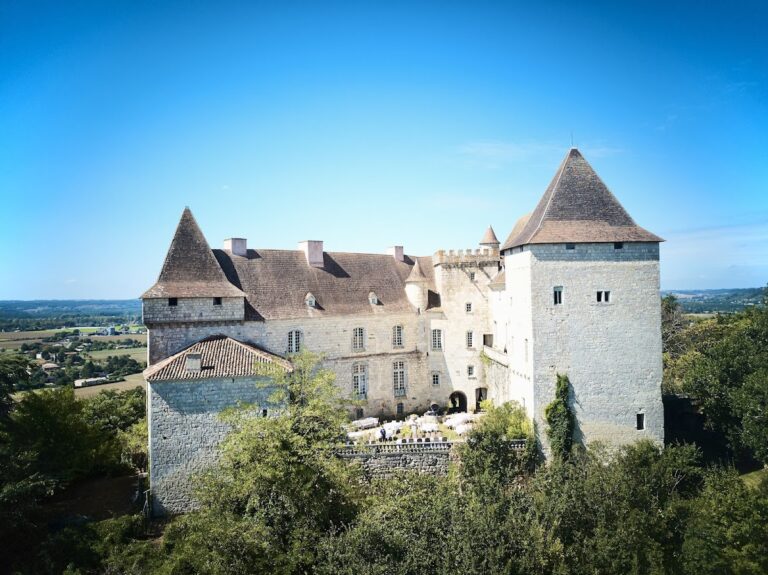
Château de Castelnoubel occupies a promontory above the Mondot valley at Saint-Denis de Lasgourgues, near Bon-Encontre. Cliffs partly bound the promontory, which helped shape the castle’s defensive position. The possible earlier castrum may have used wooden palisades along these cliffs, although the existence of that predecessor remains uncertain.
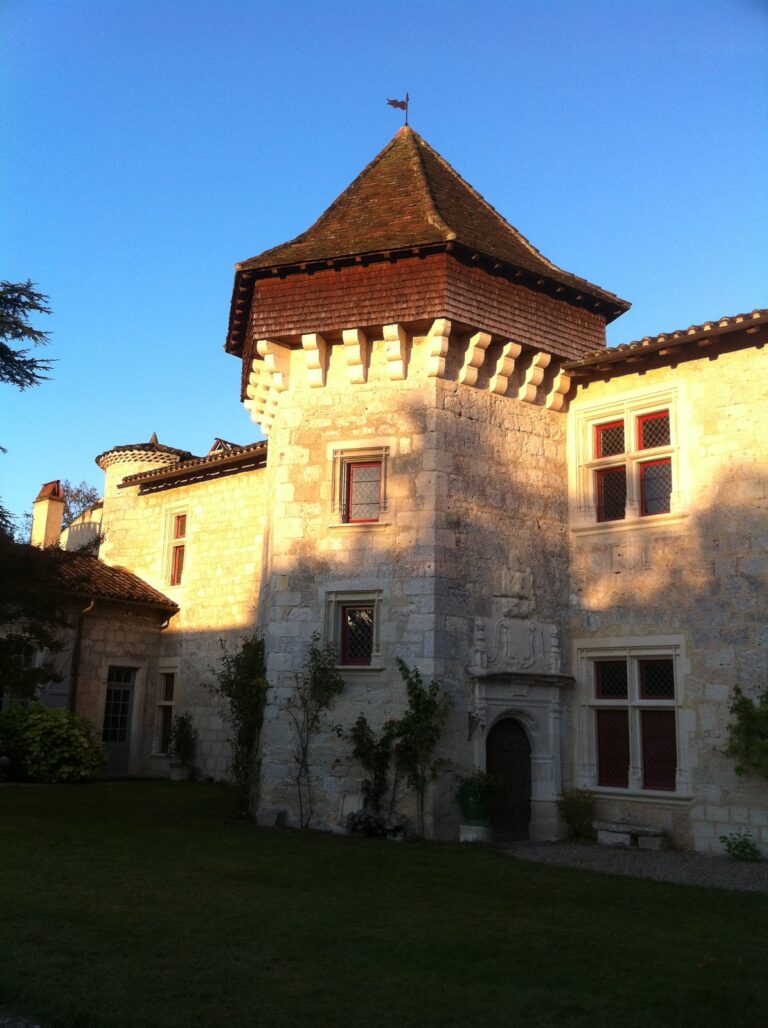
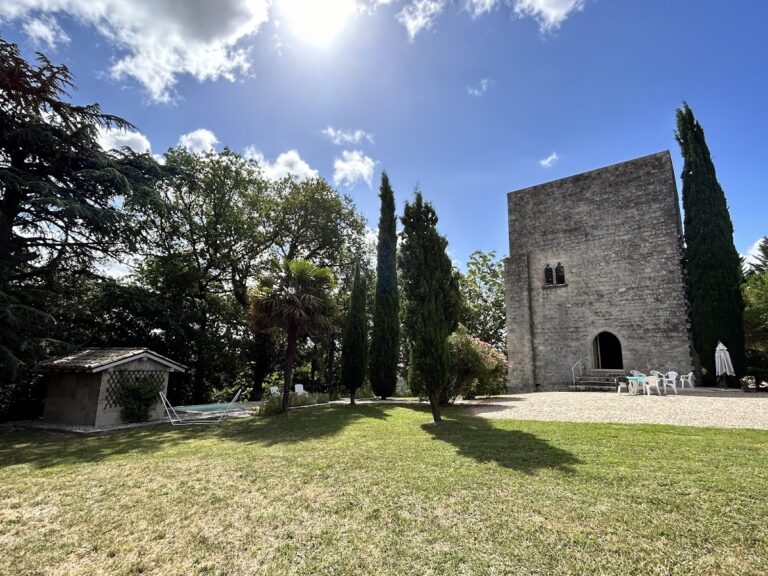
The castle was originally constructed as a defensive work. Almost nothing remains of the thirteenth-century building, which was replaced by the castle developed from the fourteenth century onward. Following the probable destruction of the castle in 1472, the round tower on the northern side was the surviving element from the thirteenth- and fourteenth-century buildings. François de Durfort rebuilt the ruined complex at the end of the fifteenth century.
Galleries and later alterations
Galleries and monumental staircase
Alain de Durfort expanded the late-fifteenth-century castle after 1535 by attaching two galleries, arranged one above the other. A monumental staircase connected the galleries with the main building, adding a prominent circulation feature to the earlier fortified structure.
Neo-Gothic work
During the nineteenth century, alterations introduced Neo-Gothic architecture and decoration inspired by medieval Gothic forms. These changes modified the appearance of the surviving castle, which remains privately owned.
Nearby sites