Castello di Oliveri: A Coastal Feudal Castle in Sicily


Site at a Glance
- Rating
- 4.4
- Popularity
- Very Low
- Country
- Italy
- Primary era
- Medieval
- Eras represented
- Medieval
- Civilizations
- Crown of Aragon, Kingdom of Sicily, Norman
- Site type
- Military
- Remains
- Castle
On this page9 sections
History
Castello di Oliveri is a privately owned castle in Italy, in Oliveri, Sicily, whose construction in the twelfth century is attributed to Grand Count Roger. Closely connected with Tindari and its fortress, it occupied the eastern natural landing place of the ancient Greco-Roman colony on the Tindari promontory and oversaw Oliveri’s historic tuna fisheries.
Origins and Norman-period description
An earlier fortification may have occupied the site during the period of the Emirate of Sicily, the Muslim polity that ruled much of Sicily before the Norman conquest. The nearby Belvedere fortress is associated, though without firm evidence, with Arab-period remains dated to 1038–1043 and with use as the prison of Oliveri Castle.
The precise construction date of the present castle remains uncertain. Its twelfth-century construction was attributed to Grand Count Roger and described by al-Idrisi, a geographer and historian who served the Norman court of King Roger II of Sicily. He portrayed Labiri as a pleasant village beside the sea, with a large castle, houses, arable land, perennial streams and mills, and a harbor supporting abundant tuna fishing.
Feudal territory and medieval holders
Oliveri formed part of a feudal territory between the Secrezia of Patti and the Vallo of Milazzo, historical territorial divisions in Sicily. The castle and settlement passed through a succession of noble holders. Bernard Blanquefort held it in 1276, followed by Ferrario Abellis in 1320 under Frederick III of Sicily. Vinciguerra d’Aragona, baron of Militello, held it in 1360, and his son Federico d’Aragona followed at an uncertain date.
Further holders included Guerao Gullielm De Sidot in 1391, Bartolomeo Iuvenio at an uncertain date, Raimondo de Azuar under Maria of Sicily, and Raimondo de Xamer in 1398. Raimondo de Xamer held the castle together with the tuna fishery below it. Bartolomeo Gioieni followed around 1399, then Federico Spadafora, baron of Venetico, in 1408, Perrone II Gioeni in 1414, and Peruccio Gioeni in 1453. Ferdinand of Castile ratified the transfer from Federico Spadafora to Perruccio Gioeni in 1414.
The Gioieni and later noble families
The Gioieni family continued to appear among the holders during the late fifteenth and sixteenth centuries. Bartolomeo II Gioieni held the property in 1494 under Ferdinand II of Aragon. Giovanni Tommaso Gioieni held it under Joanna of Castile and Charles V, followed by Andrea Ardoino in 1542. The Ardoino family received the barony and castle through marriage with the Gioieni family.
Giovanni Gioieni was recorded in 1576, Alfonso Gioieni, marquis of Burgio and Giuliana, in 1578, and Tommaso Gioieni Cardona, prince of Castiglione of Sicily and marquis of Giuliana, in 1584. In 1608 the property passed by dowry from the Gioieni family to Francesco Ardoino, marquis of Roccalumera, under Philip III of Spain. It was later sold to Francesco La Grua, prince of Carini.
Vincenzo La Grua Talamanca, prince of Carini, held the castle, tuna fishery, and trappeto of Oliveri in 1622. A trappeto was an agricultural processing facility, commonly associated in Sicily with olive-oil production. The property remained with the prince of Carini in 1650 and passed by maternal inheritance to Cesare La Grua Talamanca, prince of Carini and duke of Villareale, in 1684. It was recorded under Francesco Zappino in 1691 and Giuseppe Accordino in 1693.
Eighteenth century to private ownership
During the eighteenth and early nineteenth centuries, the holders included Vincenzo La Grua Talamanca, baron of Carini, in 1705; Annamaria Lo Faso e La Grua, duchess of Serradifalco, in 1715; Ludovico Paratore Basilotta, prince of Patti, in 1724; Leonardo Lo Faso, duke of Serradifalco, in 1751; Gaetano Paratore d’Amico, prince of Patti and baron of Tripi, in 1803; and Domenico Antonio Lo Faso, duke of Serradifalco, in 1809. Eleonora Paratore d’Amico, princess of Patti and Gaetano’s sister, and her half-brother Domenico Merlo were also later holders.
Under the Kingdom of Italy, Elena Merlo, daughter of Domenico Merlo, held the property in 1900. The succession later passed through her adopted daughter and great-niece Caterina Martorana Bonaccorsi, whose eldest daughter was Marianna Merlo, and through Domenico Bonaccorsi, a general and prince of Patti who was Caterina’s nephew. The castle is privately owned, and its owners reside there for much of the year.
Remains
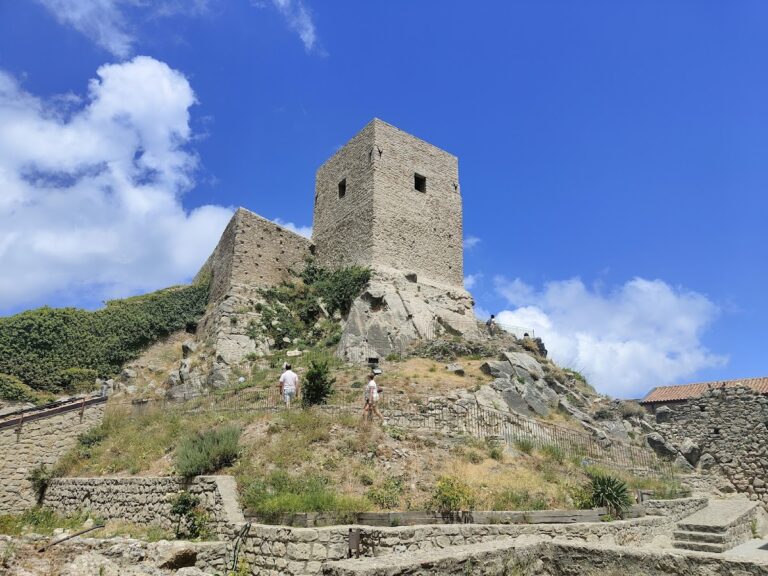
Castello di Oliveri stands on a modest elevation associated with the coastal approach to Tindari. Its position allowed it to oversee Oliveri’s historic tuna fisheries. The surviving fabric consists of limited remains of the older structures, including a tower attributed to the Aragonese period, together with an internal courtyard. The property remains usable and is described as richly furnished.
Surviving architectural fabric
Aragonese-period tower
A surviving tower is attributed to the Aragonese period. It forms part of the limited ancient fabric preserved at the castle and relates to the defensive and supervisory role associated with the elevated site and the coastal fisheries.
Internal courtyard
The castle retains a characteristic internal courtyard. Alongside the surviving tower and other older fragments, it belongs to a property that continues to be used and remains richly furnished.
Nearby sites