Merchiston Tower: A Medieval Tower House and Clan Napier Seat


Site at a Glance
- Rating
- 4
- Popularity
- Very Low
- Country
- United Kingdom
- Primary era
- Medieval
- External website
- Open
- Eras represented
- Medieval, Modern
- Civilizations
- British, Kingdom of Scotland
- Site type
- Military
- Remains
- Castle
On this page10 sections
History
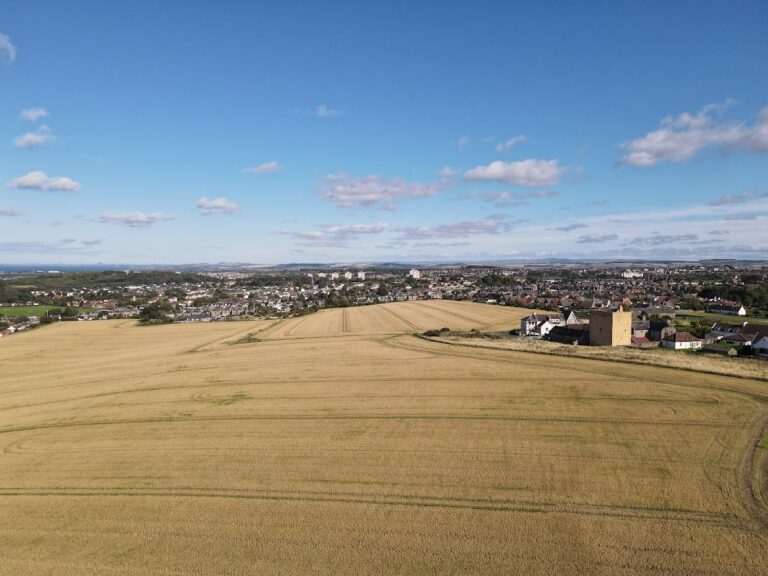
Merchiston Tower is a medieval tower house in Edinburgh, United Kingdom, probably built around 1454 by Alexander Napier, the second Laird of Merchiston. Constructed as a fortified country house, it became the seat of Clan Napier, the extended Scottish kinship group associated with the family. The tower remained connected with the Napiers for much of the following five centuries.
The Napier estate and sixteenth-century conflict
The lands around Merchiston had been acquired before 1438 by Alexander Napier, the first Laird of Merchiston. The tower’s strategic position and the political instability of the period led to heavy fortification, and it was repeatedly besieged. A 26-pound cannonball later found embedded in the masonry is thought to relate to the 1572 struggle between Mary, Queen of Scots, and supporters of her son, James VI.
Merchiston also became associated with a witchcraft accusation in 1569. William Stewart of Luthrie was accused of witchcraft and conspiracy against Regent Moray, a powerful political administrator acting for the young James VI. Stewart was said to have met Archibald Napier in an upper chamber of the tower to conjure a spirit called Obirion, and he also attempted to invoke it in the garden. In March 1584, Edinburgh town council sold Archibald Napier land for an extension to the garden.
Changing ownership and educational use
The castle left Napier ownership in 1659, when it was sold to Ninian Lowis. It remained with his family until 1729, when it passed to the governors of George Watson’s Hospital, an institution associated with the Merchant Company of Edinburgh. Francis Napier, 6th Lord Napier, brought it back into the family in 1752. In 1772 it was sold to Charles Hope-Weir, the second son of John Hope, 2nd Earl of Hopetoun. Hope-Weir sold it to Robert Turner in 1775, and Turner sold it to Robert Blair, a professor of astronomy at the University of Edinburgh, in 1785.
William Napier, 9th Lord Napier, restored the tower to Napier ownership in 1818. In 1833, Lord Napier leased it to Charles Chalmers, who founded Merchiston Castle School there. The Honourable John Scott Napier, the fourteenth Laird of Merchiston, sold the tower to the school in 1914. The school left in 1930 and moved to a site approximately three miles away.
Public ownership and restoration
In 1930 ownership passed to the Merchant Company, which used nearby playing fields for George Watson’s College. Edinburgh City Council acquired the tower in 1935. It remained unoccupied, apart from wartime service, until 1956, when it was proposed as the centrepiece of a new technical college.
Restoration began in 1958. The work revealed the entrance drawbridge and preserved a seventeenth-century plaster ceiling. Merchiston Tower is now owned by Edinburgh Napier University and stands at the centre of its Merchiston campus, continuing a use of the building that extends from the fifteenth century into the twenty-first. It has been a Category A listed building since 1966. In Scotland, this designation is applied to buildings considered of national or more than local importance.
Remains
Merchiston Tower is an elaborate stone tower house built on an L-shaped plan, with a wing projecting to the north. An L-plan tower house combines a principal block with a projecting wing to create a fortified Scottish residence. Some walls are as much as six feet thick. The second floor and roof level were originally vaulted, using curved structural forms, while the building’s unusual entrance arrangement placed the main doorway at second-floor level on the south front.
Entrance and defensive features
Drawbridge entrance
The entrance doorway is set within a tall, shallow recess that probably held a drawbridge. The bridge would have rested on an external outwork, a defensive structure beyond the main building, positioned approximately 14 feet above ground level and 10 feet from the tower. Restoration work in the twentieth century led to the discovery of this entrance arrangement.
Later additions and surviving interiors
School extension
After the tower was leased to Merchiston Castle School, it was substantially altered by the addition of a two-storey extension in the castellated Gothic style and by the construction of a basement. The basement was later removed.
University alterations
Large sections of the wall in the northern extension were subsequently removed by Edinburgh Napier University to create a corridor through the tower to other campus buildings. The 26-pound cannonball recovered from the masonry remains a physical trace associated with the tower’s sixteenth-century conflict, while the seventeenth-century plaster ceiling survives as an interior feature preserved during restoration.
Nearby sites