Nijenborgh Castle: Residence of the Counts of Horn in the Netherlands


Site at a Glance
- Rating
- 4.2
- Popularity
- Very Low
- Country
- Netherlands
- Primary era
- Medieval
- Eras represented
- Medieval, Modern
- Civilizations
- Dutch, Holy Roman Empire
- Site type
- Military
- Remains
- Castle
On this page12 sections
History
Nijenborgh Castle, also known as Huis Op de Biest, was a fifteenth-century late Gothic water castle in Weert, Netherlands, built as the residence and seat of the Counts of Horn. Construction took place from 1455 to 1461, when the noble family replaced its earlier seat, the Aldenborgh, with a larger and more up-to-date stronghold.
From Aldenborgh to Nijenborgh
From the twelfth century, the lords of Horn held guardianship over Weert. They moved their seat from their ancestral castle at Horn to the town and established the Aldenborgh. By the middle of the fifteenth century, that residence no longer met contemporary requirements. A new castle was therefore commissioned in 1455 a few hundred metres away, against Weert’s town walls. Its name, Nijenborgh, means “New Castle.”
Jacob I van Horne was the first resident. After taking part in a crusade to the Holy Land in 1450, he was knighted by Frederick III, Holy Roman Emperor from 1452 to 1493, and received permission to use the title Count of Horn. Once Nijenborgh was complete, the Aldenborgh was given to the Friars Minor, the Franciscan religious order founded by Saint Francis of Assisi, in 1461.
Jacob I’s son Jan van Horne, born in 1458, later became prince-bishop of Liège. His other son, Jacob II van Horne, succeeded his father in 1472 as lord of Weert and Count of Horn. Jacob I then lived with the Friars Minor at the Aldenborgh.
The Montmorency family and the Dutch revolt
In 1540, Philippe de Montmorency inherited Nijenborgh, the County of Horn, and the lordships of Heusden, Altena, and Weert through a disposition made by his stepfather, Jan van Horne. Philippe became governor and military commander of Guelders in 1555, a knight of the Order of the Golden Fleece in 1556, admiral of the Netherlands in 1558, and general admiral of the Spanish fleet in 1559. He later served on the Council of State.
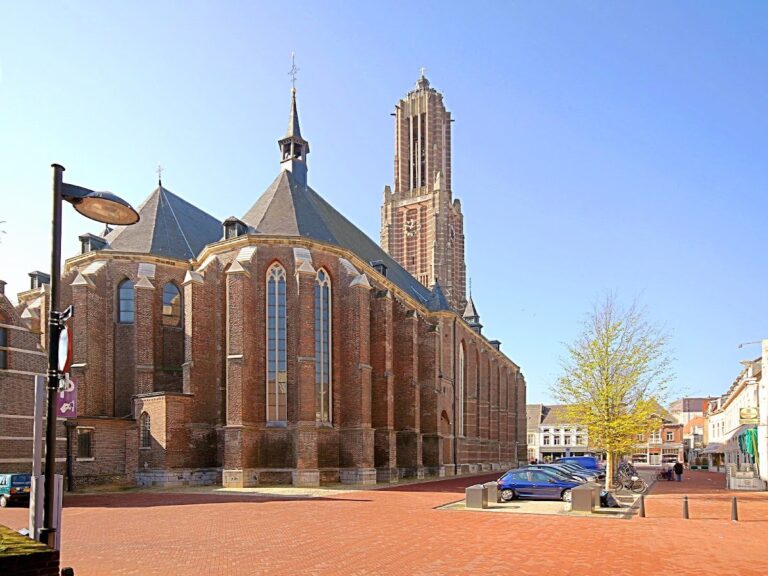
Philippe became a leading opponent of the policies of Cardinal Antoine Perrenot de Granvelle, including the introduction of the Inquisition and the persecution of Protestants in Flanders. He acted alongside William of Orange, Lamoral of Egmont, and Brederode. After Philip II sent the Duke of Alba to the Netherlands in 1566 following the Iconoclastic Fury, Alba arrested the Counts of Egmont and Horn. Philippe de Montmorency and Egmont were beheaded in Brussels on 5 June 1568. Philippe was buried in Saint Martin’s Church in Weert, while the title Count of Horn passed to his younger brother Floris. Floris was executed after a mission to the Spanish king in 1570.
Sieges and destruction
The Princes of Chimay from Hainaut succeeded the van Hornes as lords of Weert. During the Eighty Years’ War, the long Dutch revolt against Spanish Habsburg rule, Nijenborgh was besieged repeatedly by Spanish and Dutch forces. William of Orange captured the castle in 1578, but the Duke of Parma retook it about three months later, in February 1579.
In 1702, troops commanded by John Churchill, Duke of Marlborough, almost completely destroyed Nijenborgh during the siege of Weert in the War of the Spanish Succession, the European conflict of 1701 to 1714 over the Spanish throne. The Princes of Chimay retained ownership of the ruined castle but did not rebuild it, and the remains continued to deteriorate.
Archaeological research in 2018 and 2019 recovered lead musket balls and the skeletons of four soldiers from the Eighty Years’ War. Their relationship to the fighting remains uncertain. The musket balls may have been used for target practice, while the skeletons may belong to four of the sixteen Spanish soldiers hanged from the castle windows in 1579.
Ruins and later ownership
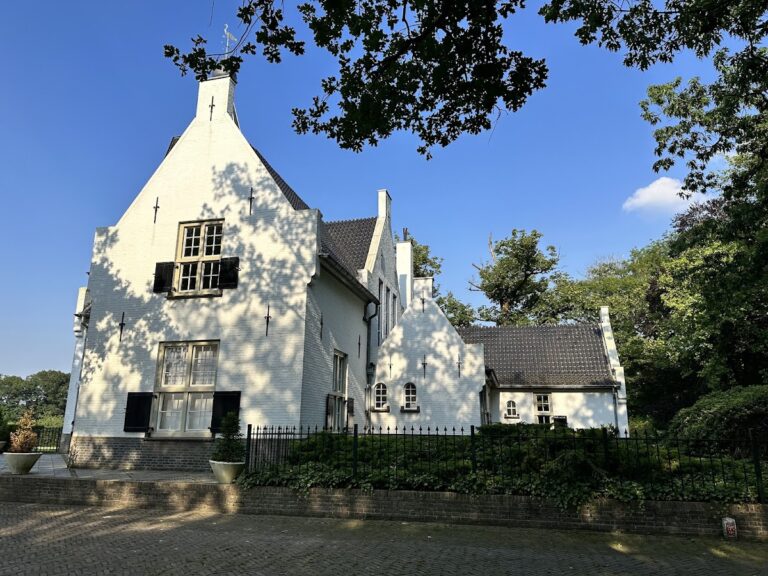
In 1841, Louis Beerenbroek, a former mayor of Weert, bought the ruins and commissioned Huis Op de Biest on the foundations of the southern square tower. After his death, the property passed to the Coenen family, a family of Weert mayors. From 1918 it changed hands several times and was occupied by the Mathijsen and Wolterbeek families. The castle was auctioned in 1923 and acquired by the Scheijmans family, which established a timber business on the forecourt.
Weert designated 2018 as the Van Horne Year. On 1 January 2020, the municipality acquired the forecourt, and the timber business moved to the Kampershoek industrial area as plans developed for an urban park around the castle. Nijenborgh has been protected as a Dutch national monument, Rijksmonument 38455, since its registration on 19 July 1967. A statue of Philippe de Montmorency, also known as Philips van Horne, was erected on the forecourt on 5 June 2022.
Remains
Nijenborgh originally comprised a main castle and a fifteenth-century outer bailey, a secondary enclosed area outside the main fortification that commonly contained entrance and service facilities. The main enclosure stood between two surrounding moats and formed a rectangle of approximately 75 by 60 metres, with a fortified inner courtyard. Four corner towers, a residential wing, a gatehouse, and enclosing walls shaped the complex.
Main castle layout
The larger northern and southern corner towers were square and carried tall spires. Their late Gothic features included large windows, small turret-like projections, dormer windows, and a stair tower. Two smaller round towers occupied the other corners. Along one of the castle’s long sides stood a very tall residential wing with stepped gables, while the gatehouse and castle walls enclosed the remaining sides.
Surviving structures
Huis Op de Biest
The present Huis Op de Biest was built in 1841 on the foundations of the southern square tower. It forms the principal later building associated with the castle site and incorporates the position of one of the original corner towers.
Eastern round tower
The eastern round tower was heightened during the nineteenth century. It belongs to the surviving fragments of the former castle’s corner-tower system.
Outer-bailey entrance
Parts of the enclosing walls, remnants of several corner towers, and portions of the outer-bailey gatehouse survived the destruction of 1702. The ruins of the outer-bailey entrance remain as physical evidence of the former approach and secondary enclosure.
Castle forecourt
The forecourt contains the statue of Philippe de Montmorency, erected in 2022. The surviving ruins and later buildings on the site retain elements of the castle’s medieval footprint.