Mainzer Schloss: The Former Electoral Mainz Government Residence in Heiligenstadt


Site at a Glance
- Rating
- 4
- Popularity
- Very Low
- Country
- Germany
- Primary era
- Early Modern
- External website
- Open
- Eras represented
- Early Modern
- Civilizations
- Holy Roman Empire
- Site type
- Civic
- Remains
- Palace
On this page8 sections
History
Mainzer Schloss is an eighteenth-century Baroque castle in Germany, located in Heiligenstadt, and was built as the residence of the governor representing the Electorate of Mainz. The Electorate of Mainz was an ecclesiastical principality of the Holy Roman Empire ruled by the archbishop-elector of Mainz. Constructed between 1736 and 1738, the castle became a regional governmental centre for the Eichsfeld, a historical region of central Germany.
Ecclesiastical administration on the Stiftsberg
The castle stands on the Stiftsberg at the western edge of Heiligenstadt’s historic centre. The hill had held an ecclesiastical administrative role since the establishment of St. Martin’s collegiate foundation and its archdeaconry around 900. A collegiate foundation was a community of clergy organized around a collegiate church, while an archdeaconry was an ecclesiastical district governed by an archdeacon. This institutional presence gave the site a continuing administrative function in the Eichsfeld and, at times, in neighbouring territories.
Heiligenstadt had belonged to the Electorate of Mainz since 1022, although the territory had previously been administered from Rusteberg. In 1540, the Mainz administrative district and court were transferred from Rusteberg to Heiligenstadt. The chief officials and their administration first occupied part of the collegiate curia, a residence or administrative building belonging to the foundation, and later moved into the collegiate granary and brewery.
The Electoral Mainz building campaign
In 1603, Archbishop-Elector Johann Schweikhard von Cronberg ordered the earlier buildings to be demolished. A new archiepiscopal court, administrative headquarters, service buildings, and the Laurentius Chapel were erected on the site. Parts of those service buildings remain behind the castle, and a stone tablet at the Alte Sparkasse commemorates Johann Schweikhard’s commission.
After Chief Administrator Johann Eberhard von der Leyen died, Elector Philipp Karl von Eltz-Kempenich appointed his nephew Hugo Franz Carl von und zu Eltz-Kempenich as the Mainz elector’s representative in 1732. The administrative district was then transformed into a governorate, or a jurisdiction administered by a governor on behalf of the territorial ruler. Its expanding responsibilities required larger premises, so the old administrative headquarters and several collegiate curiae were demolished.
Philipp Karl von Eltz-Kempenich commissioned the present castle as the governor’s residence. Johann Christoph Heinemann of Dingelstädt built it from 1736 to 1738, and he was also associated with nearby Bischofstein Castle. The earlier Laurentius Chapel was demolished as a separate structure and incorporated into the new building. Mainzer Schloss survived the devastating town fire of 1739 and continued to serve as the seat of the Electoral Mainz government of the Eichsfeld, the Higher Regional Court of Heiligenstadt, and for a short period the episcopal commissariat of the Eichsfeld.
The Mainz electors normally resided at the Electoral Palace in Mainz and used Aschaffenburg Palace as a second residence. In Heiligenstadt, the governorate provided accommodation during visits to Erfurt. Elector Friedrich Karl Joseph von Erthal, the last territorial ruler to stay at the castle, was there in 1777, 1792, and 1796.
Prussian and later administrative use
Political changes at the beginning of the nineteenth century brought new administrations to the castle. During the Kingdom of Westphalia, the Napoleonic state established in central Germany in 1807, the building housed the prefect of the Harz Department. After Prussia took permanent possession of the Upper Eichsfeld, Mainzer Schloss became the administrative seat of the Heiligenstadt district. The Prussian government for the Eichsfeld and neighbouring territories operated temporarily from Heiligenstadt between 1802 and 1804, before moving to Erfurt. The Eichsfeld-Erfurt War and Domain Chamber, a Prussian authority concerned with government, state property, and financial administration, also operated there in 1803–1806 and 1813–1816.
The building continued to accommodate the Prussian district administration, the Westphalian prefecture, and later district administrations. The writer and jurist Theodor Storm had his official rooms there while serving as a district judge in Heiligenstadt, adding a literary and judicial association to the building’s administrative history.
After the 1945 administrative reorganization of Thuringia, the former districts of Heiligenstadt and Worbis were combined into the Eichsfeld district. In 1946, the district was renamed the Worbis district, although its seat remained at Heiligenstadt. Following the East German administrative reform of 1952, the castle became the seat of the Heiligenstadt district council. It later housed the Heiligenstadt district administrator from 1990 and the Eichsfeld district administration from 1994. A general renovation and conversion began in 2019, with completion planned for 2024.
Remains
Mainzer Schloss occupies the elevated Stiftsberg above the lower-lying town. Its complex combines the principal castle building with a side wing, surviving parts of the earlier administrative service buildings, and the former savings bank building. The town-facing side is enclosed by a high wall, while the rear area retains a section of the service buildings associated with the earlier administrative headquarters.
Baroque castle and chapel
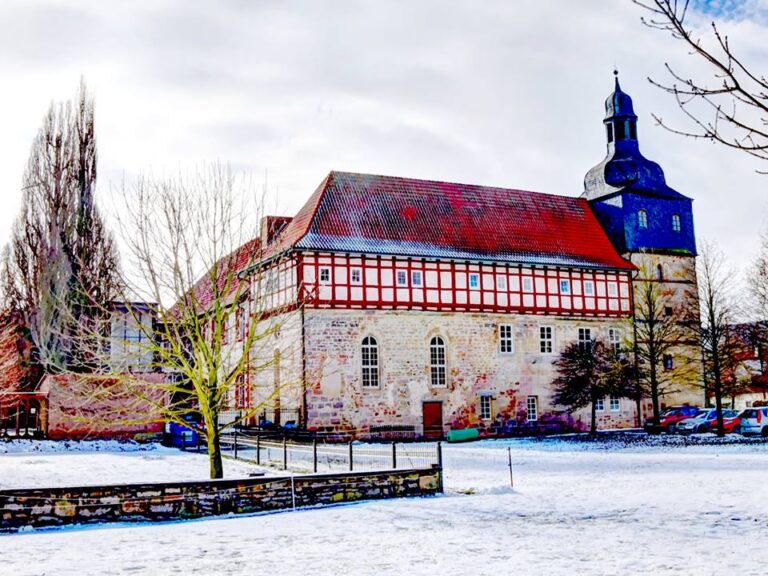
The main building and side wing form the central Baroque composition. They are constructed from sandstone ashlar, regularly cut sandstone blocks laid as finished masonry. Above the main entrance, the principal façade features two balconies and an elaborate curved pediment carrying the coat of arms of Elector Philipp Karl von Eltz-Kempenich. The entrance portal contains a star gate, while an oak-carved staircase and stucco work in the stair hall and other rooms preserve important elements of the eighteenth-century interior.
The Laurentius Chapel was refitted within the main building when the castle was constructed. It retained an external entrance and became part of the castle’s architectural arrangement rather than remaining a separate building. Its incorporation reflects the way the new governor’s residence absorbed elements of the earlier ecclesiastical complex.
Service buildings and enclosure
Behind the castle, a surviving portion of the former service buildings belongs to the administrative headquarters created in the early seventeenth century. The castle wall at Knickhagen is another identifiable component of the complex. Together with the chapel and the main building, these remains preserve the layered development of the site from ecclesiastical and territorial administration to the eighteenth-century governorate.
Former savings bank building
The complex also includes the Alte Sparkasse, or former savings bank building, which was constructed in the nineteenth century. A stone tablet there commemorates Johann Schweikhard von Cronberg’s building campaign of 1603. The building therefore forms part of the later architectural history of the site while retaining a material reference to the earlier Electoral Mainz administration.
Nearby sites