West Blockhouse Fort: A Victorian Coastal Artillery Fort in Pembrokeshire


Site at a Glance
- Rating
- 4.7
- Popularity
- Very Low
- Country
- United Kingdom
- Primary era
- Modern
- External website
- Open
- Eras represented
- Modern
- Civilizations
- British
- Site type
- Military
- Remains
- Fort
On this page12 sections
History
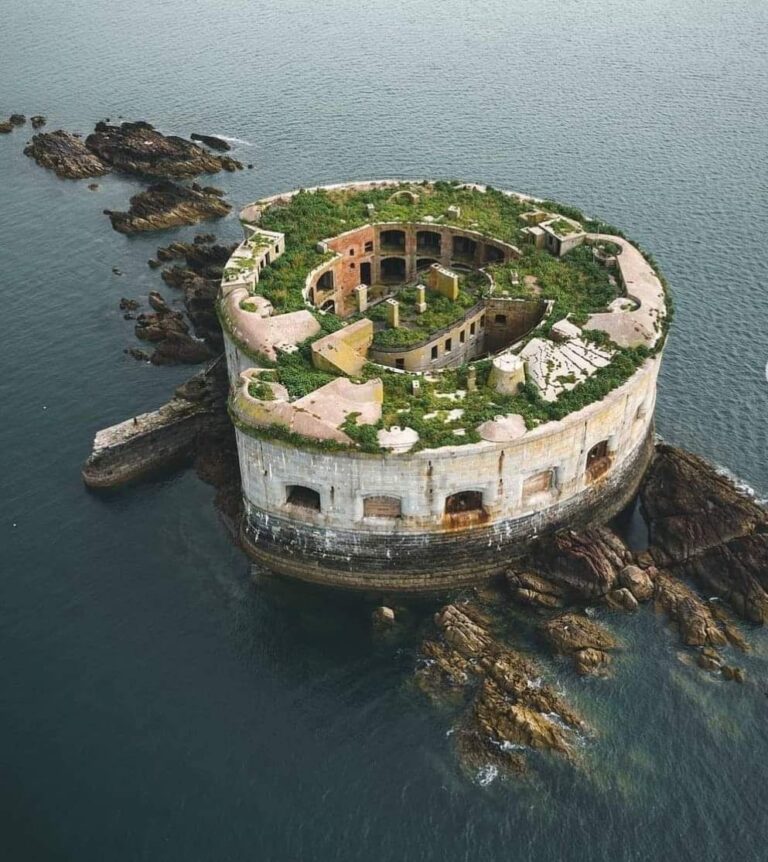
West Blockhouse Fort is a British mid-nineteenth-century coastal artillery fort at West Blockhouse Point near Dale in the United Kingdom. Built in 1857–1858 in response to concern about Emperor Napoleon III of France, it formed part of the Palmerston forts, a network of coastal-defence works developed amid fears about French military power. The fort was intended to protect the anchorage at the mouth of the Milford Haven Waterway through interlocking fire with Thorn Island Fort and Dale Fort.
The Tudor predecessor
The headland had earlier been occupied by a West Blockhouse built by order of Henry VIII, the Tudor king whose government began a national coastal-fortification programme in 1539. Its construction formed part of wider defensive preparations shaped by international and religious tensions. Across the waterway near Angle stood the planned East Blockhouse, a corresponding gun tower that was never completed. The earlier West Blockhouse had fallen into disuse before it was demolished to make way for the present fort.
Construction and nineteenth-century service
The present fort was planned in the early 1850s, after Napoleon III came to power in France following his December 1851 coup. Construction took place in 1857 and 1858, and the completed work was initially armed with six 68-pounder muzzle-loading guns. These guns were loaded through the front of the barrel, reflecting the artillery technology of the fort’s first period.
As the fort became increasingly obsolete, proposals considered either rearming it or abandoning it. In 1893 it was reduced to the status of a practice battery, and it was disarmed in 1900. The following year, the rebuilt terreplein, a level platform for artillery, received four 5-inch breech-loading guns. Two 3-pounder quick-firing guns were also placed on the roof of the barrack block. After the separate West Blockhouse Battery was completed nearby, all the guns were removed from the fort by 1907, although the buildings continued to serve for storage and accommodation.
Wartime use and preservation
During the Second World War, West Blockhouse Fort became the headquarters of the Haven’s searchlight defences. Two searchlight positions were built close to the fort. Military use ended in 1956, when coastal artillery was abolished, and the site subsequently became derelict.
The Landmark Trust purchased the buildings in 1969 and the land in 1970. Restoration began in late 1986, converting the barracks internally into holiday apartments and rebuilding the original brick-vaulted roof. The conversion was designed by Andrew Thomas of Thomas Jones Associates of Builth Wells. West Blockhouse Fort received Grade II* listed status in 1996, when it was regarded as probably the best-preserved of the Palmerston forts around Milford Haven.
Remains
The main fort
West Blockhouse Fort is arranged as a coastal artillery work centred on a barrack block and a terreplein, with associated defensive and military installations. The date 1857 is inscribed above the main entrance. The barracks originally had a brick-vaulted roof, which was later replaced with concrete to carry the 3-pounder quick-firing guns. The late-twentieth-century restoration rebuilt the brick vaulting, while the interior was reconstructed as holiday apartments.
The terreplein
The terreplein was rebuilt in 1901 to carry four 5-inch breech-loading guns. This alteration belongs to the fort’s later artillery phase, after its original muzzle-loading armament had become obsolete. The platform forms part of the surviving military arrangement alongside the barrack block.
Roof armament
Two 3-pounder quick-firing guns were installed on the roof of the barrack block before being removed by 1907. Their placement reflects the attempt to adapt the fort to more rapidly fired artillery before the nearby battery took over its coastal-gunnery role.
West Blockhouse Battery
Gun emplacements
West Blockhouse Battery occupies a separate site 150 yards, or 138 metres, west of the fort, higher up the cliff. Construction began in 1900, and the battery was completed with two BL 9.2-inch Mk X guns and three BL 6-inch Mk VII guns. BL means breech-loading, while the Roman numerals identify the model or mark of each gun. The concrete gun emplacements remain, while other parts of the battery have been demolished, buried, or become overgrown.
Later artillery arrangement
The battery’s guns were withdrawn and reinstated at various times. The two 9.2-inch guns were removed in 1939, leaving two 6-inch guns that appear to have remained manned until coastal artillery ended in 1956. A similar battery was built at East Blockhouse near Angle, extending the defensive system across the Milford Haven Waterway.
Searchlight defences
Two searchlight positions built near the fort during the Second World War formed part of the Haven’s searchlight defences. They belonged to the wartime military installations associated with the headquarters housed in the fort.