Kevernburg: A Medieval Hill Castle and Dynastic Seat in Germany


Site at a Glance
- Rating
- 4.6
- Popularity
- Very Low
- Country
- Germany
- Primary era
- Medieval
- Eras represented
- Medieval
- Civilizations
- Holy Roman Empire
- Site type
- Military
- Remains
- Castle
On this page7 sections
History
Kevernburg, formerly called Käfernburg, is a medieval hill castle in Arnstadt, Germany, above the districts of Angelhausen and Oberndorf. Probably established around the turn of the first millennium, it used elevated ground to protect an old commercial and military route through the Ohragrund, along the Ohra River and across the Oberhof Pass.
Origins and the Counts of Kevernburg
The castle’s exact construction date is uncertain. Its first documented reference appears on 8 November 1141, when Count Sizzo III of Kevernburg was named as a witness. During its most important period, the fortress served as the ancestral seat of the Counts of Kevernburg and as the governmental center of their county.
Several forms of service and authority operated through the castle. Hersfeld Abbey held the site with Kevernburg reeves, local officials who exercised authority for a superior institution. Ministerials, members of the service nobility who undertook administrative, military, or household duties, also served there. Among them were the Schenks of Kefernburg, a branch of the Schenks of Vargula.
Changes of Lordship
Control of Kevernburg shifted repeatedly through pledges, enfeoffments, inheritance divisions, and sales. An enfeoffment granted land or related rights in return for service or allegiance. The recorded holders included the Counts of Kevernburg, Heinrich of Hohnstein, Otto of Orlamünde, the Landgraves of Thuringia, the Counts of Schwarzburg, the Counts of Gleichen, and Elector Johann Friedrich I. A landgrave was a high-ranking territorial ruler in the Holy Roman Empire, while an elector was a prince entitled to take part in choosing the emperor.
The Kevernburg dynasty ended in 1365. On 29 May 1387, the lordship was sold to Landgrave Balthasar of Thuringia. He pledged the castle and lordship to his younger brother Wilhelm on 15 July 1394. After 1446, the territory passed to the Counts of Schwarzburg, who were related to the Kevernburg family.
Administrative Use and Decline
Following the Reformation, the sixteenth-century movement that challenged established Western Catholic institutions and produced Protestant churches, Kevernburg housed various administrative offices. Its decline began during the Thirty Years’ War, the European conflict of 1618 to 1648 that caused widespread destruction in the German lands.
Afterward, inhabitants of nearby villages dismantled parts of the old fortress for building material. Stone, bricks, tiles, and timber were used in houses and roads, and some materials were reused at Neideck Castle. This process further reduced the visible remains of the medieval stronghold.
Remains
Hilltop Earthworks
Kevernburg occupied the Schlossberg, a hill approximately 383 metres high above Angelhausen and Oberndorf. The elevation is also described more broadly as about 380 metres above sea level. As a hill castle, it was a fortified residence or stronghold built on elevated ground, where the terrain supported defense and visibility.
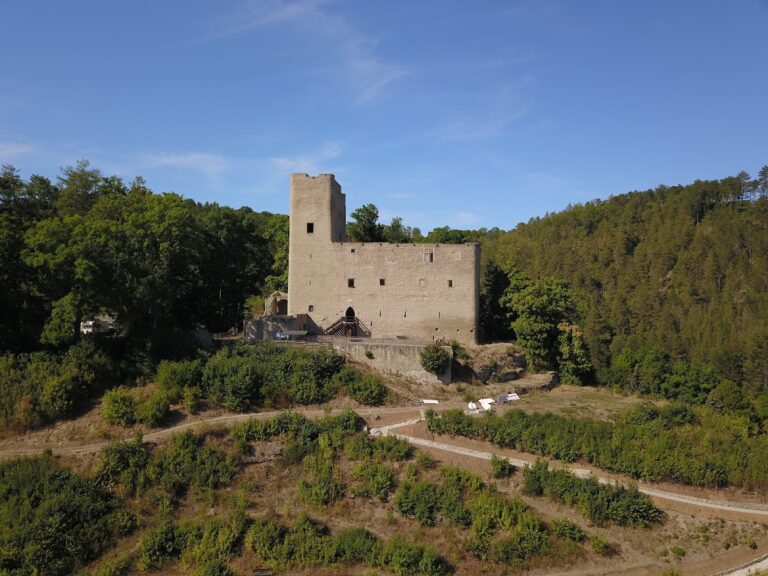
The surviving layout is represented chiefly by a system of ramparts and ditches. Only slight remnants of the original walls remain. The earthworks are difficult to see because dense, thorny vegetation covers them, while the materials removed from the fortress survive in later construction at the surrounding settlements and at Neideck Castle.
Historical Evidence
No authentic historical image of Kevernburg is known to survive. The castle’s form must therefore be understood through its remaining earthworks, limited wall fragments, and the written record of its role as the seat of the Kevernburg dynasty and the administration of its county.