Suur-Merijoki Manor: A Finnish National Romantic Estate in Vyborg


Site at a Glance
- Rating
- 4.3
- Popularity
- Very Low
- Country
- Finland
- Primary era
- Modern
- External website
- Open
- Eras represented
- Modern
- Civilizations
- Russian
- Site type
- Domestic
- Remains
- Manor House
On this page12 sections
History
Suur-Merijoki Manor was an estate in Vyborg, Russia, on territory formerly belonging to Finland. Documented from the sixteenth century, it acquired formal estate status in 1651 and became known for its successive noble owners, its agricultural enterprises, and the Forest Palace built in 1901–1904 in the Finnish National Romantic style.
Early estate history
The manor changed hands repeatedly through gifts and inheritance. Among its owners were the nobleman Erik Lilieshköld, Ivan Maximovich Shuvalov, chief commandant of Vyborg Fortress, and Admiral Dmitry Ilyich Rudakov. The property lay in the western part of the Vyborg rural commune of Vyborg County, an area that was formerly within the Russian Empire and is now part of Seleznyovskoye Rural Settlement in Vyborg District, Leningrad Oblast.
The composer Alexander Konstantinovich Glazunov stayed at Suur-Merijoki after arriving there in May 1881. During the summer, he composed several romances, variations, and other works at the manor while continuing work on his First Symphony.
The Neuscheller estate
In 1900, the estate was purchased by Maximilian Otmar Neuscheller, a Swiss citizen, Saint Petersburg entrepreneur, patron, philanthropist, and principal shareholder of the Treugolnik factory. Before the Revolution, Suur-Merijoki served as the Neuscheller family’s summer residence in Russia. The estate covered 865 hectares.
The Neuschellers immediately reorganized the property. Several hundred hired workers reconstructed the manor grounds, renovated housing for rent, and replaced ruined farm buildings with new structures. The agricultural complex included Ayrshire cattle, horses, and poultry. A breeding bull named Grey was brought from England for the Ayrshire herd, which comprised 300 cows. The farm also kept 55 horses and 100 poultry, while a sculpture of Grey was installed in the manor courtyard at Neuscheller’s direction.
The estate had a sawmill and a mill, and in 1910 a factory began producing linseed oil and drying oil. Neuscheller also encouraged modern agricultural methods. A tractor was used for the first time in Finland on the surrounding estate lands.
The Forest Palace
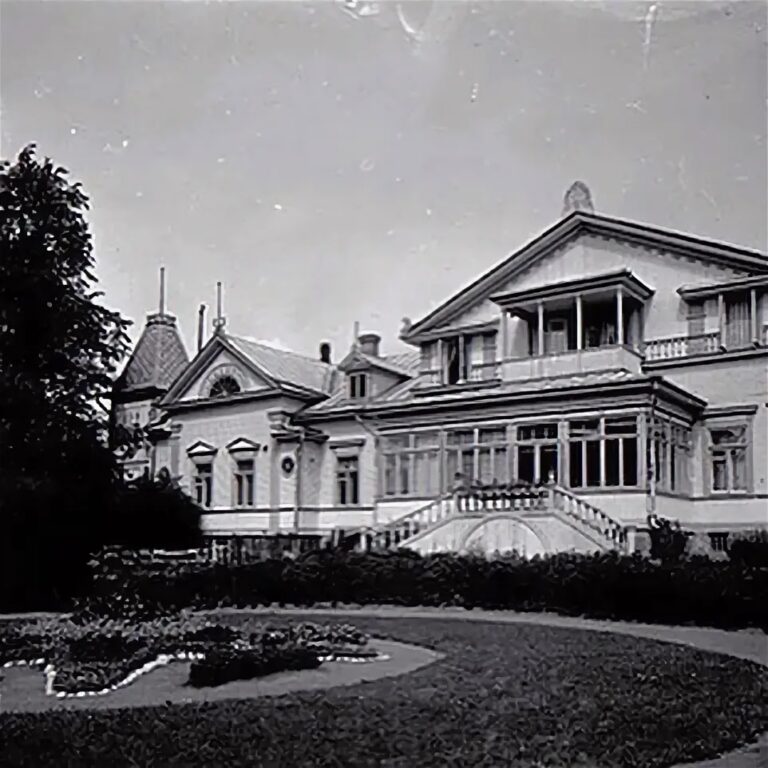
The principal manor house, known as the Forest Palace, was built between 1901 and 1904 by the Finnish architectural partnership Gesellius, Lindgren and Saarinen. Herman Gesellius, Armas Lindgren, and Eliel Saarinen were associated with the development of National Romantic architecture, a movement that combined modern design with regional history, traditional materials, folklore, and national cultural motifs. Their international reputation had grown after their pavilion at the 1900 Paris World’s Fair.
The house became the architectural centre of the Neuscheller estate and its summer life. Its interiors were created through individual commissions based on drawings prepared by the project designers and artists, bringing sculpture, metalwork, frescoes, Finnish carpets, tiled stoves, and specially designed light fixtures into a unified setting.
Revolution, aviation, and war
Neuscheller was arrested in late 1917 as the owner of capitalist property and taken to Moscow. He was released in 1919 but died while travelling from Moscow to Saint Petersburg. His widow, Cornelia Neuscheller, died in 1924. The family sold the estate to the Finnish businessman Ingman in 1926, and the Finnish armed forces acquired it in 1927.
The Finnish government purchased Suur-Merijoki for the country’s air force. An airport was established on the manor grounds, and the Separate Ground Squadron was based there until 1939. Before the Second World War, the airfield hosted regular air shows with aerobatic pilots. The show held in 1935 attracted 20,000 spectators.
On 1 May 1937, Aero Oy’s first domestic scheduled flight arrived at Suur-Merijoki Airport. The flight, operated by a De Havilland Dragon Rapide, travelled from Helsinki to Vyborg, and seasonal passenger service continued until the end of August 1939. After the outbreak of the Second World War in autumn 1939, the airport became a military airfield and the manor house was used as an officers’ club, a military facility for commissioned officers’ accommodation, dining, social activity, or administration.
During the war, a bomb struck the villa and caused a fire that damaged the roof and upper floor. After repairs, the building was used as a hospital. It was ultimately destroyed during the Soviet period. After the war, a large barracks was built on the abandoned airport site. Suur-Merijoki Manor is now recognized in Russia as an identified cultural-heritage site under object number 4730379000.
Remains
The Forest Palace
Villa structure
The manor complex was built with brick, stone, and plaster. The Forest Palace had a total area of 900 square metres and combined National Romantic design with a varied silhouette. A cylindrical corner tower was crowned by a helmet-shaped dome and accompanied by a projecting bay window. The principal hall contained an arched panoramic window measuring 5 metres wide and 4.8 metres high, while the house was covered by a high tiled roof.
The surviving parts of the villa are fragmentary. They include part of the basement, the arch of the passage between the music hall and billiard room, and part of the stone enclosure around the inner courtyard. The rest of the building is ruined.
Interior decoration
The interior programme incorporated Finnish national-folkloric themes. Felix Nylund and Loja Gesellius-Saarinen supplied sculpture, while Eric Erström produced metal repoussé, a technique that raises designs by working the reverse side of a metal sheet. Väinö Blomstedt and Gabriel Engberg created frescoes, which are wall paintings made on wet plaster.
Traditional Finnish carpets included designs associated in part with Akseli Gallen-Kallela, the artist particularly known for visual interpretations of the Kalevala, Finland’s national epic compiled from Finnish and Karelian oral poetry. Richly tiled stoves and light fixtures also formed part of the interior scheme. Before the war, Finnish officers removed several furnishings, pieces of furniture, household objects, and fittings, which were preserved in museums in Finland.
Estate grounds and agricultural buildings
Farm complex
The agricultural estate included cowsheds, stables, barns, and other farm structures. Some of these buildings remain, along with the stone foundation of a barn. Their surviving presence reflects the working agricultural complex that accompanied the principal residence and supported the estate’s cattle, horse, and poultry production.
Observatory and garden
An observatory built in 1910 survives at the estate. The principal house also contained a photographic laboratory for developing photographs. The manor garden and surrounding lands were substantially reconstructed after the Neuschellers acquired the property, and the grounds included trees of rare varieties. Surviving manor trees remain part of the physical landscape.
The former estate lands are now partly occupied by Soviet-era apartment buildings in Vyborg’s Kharitonovsky Microdistrict and partly by Seleznyovo settlement. The sculpture of the bull Grey was removed by Finnish officers during the Soviet-Finnish wars of 1939–1944 and taken to Järvenpää.