Virunum Amphitheatre: Roman Arena at Maria Saal, Austria

Site at a Glance
- Rating
- 4.5
- Popularity
- Very Low
- Country
- Austria
- Primary era
- Classical
- Eras represented
- Classical
- Civilizations
- Roman
- Site type
- Entertainment
- Remains
- Amphitheatre
On this page13 sections
History
The Virunum Amphitheatre is a Roman arena in Austria, near Maria Saal, built as part of the city of Virunum, which was founded under Emperor Claudius around the middle of the 1st century AD. Virunum succeeded the earlier Celtic-Roman settlement on Magdalensberg and became the capital of the Roman province of Noricum, a territory covering much of present-day Austria and adjoining parts of the eastern Alps. After Diocletian’s late 3rd-century reforms divided the province, Virunum served as the capital of Noricum mediterraneum, the smaller southern province.
Virunum as a provincial capital
Virunum stood on the main route between the Adriatic and the Danube. A branch road connected the city with the Amber Road through southeastern Carinthia. Its administrative territory covered about 9,000 square kilometres, including central and lower Carinthia and parts of Styria. During the 1st and 2nd centuries AD, the city developed into an economic and cultural centre for the southeastern Alpine region.
Virunum possessed Latin rights and was the seat of the procurator Augusti provinciae Norici, the imperial financial and administrative governor of Noricum, until the middle of the 2nd century. After the provincial administration moved to Ovilava, the Roman city now known as Wels, following the Marcomannic Wars, Virunum continued to oversee provincial finances.
Late Roman transformation and abandonment
From AD 343, Virunum was a bishop’s see, meaning that it served as the official seat of a Christian bishop. During the Migration Period, the city’s unfortified position in a flat valley probably contributed to its partial or complete evacuation. Inhabitants moved to nearby hill settlements, including Ulrichsberg and Grazerkogel, and Virunum was ultimately abandoned by the 6th century.
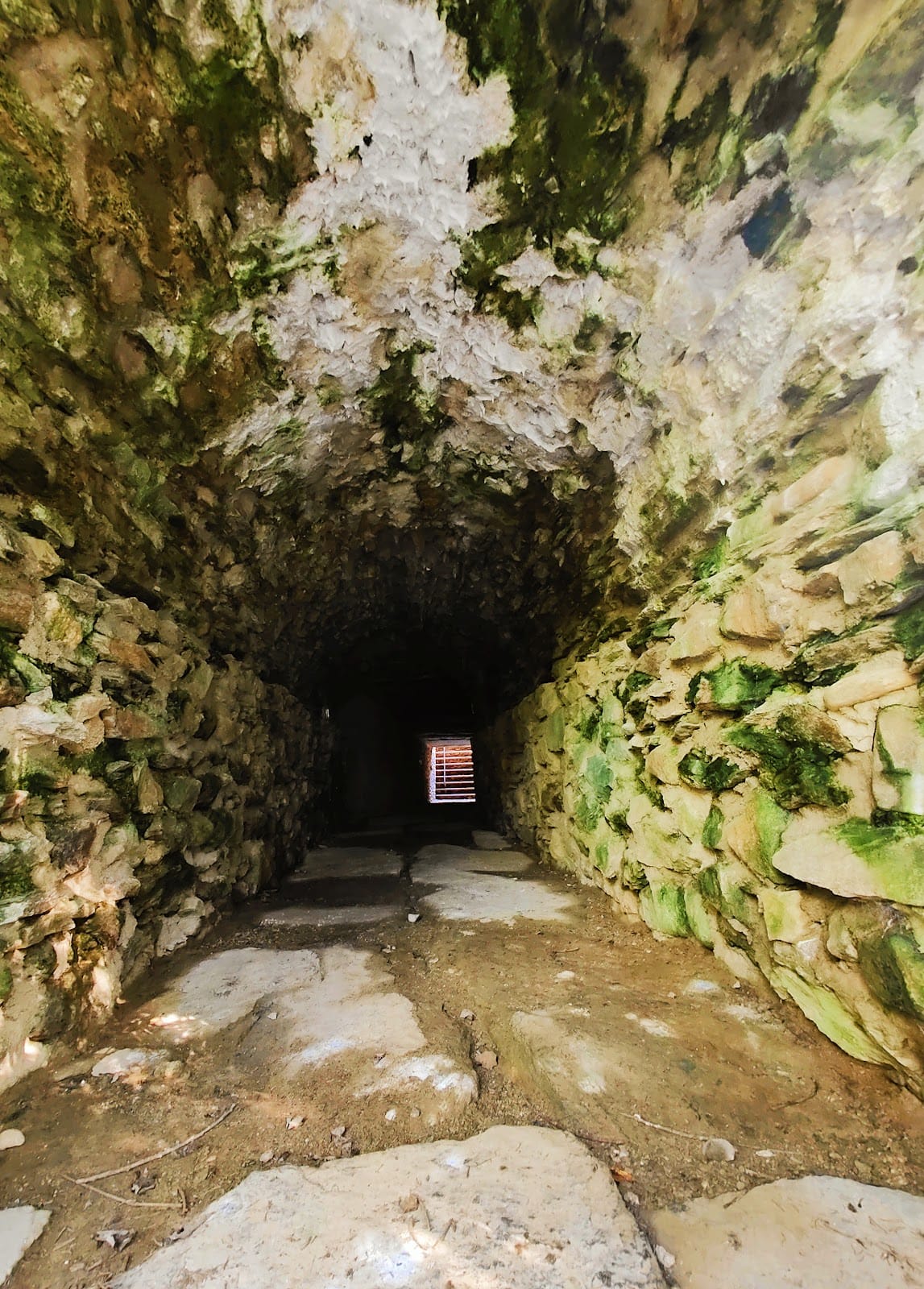
The amphitheatre had served as the setting for the Roman munera, public spectacles that included animal hunts and gladiatorial contests. These events generally began in the morning with hunts and ended with gladiatorial combat. Gladiators entered the arena through an underground passage opposite the Nemeseum, a sanctuary dedicated to Nemesis, the goddess associated with fate, retribution, and the regulation of fortune.
Excavation and restoration
Investigations at Virunum began in the second half of the 18th century and continued into the early 19th century, although the first records were limited. More systematic excavation took place from the late 19th century until 1931. Work resumed at the end of the 20th century and eventually led to the excavation of the amphitheatre. It is the only building at Virunum that has been restored and made accessible to the public.
Remains
The amphitheatre complex
Arena and seating
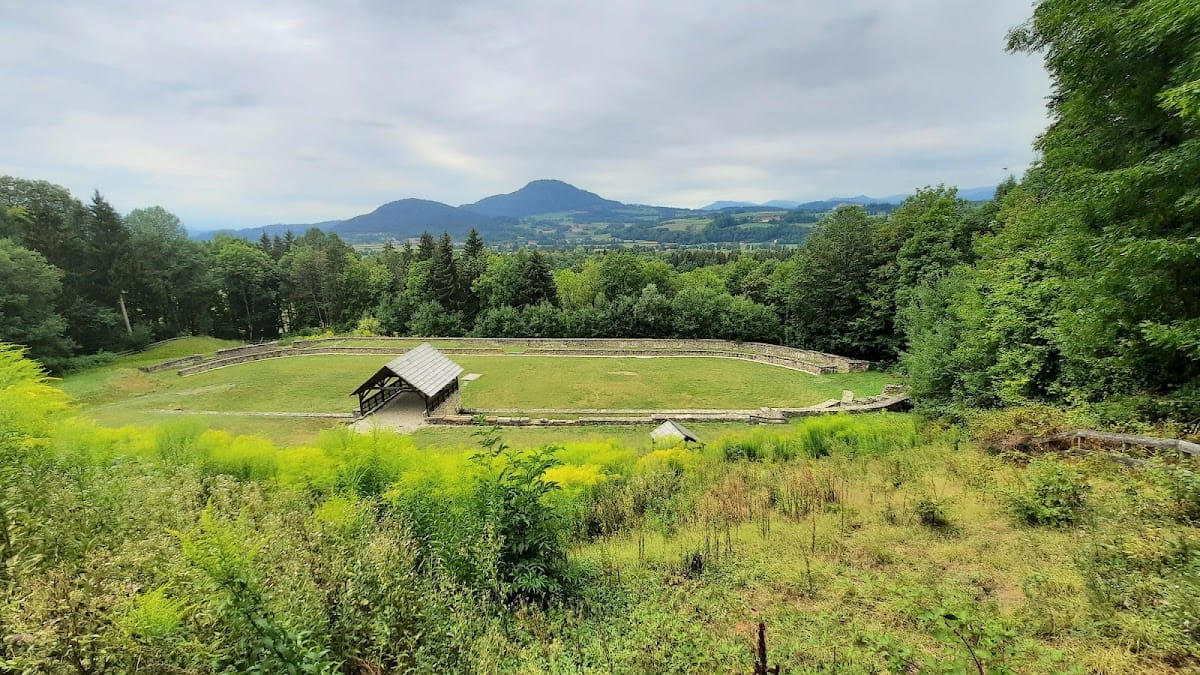
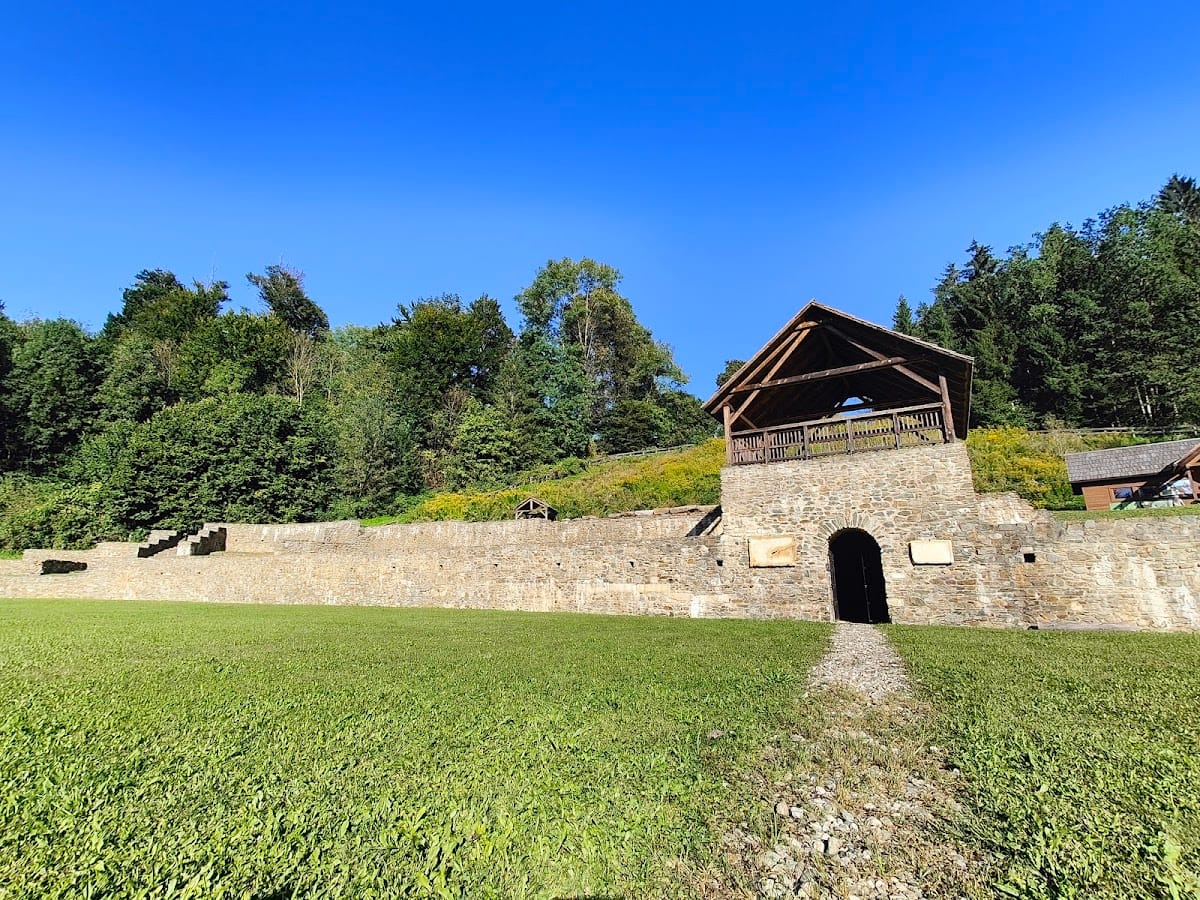
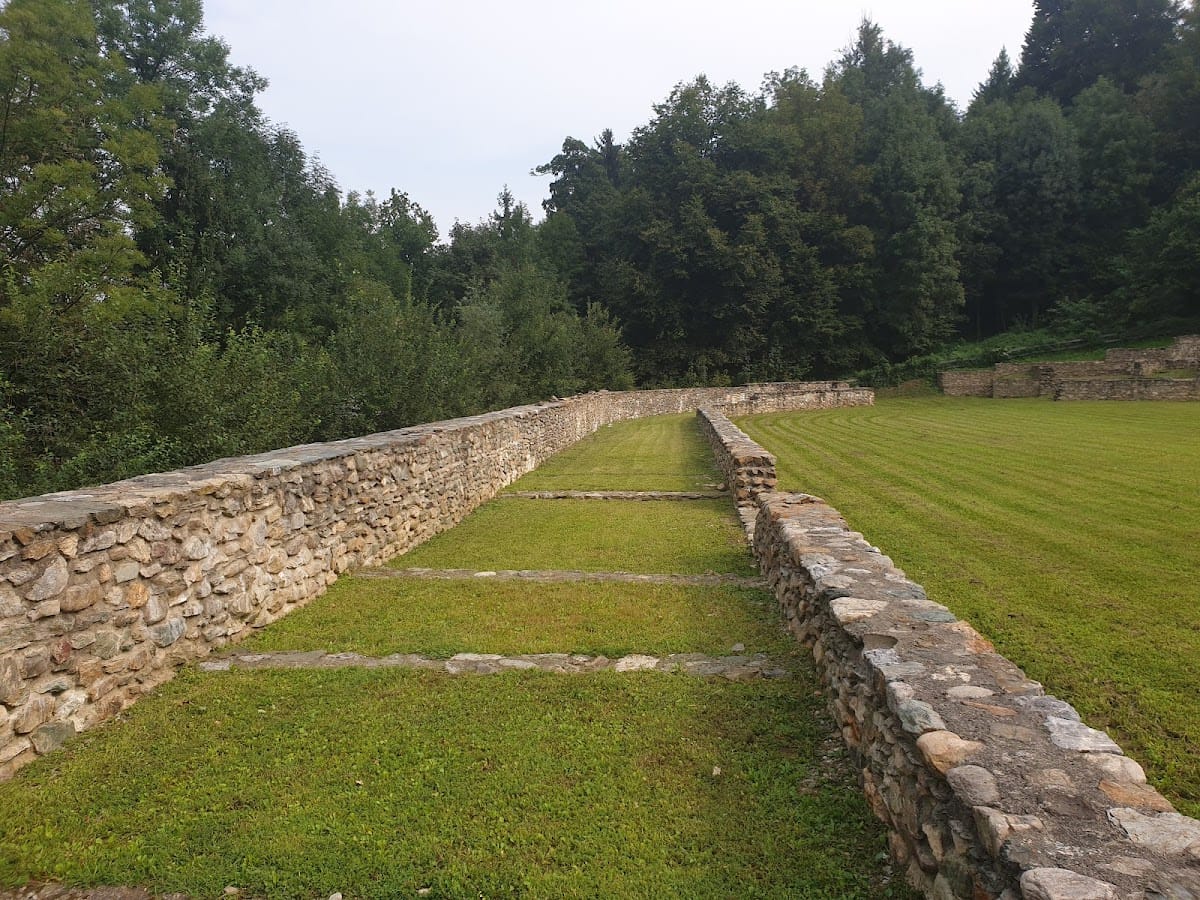
The amphitheatre is an elongated oval structure on the slope of Töltschach Hill. It stands on an artificial terrace measuring about 120 by 50 metres, created through ancient levelling works. The building combined masonry with timber construction. An arena approximately 100 metres long and 30 metres wide was enclosed by two concentric stone wall rings.
Wooden seating tiers occupied the space between the two masonry rings. Seven rows could hold about 3,500 to 4,000 spectators. This arrangement connected the large central arena with a substantial timber-built viewing area while retaining the stone walls that defined the building’s oval form.
Underground passage
An underground passage led into the centre of the arena from the side opposite the Nemeseum. It provided the entrance used by gladiators during the games, and the passage survives as a walkable element of the restored amphitheatre.
Nemeseum
The Nemeseum stood directly opposite the gladiators’ entrance. Renovation inscriptions, votive altars, and reliefs showing animal-combat scenes are displayed there. Two votive relief plaques connected with a temple of Nemesis near the amphitheatre were discovered in 1999. Together, these remains link the arena’s spectacles with the religious setting associated with Nemesis.
Urban remains of Virunum
Street grid and civic centre
Excavation and aerial photography allow much of Virunum’s urban plan to be reconstructed. The city followed a regular grid of streets, with residential blocks, a central forum, a Capitolium, a theatre, and the amphitheatre. It covered about one square kilometre, and its principal axis ran from south-southwest to north-northeast. Excavations along this axis exposed the forum, the Capitolium, and two adjoining blocks.
The largely unbuilt ancient urban area remains an important archaeological source for the history of Carinthia. Its surviving layout preserves the relationship between the city’s civic spaces, residential areas, religious buildings, and entertainment venues.
Religious and infrastructural remains
Finds from the wider city include a nearly 30-square-metre mosaic depicting Dionysus, a sewage system, lead pipes, and public water points. Excavated sanctuaries include a Dolichenum dedicated to Jupiter Dolichenus, a Roman military deity particularly associated with soldiers. Inscriptions also attest two Mithraea, sanctuaries used by communities devoted to the mystery cult of Mithras.
Theatre and governor’s palace
A Roman theatre on the slope of Töltschach Hill is regarded as the only known theatre in Noricum. Farther east, a large building is believed to have been the palace of the provincial governor, although that identification remains interpretive.