Zamoyski Palace: A Historic Palace and University Complex in Warsaw


Site at a Glance
- Rating
- 4.4
- Popularity
- Very Low
- Country
- Poland
- Primary era
- Early Modern
- Eras represented
- Early Modern, Modern
- Civilizations
- Polish–Lithuanian Commonwealth, Russian
- Site type
- Civic
- Remains
- Palace
On this page9 sections
History
Zamoyski Palace is a complex of two connected buildings in Warsaw, Poland, developed from a seventeenth-century residence into a Neo-Renaissance palace-like tenement and office building. Its history reflects the changing political and urban role of Nowy Świat, from aristocratic property to government offices, wartime headquarters, and a University of Warsaw complex.
From Wielopolski residence to aristocratic palace
The property belonged to Jan Wielopolski from 1667. He soon built a palace and established a garden around it, although a masonry manor already stood on a set-back part of the plot before 1665. In 1744–1745, Wielopolski’s heirs commissioned a reconstruction designed by Piotr Hiż. The property later passed to Franciszek Ksawery Branicki, who ordered further renovation from Szymon Bogumił Zug.
Anna Sapieżyna, born Zamoyska, acquired the palace in 1802. The Polish clergyman, philosopher, writer, and statesman Stanisław Staszic lived there and died in the building in 1826. In the late 1830s, ownership passed to Andrzej Artur Zamoyski.
The nineteenth-century rebuilding and the 1863 attack
Between 1843 and 1846, Zamoyski rebuilt and enlarged the property as a prestigious income-producing tenement and office building rather than as his private residence. Storage and commercial premises occupied the ground floor. The rebuilding gave the complex its Neo-Renaissance character, reviving forms associated with Renaissance architecture, and used Rome’s Palazzo della Cancelleria as its stylistic model.
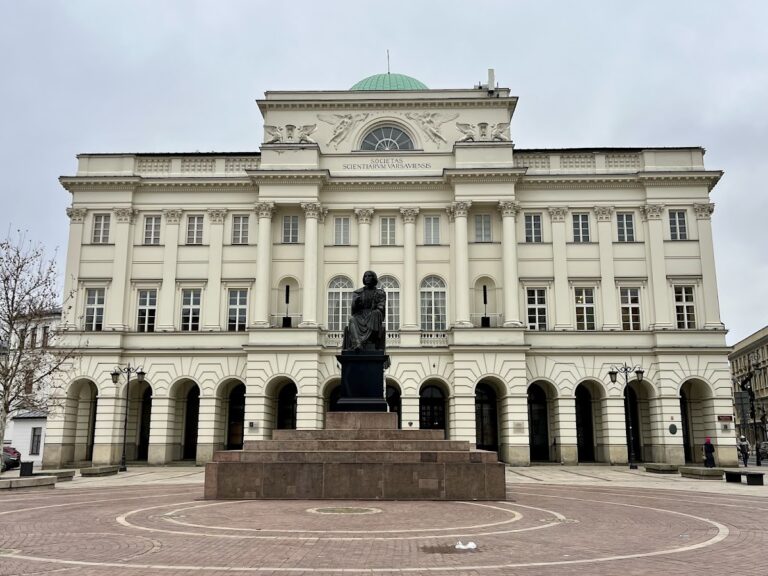
On 19 September 1863, during the January Uprising, the major Polish insurrection against Russian rule that began that year, members of the National Gendarmerie threw bombs from a palace window at the carriage of Fiodor Berg as it passed along Nowy Świat. Berg, the Russian governor of Congress Poland and a senior representative of imperial authority in Warsaw, survived. Russian troops retaliated by looting the palace, throwing residents’ possessions into the street, carrying them to the nearby monument to Nicolaus Copernicus, and burning them.
The apartment of Izabela Barcińska, Frédéric Chopin’s sister, was ransacked during the reprisals. Chopin’s piano was thrown from a window and destroyed, an event later evoked in Cyprian Kamil Norwid’s poem Chopin’s Piano. A valuable library and printing-ready works belonging to the Orientalist Józef Szczepan Kowalewski, who lived in the building, were also destroyed.
Government, military, and wartime uses
Russian authorities confiscated the palace in 1863 and converted it into a government building. From 1867, it housed the Directorate of Engineering of the Warsaw Military District, along with other Russian military offices, an officers’ casino, and the Warsaw Military Court. During the interwar period, number 69 accommodated the Ministry of the Interior, while number 67 housed the Main Headquarters of the State Police.
From 8 to 17 September 1939, during the defence of Warsaw, number 69 served as the headquarters of the Warsaw Defence Command. The headquarters moved on 17 September to the PKO Central Office building at the intersection of Marszałkowska and Świętokrzyska Streets.
Luftwaffe air raids damaged the palace in 1939, and the Warsaw Uprising of 1944 caused further destruction. The building functioned as a fortified German centre of resistance until insurgents captured it on 23 August 1944. Approximately 90 percent of the palace was destroyed during the fighting.
Reconstruction and university use
The palace was reconstructed in 1948–1950 to designs by Mieczysław Kuźma under the direction of Zygmunt Stępiński, with alterations to its pre-war form. It was entered in the heritage register under number 362 on 1 July 1965. The complex now contains offices and teaching spaces of the University of Warsaw, including the Faculty of Political Science and International Studies, the Institute of Applied Social Sciences, the Faculty of Journalism, Information and Book Studies, and the Faculty of Artes Liberales. The university’s language school and other departments also occupy parts of the complex.
Memorial plaques installed in 2001 commemorate Cyprian Kamil Norwid and the destruction of Chopin’s piano. A sandstone plaque installed in 1950 recalls the building’s use as the headquarters of the Warsaw Defence Command in September 1939.
Remains
Plan and setting
Zamoyski Palace occupies the narrowing of Warsaw’s historic Royal Route at the transition from Krakowskie Przedmieście to Nowy Świat. Its elongated northern section borders a small square containing the monument to Nicolaus Copernicus, while the southern section faces the western side façade of Staszic Palace.
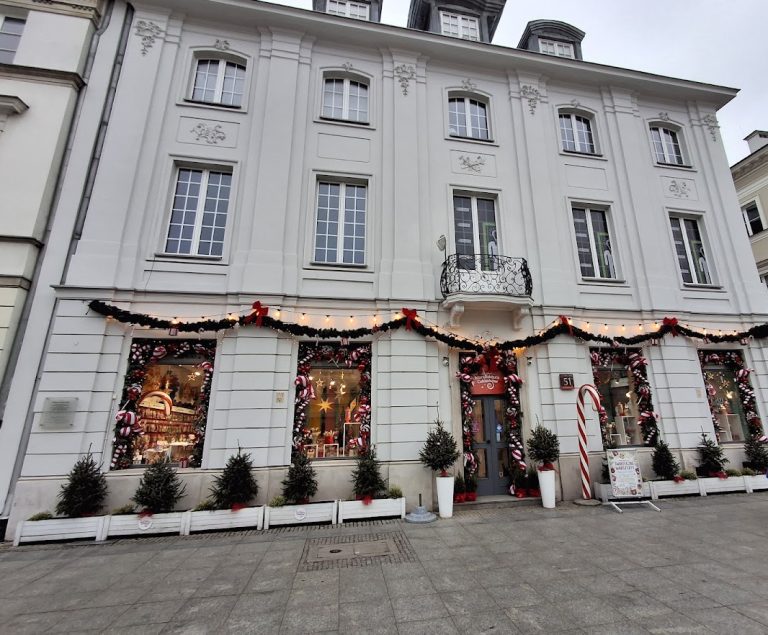
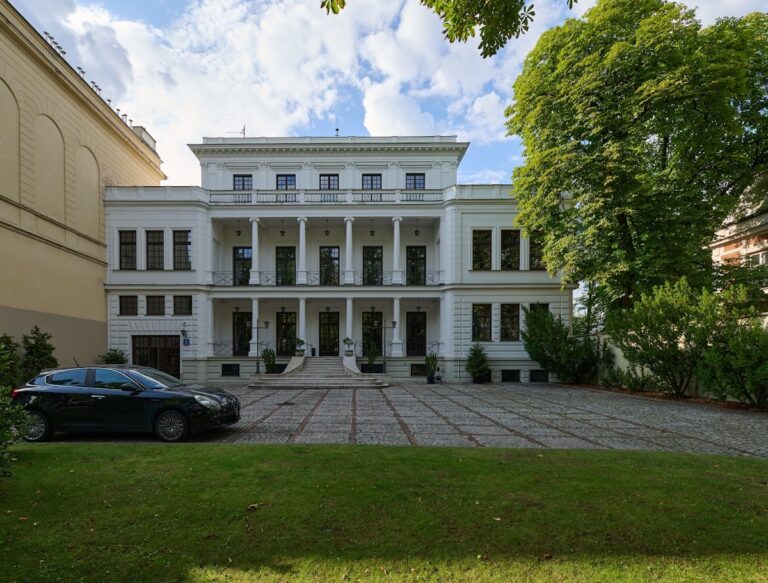
The complex consists of two connected five-storey buildings. The principal building is approximately rectangular and about 100 metres long, with projecting side sections and a projecting central section. The earlier residence developed around a formal courtyard opening toward Nowy Świat and was associated with a garden established around the original palace.
Neo-Renaissance façade
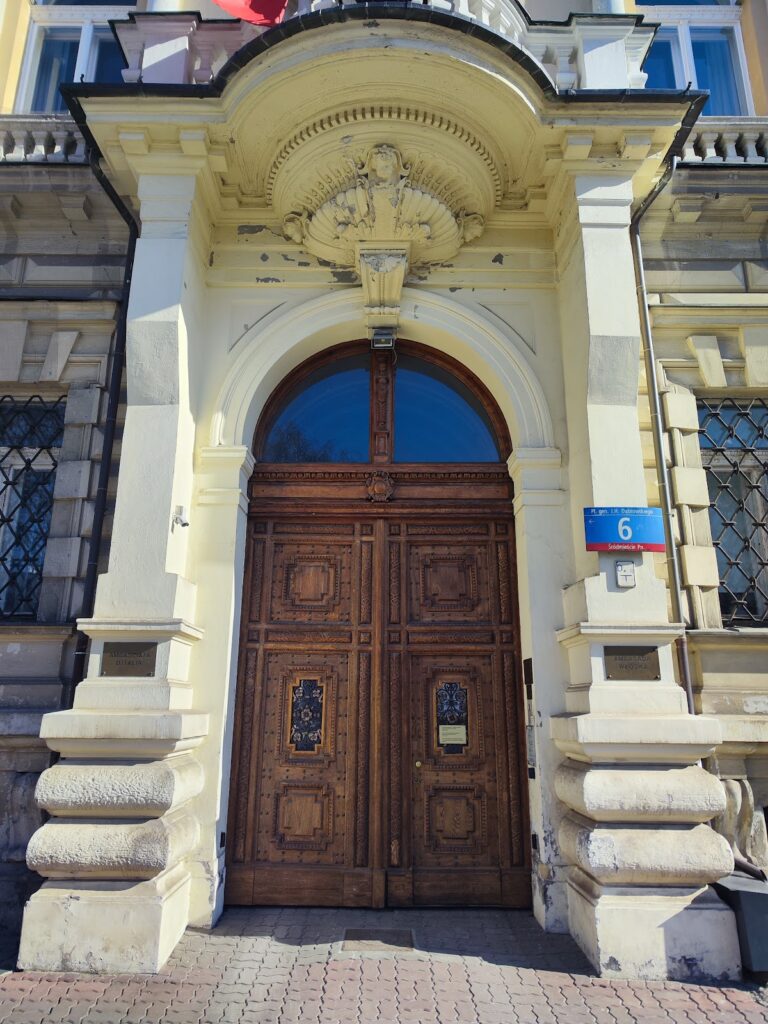
The 1843–1846 rebuilding created a large palace-like tenement and office building in the Neo-Renaissance style. Its façade is dominated by a triangular pediment, or tympanum, the framed field above a classical façade, decorated with reliefs by the Polish sculptor Paweł Maliński.
Maliński’s sculptural programme uses mythological allegories for the activities associated with the building’s commercial and urban character. Minerva represents industry, Ceres agriculture, Mercury trade, and Jason wealth. Navigation is represented by personifications of the Vistula and Bug rivers.
Postwar appearance and memorials
The reconstruction of 1948–1950 changed the building’s appearance. The balconies at second-storey level were not restored, and the windows were given a more Classical appearance. These alterations form part of the surviving postwar architectural fabric of the complex.
The sandstone plaque installed in 1950 commemorates the Warsaw Defence Command’s occupation of number 69 in September 1939. The two plaques added in 2001 preserve the memory of Norwid and the destruction of Chopin’s piano within the palace’s later commemorative landscape.
Nearby sites