Gross Wohnsdorf Castle: A Teutonic Order Stronghold in Russia


Site at a Glance
- Rating
- 4.3
- Popularity
- Very Low
- Country
- Russia
- Primary era
- Medieval
- Eras represented
- Medieval, Early Modern, Modern
- Civilizations
- Kingdom of Prussia, Teutonic Order
- Site type
- Military
- Remains
- Castle
On this page7 sections
History
Gross Wohnsdorf Castle is a former Teutonic Order stronghold in Russia, located at present-day Kurortnoye in Kaliningrad Oblast. The medieval complex developed on the site of an earlier Prussian hillfort above the Alle River, known as the Lawa in Russian. The Teutonic Order, a medieval Catholic military-religious order that governed fortified territories in the eastern Baltic, stormed the hillfort in 1255 and established a hunting lodge there.
Wooden Fortification and Stone Reconstruction
A wooden-and-earth castle was built during the thirteenth century. Lithuanian forces destroyed it in 1319, but it was rebuilt the following year. They captured and burned it again in 1347, prompting the Teutonic Order to replace the wooden defenses with stone.
Gross Wohnsdorf became a Kammeramt in 1348, an administrative district within the Teutonic Order’s territorial system, under the commandery at Insterburg. Stone construction began in 1356 and was completed around 1372. The defensive complex was rebuilt again in 1391 because the earlier defenses were considered insufficiently resistant. The gate tower dates from the beginning of the stone-building phase.
From Order Stronghold to Private Estate
Grand Master Ludwig von Erlichshausen visited the castle in 1450. In 1468, soon after the Thirteen Years’ War, a conflict between the Teutonic Order and the Polish Crown, financial difficulties led the Order to pledge the castle and its associated lands to Hans von Weyer. The property then became the center of a private estate.
In 1525, Duke Albrecht of Prussia secularized the Teutonic Order’s territory and granted the estate to the nobleman Heyno von Döberitz. Andreas von Flanns received it in 1552. Major reconstruction followed around 1590, including an enlargement of the estate buildings. From 1688 or 1702 until 1945, the property belonged to the von Schrötter family.
The von Schrötter Estate and Later Destruction
Friedrich Leopold von Schrötter, who later became a minister of the Prussian provinces and a member of the state council, was born at the estate and spent part of his youth there, including a period in the gate tower. Immanuel Kant, the eighteenth-century German philosopher, regularly visited the von Schrötter family. Kant and Friedrich Leopold’s father, Friedrich Wilhelm von Schrötter, were associated with philosophical conversations on the tower terrace.
A major fire damaged the castle in 1790. Friedrich Gilly restored the complex and remodeled the gate tower. A more destructive fire in 1830 destroyed the castle buildings. The castle was not rebuilt, and its materials were dismantled for reuse. Stones from the ruins were incorporated into a new estate building erected in 1868–1869 in the park, on the site of the former outer bailey.
After the Second World War, Gross Wohnsdorf and the neighboring estate of Agnesenhof became part of the Soviet Union with northern East Prussia. In 1950, the two settlements received the shared Russian name Kurortnoye. The ruins received regional cultural-heritage status through a resolution of the Government of Kaliningrad Oblast dated March 23, 2007.
Remains
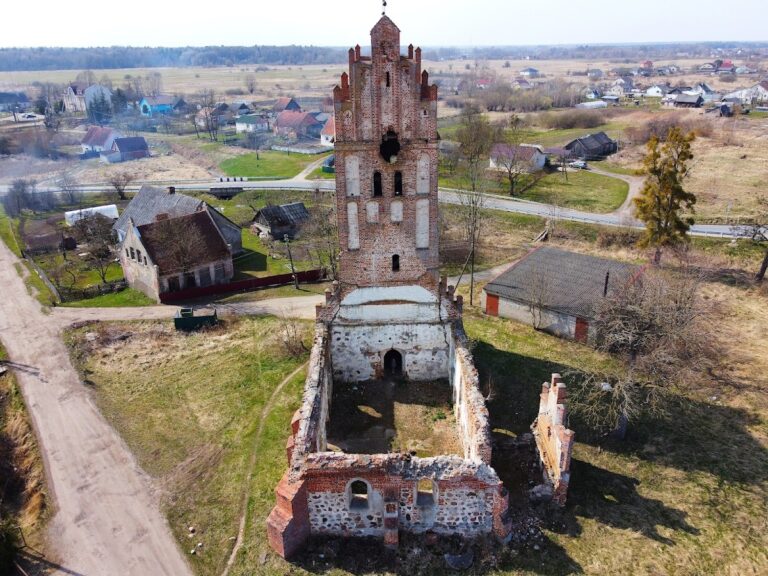
The surviving remains occupy the former stronghold site on a high bank above the Alle River. The original defenses were made from wood and earth before the complex was rebuilt in stone during the mid-fourteenth century. The later castle formed a fortified complex that included a principal entrance tower and an outer bailey, the outer enclosed part of a castle distinct from its main fortified area. The site now survives in a ruined condition.
Surviving Gate Tower
Built in 1356, the gate tower was a fortified structure around the principal entrance to the stone castle. It was remodeled by Friedrich Gilly after the fire of 1790 and is the surviving structure of the former castle. The tower is now a ruin, while its terrace remains associated with the philosophical conversations between Friedrich Wilhelm von Schrötter and Immanuel Kant.
Outer Bailey and Estate Building
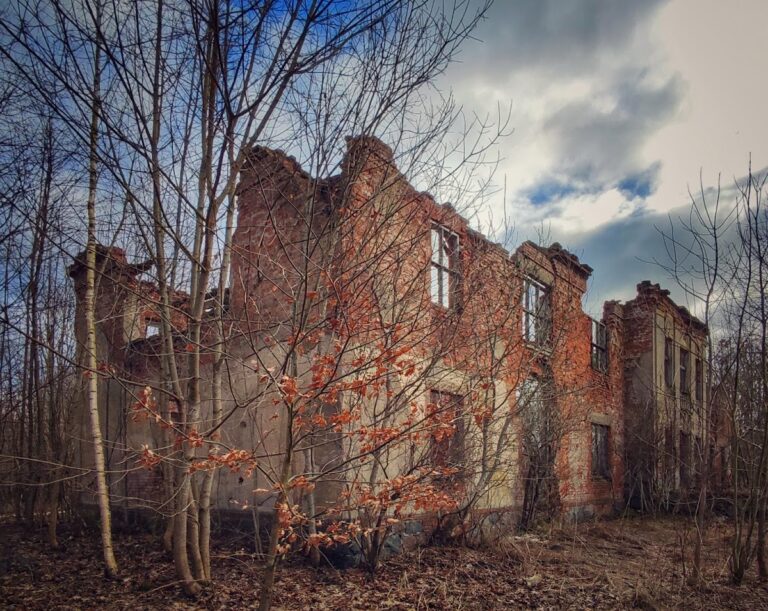
The former outer bailey later became the site of a new estate building erected in the park in 1868–1869. That building incorporated stone taken from the dismantled castle after the 1830 fire, linking the surviving estate landscape with the materials of the earlier fortified complex.
Nearby sites