Rechenburk: A Thirteenth-Century Colonization Castle in Czechia


Site at a Glance
- Rating
- 4.1
- Popularity
- Very Low
- Country
- Czechia
- Primary era
- Medieval
- Eras represented
- Medieval
- Civilizations
- Holy Roman Empire, Kingdom of Bohemia
- Site type
- Military
- Remains
- Castle
On this page8 sections
History
Rechenburk was a short-lived medieval castle in Czechia, established during the second half of the thirteenth century by the Lords of Švábenice. Located in the Trutnov region, it supported the organized expansion of settlement, administration, and economic activity along the border between Bohemia and Silesia.
Foundation and Purpose
The castle was also known as Rechemberk. Its name derived from the personal name Hrabiše. The Lords of Švábenice, a family related to the Hrabišici, were involved in the colonization of the Trutnov region. The Hrabišici were a medieval noble lineage associated with the political and settlement expansion of northern Bohemia.
Rechenburk probably functioned as a power base and support point for this colonization rather than as a permanent residence. A nearby castle on Zámecký vrch near Trutnov probably served a similar purpose and followed a similar construction approach.
Abandonment and Evidence
The castle ceased to exist around the turn of the thirteenth and fourteenth centuries, after the Lords of Švábenice left the Trutnov region. Ceramics recovered during archaeological work in the 1970s confirmed the period in which the castle existed. Two iron nails were also found within the castle area.
Remains
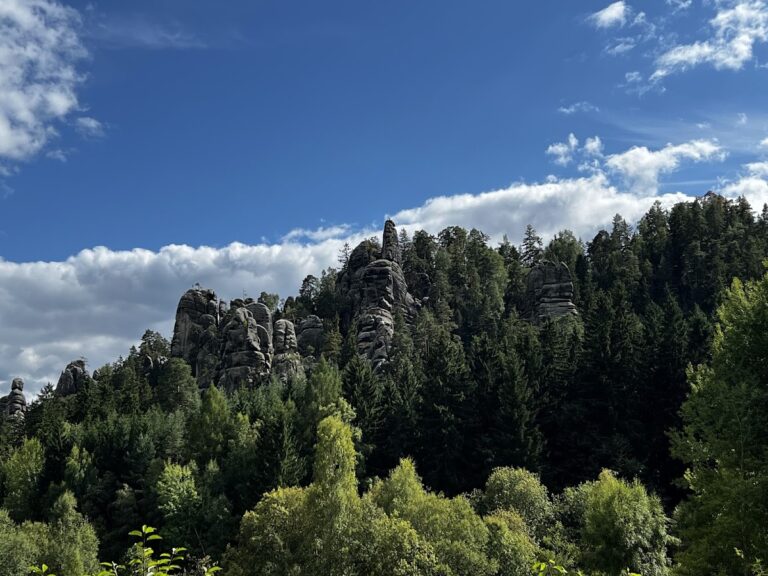
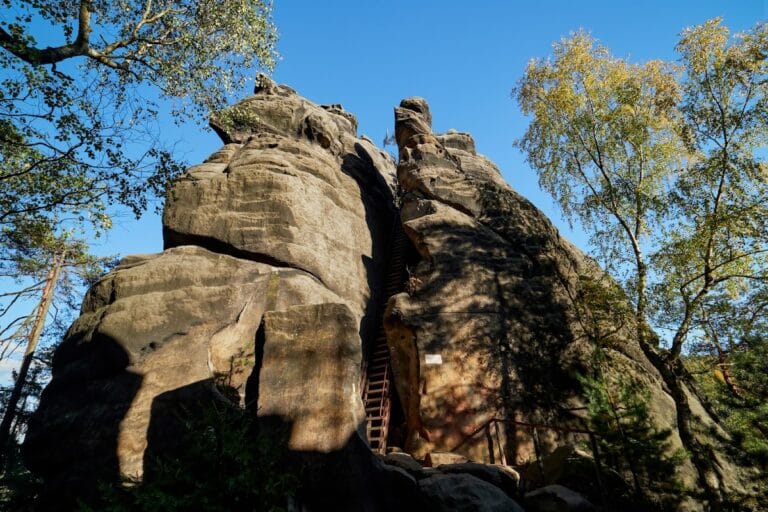
Rechenburk stood on a rocky promontory between Horní Staré Město and Libeč, about 1.5 kilometres west of Libeč. The single-part castle extended for approximately 120 metres and measured between 40 and 60 metres in width. Its accessible southwestern side was protected by three ditches and an earthwork rampart, while the rounded castle core occupied the area behind these defenses.
Fortifications and Castle Core
Defensive Works
The southwestern approach crossed a triple ditch and rampart before reaching the castle core. An additional ditch separated the rear northeastern part of the castle from the core, creating another line of division within the site.
Principal Building and Perimeter Foundation
A building in the castle core stood on a foundation made from stones laid without mortar. Its tower-like form probably made it the principal structure of Rechenburk. Another dry-laid stone foundation followed the perimeter of the castle core.
Water Cistern
A cistern, a constructed reservoir for collecting and storing water, was cut into the bedrock in the inner ditch. Its position formed part of the castle’s internal arrangement and provided a built water-storage feature within the defended area.