Castell de Vallmoll: A Medieval Castle in Tarragona, Spain


Site at a Glance
- Rating
- 4.1
- Popularity
- Very Low
- Country
- Spain
- Primary era
- Medieval
- External website
- Open
- Eras represented
- Medieval
- Civilizations
- Unclassified
- Site type
- Military
- Remains
- Castle
On this page7 sections
History
Castell de Vallmoll is a medieval castle in Vallmoll, Spain, whose origins date to the eleventh century during the Christian Reconquista, the long expansion of Christian rule across the Iberian Peninsula. The castle and the surrounding territory first belonged to the Castellvell family and later passed to the Montcada family.
Castellvell, Montcada, and the religious orders
Vallmoll is first mentioned in 1153, when Guillem IV de Castellvell granted the Malgraneda estate in its territory. In 1176, Guillem V de Castellvell, lord of Vallmoll, left his lordship there to the Order of the Temple, a religious-military order founded to protect pilgrims and Christian interests in the eastern Mediterranean. The bequest extended from the land of Ponç de Fonollar to the Francolí River.
By the end of the twelfth century, the Hospitallers had established a commandery at Vallmoll. A commandery was an administrative estate or jurisdiction belonging to a religious-military order. This development produced conflicts between the Hospitallers and the Castellvell-Montcada family, although the family continued to hold Vallmoll and its castle.
Royal transfer and the County of Cardona
In 1291, Guillema de Montcada brought the castle among her properties as a dowry when she married Prince Pere, the brother of James II, a medieval king of the Crown of Aragon. In 1300, she transferred the Montcada and Castellvell baronies, including Vallmoll, to James II while retaining lifelong usufruct, meaning the right to use and benefit from the property during her lifetime.
From the fourteenth through the sixteenth centuries, Vallmoll and its castle were held by the Cardona family. When King Peter III created the County of Cardona in 1375, Vallmoll Castle became part of its possessions within the Tarragona vegueria. A vegueria was a territorial district administered by a royal official called a veguer.
Later noble ownership
Vallmoll subsequently passed through several lordly families. In 1420, Gregori de Burguès held the Barony of Vallmoll, which included Vallmoll, Bràfim, and Nulles. Around 1562, the barony passed by marriage to the Pacs, Barons of Brunyolí. At the end of the sixteenth century, it passed to the Boixadors, Counts of Savallà.
The Counts of Peralada lived in the castle during the seventeenth, eighteenth, and nineteenth centuries. At the beginning of the nineteenth century, ownership belonged to the Dameto family, Marquises of Bellpuig. In 1922, the Marquis of la Torre sold the castle to Josep Orga. Around the 1940s, Orga sold it to the municipality of Vallmoll for 10,000 pesetas, making the municipality its last owner.
Heritage protection
Castell de Vallmoll is protected as a Cultural Asset of National Interest and as a historical monument in the Catalan and Spanish heritage registers, under reference RI-51-0006770. It appeared on the Red List of endangered heritage sites from 2007 to 2009. Restoration is in progress.
Remains
Enclosure and towers
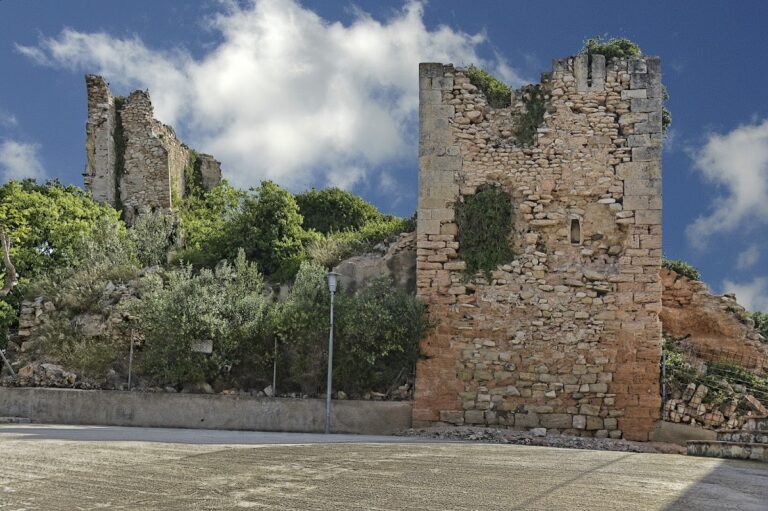
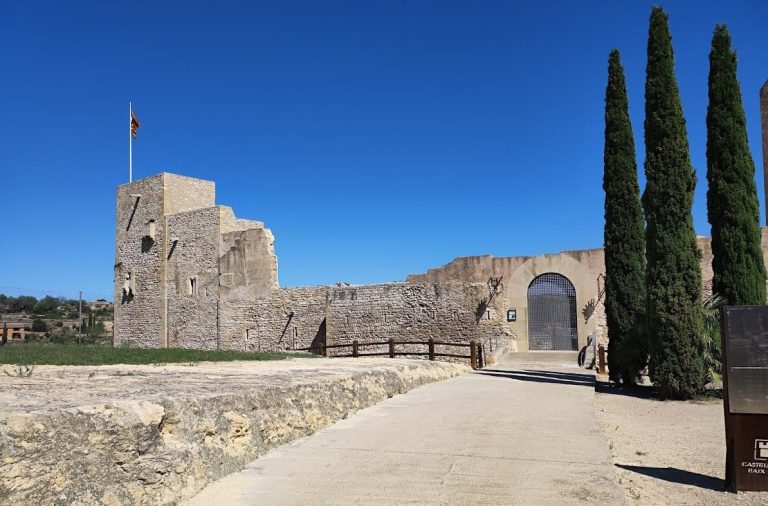
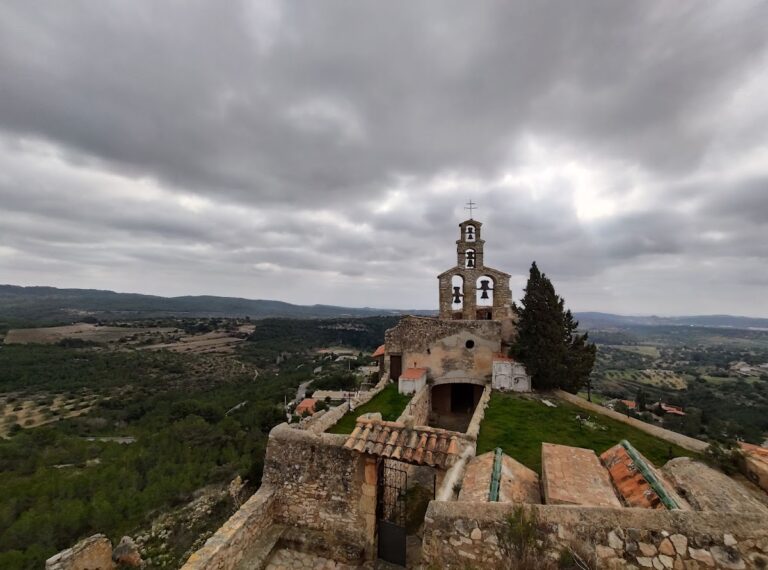
Castell de Vallmoll stands beside the urban fabric and overlooks the oldest group of houses in the upper part of Vallmoll. Its surviving fabric includes the perimeter enclosure and parts of the towers that once flanked it. The castle plan is rectangular, as are the plans of the towers. The complex is in an almost ruinous condition, but superimposed elements from different periods and architectural styles remain visible, reflecting its long history of alteration.
One tower has an attached feature containing two arches, one raised and the other semicircular. Its function is difficult to determine because the complex is in a precarious state of conservation. The area immediately around the castle on the Carrer Major side has recently been urbanized.