Laubeck Castle: A Medieval Fortified Castle in France


Site at a Glance
- Rating
- 4.4
- Popularity
- Very Low
- Country
- France
- Primary era
- Medieval
- Eras represented
- Medieval
- Civilizations
- Holy Roman Empire
- Site type
- Military
- Remains
- Castle
On this page7 sections
History
Foundation and Family Conflict
Laubeck Castle is a ruined medieval fortified castle in Pfaffenheim, France. It was founded during the thirteenth century, possibly around the middle of the century, by the Laubgassen family. By the end of that century, ownership had been divided among several members of the family, and their inability to agree soon developed into open conflict.
A chronicle produced by the Dominican Order, a Catholic religious order whose members recorded medieval events, states that a man named Cesso occupied the castle illegally in 1294. His relationship with the Laubgassen family is unknown. In 1302, the bishop of Strasbourg imposed a castral peace, a medieval agreement intended to end disputes between rival claimants to a castle or lordship.
Destruction and Abandonment
The agreement did not resolve the dispute. In 1315, the bishop of Strasbourg seized Laubeck Castle by force, destroyed it, and imprisoned several members of the Laubgassen family at Girbaden Castle. After its destruction, the castle was abandoned and was not rebuilt.
Remains
Mountain Setting and Defensive Layout
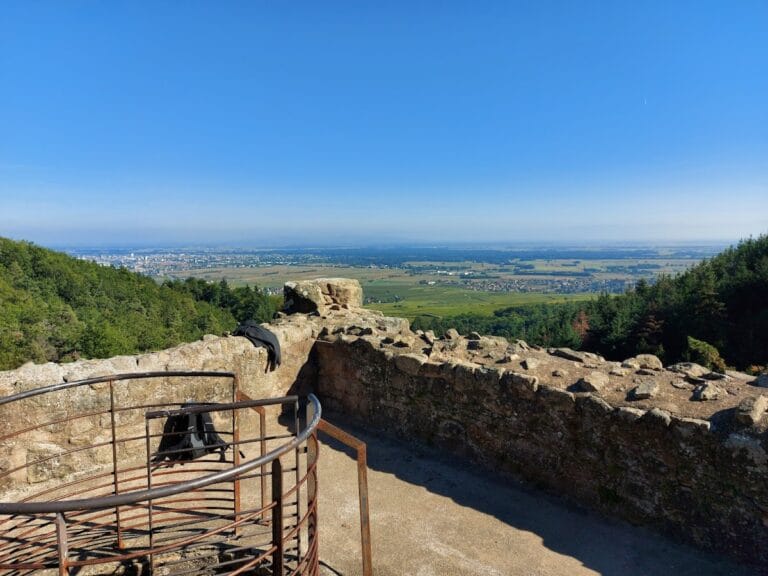
Laubeck Castle stood on Laubeck mountain between Soultzbach-les-Bains and Wasserbourg, on the right bank of the Krebsbach in a side valley of the Munster valley. Its position overlooked the castles of Schrankenfels and Haneck across the Ammelthal valley, about one kilometre to the northeast, and Wassenberg Castle, about three kilometres to the southwest. The site also controlled the Wolfsgrube Pass, an approach to the Alsatian plain through Gueberschwihr and Pfaffenheim.
Keep and Residential Building
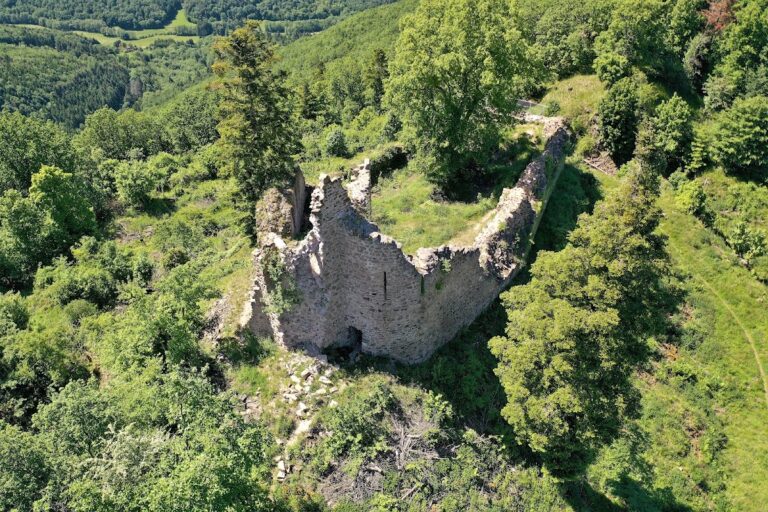
The castle appears to have been arranged around a large circular keep set on a rock, with a residential building attached to it. The rock believed to have supported the keep survives as one of the principal visible features of the site.
Ditches and Enclosing Wall
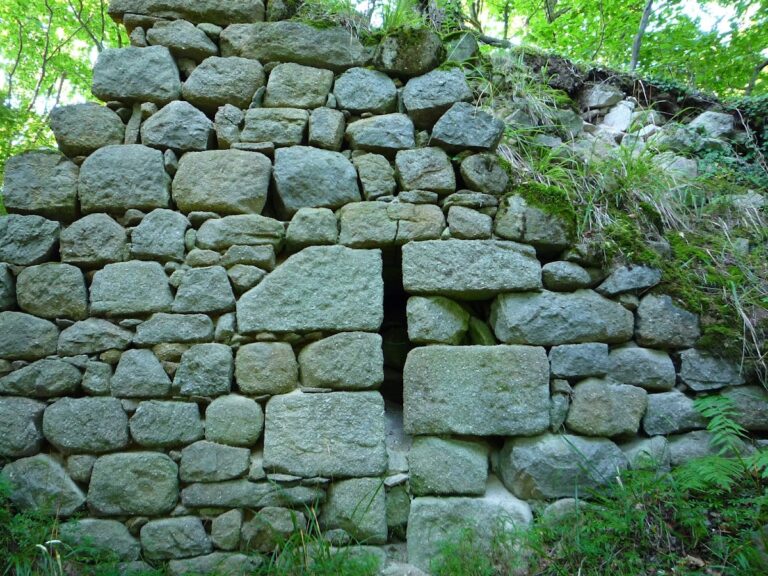
Two ditches and an enclosing wall surrounded the castle complex. A fragment of that wall remains, providing physical evidence of the defensive boundary that once encircled the keep and residential building. The destruction carried out by the troops of the bishop of Strasbourg shaped the fragmentary condition of the surviving remains.
Nearby sites