São Pedro Fort: A Portuguese Coastal Defence Fort in Biscoitos


Site at a Glance
- Rating
- 4
- Popularity
- Very Low
- Country
- Portugal
- Primary era
- Early Modern
- Eras represented
- Early Modern
- Civilizations
- Portuguese
- Site type
- Military
- Remains
- Fort
On this page7 sections
History
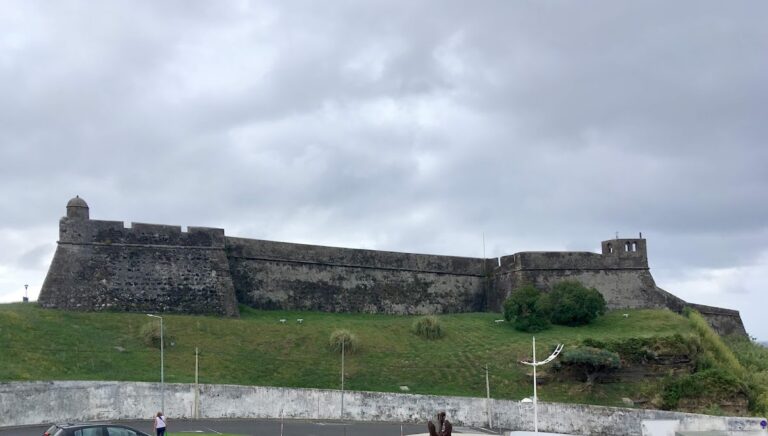
São Pedro Fort is a Portuguese coastal fort in Biscoitos, Portugal, built around 1520 during the Age of Discovery, the period of Portuguese and European maritime exploration and overseas expansion. Pedro Anes do Canto, the “Provider of Fortifications,” constructed it to defend the anchorage at Biscoitos, which served both his lands and Portuguese ships. The fort took its name from him and protected the bay against pirates and privateers, privately operated armed vessels authorised by governments to attack enemy shipping.
Early defence of Biscoitos Bay
São Pedro Fort formed part of the coastal defences of Terceira Island. Its guns could exchange fire with Rua Longa Fort to the east, helping protect the anchorage and the approaches to Biscoitos Bay. The fort appears to have been rebuilt between 1579 and 1581, although precise evidence for this phase is lacking. The work was probably ordered by Ciprião de Figueiredo e Vasconcelos, the magistrate of the Azores, during the Portuguese succession crisis and formed part of Terceira’s wider defensive plan.
Conflict and later military use
In 1828, during the Portuguese Civil War of 1828–1834, São Pedro Fort was reinforced and occupied by a troop detachment. The war opposed absolutists, who supported traditional royal authority, to liberal constitutionalists, who supported constitutional government. The detachment was intended to prevent a possible landing by absolutist forces opposing the liberal constitutionalist regime supported by Terceira. After the conflict, the fort was left unguarded.
Minor repairs followed in 1862, when the area was regarded as the most promising landing site for enemy forces on Terceira’s north coast. By 1881, the fort was reported as abandoned and partly ruined, while its garrison house was occupied by a fisherman. During the Second World War, the site gained another military role through the installation of a machine-gun emplacement. Its surviving remains are now preserved through the initiative of the Biscoitos Parish Council.
Remains
Fortifications and associated buildings
Irregular pentagonal fort
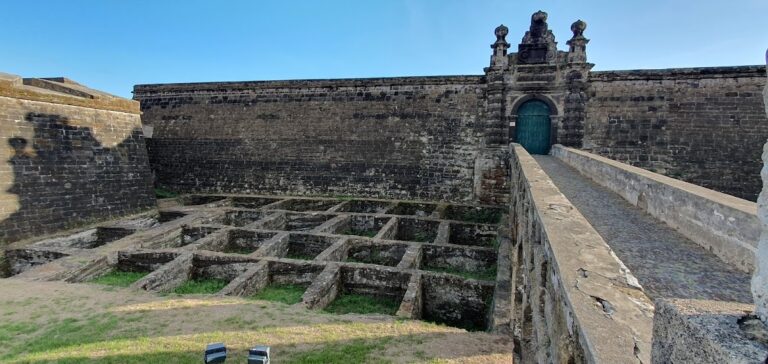
São Pedro Fort stands on the north coast of Terceira Island, in Biscoitos in the municipality of Praia da Vitória. A plan prepared by Damião Pego in 1881 shows an irregular pentagonal enclosure. The outer walls are built of stone and contain three gun emplacements. The fort is partly preserved, retaining the basic outline of its fortified area and elements connected with its coastal artillery function.
Garrison house
A separate garrison house stood outside the fortified enclosure. It was built of masonry and covered by a thatched roof. By 1881, this building was occupied by a fisherman, reflecting the fort’s abandoned condition at that time. The house formed an associated part of the military site rather than part of the pentagonal defensive walls.
Nearby sites