Fort of São João Baptista of Praia Formosa: A Portuguese Maritime Defence


Site at a Glance
- Rating
- 3.9
- Popularity
- Very Low
- Country
- Portugal
- Primary era
- Early Modern
- Eras represented
- Early Modern
- Civilizations
- Spanish
- Site type
- Military
- Remains
- Fort
On this page6 sections
History
The Fort of São João Baptista of Praia Formosa is a ruined sixteenth-century Portuguese maritime fort in Almagreira, Portugal, built to defend the anchorage at Praia Formosa during the Age of Discovery, the period of European maritime expansion from the fifteenth through the seventeenth centuries. Also called Castelo da Praia, it protected the southern coast of Santa Maria from pirates and privateers using the Atlantic routes.
Early references and the need for defence
The beach was called “Plaia Hermosa” in 1584, when the island was under Spanish dominion. In 1587, the Portuguese cartographer Luís Teixeira described the area as part of the parish of Figueira, whose small population numbered little more than 40 people before the fort was constructed. The fort is commonly identified as a sixteenth-century work, although twentieth-century archaeological campaigns did not conclusively establish that it was among the oldest forts in the Azores.
Local inhabitants had requested defensive works since an English privateer attack on the beachhead in 1599. The danger became more immediate in June 1616, when Algerian Barbary pirates, maritime raiders operating from the North African coast, used Praia Formosa during an assault that caused major damage to Vila do Porto. In 1617, Pedro Soares de Sousa, the island’s third Donatary-Captain, a Crown-appointed lord responsible for administration, settlement, and defence, appealed directly to Philip III of Spain.
Construction and military administration
Measures to strengthen the island’s defences began in 1618. Marcos Fernandes de Teive had been sent to the islands by royal order in 1617 to design and begin new battlements and reorganize the militia. The fort’s construction proceeded slowly, and its architect or builder is not identified. Sergeant-major Marco de Teive, who visited the archipelago in 1630, has been associated with the work, but that connection remains speculative.
Financial support was arranged in 1624, when Philip IV of Spain granted Brás Soares de Sousa command of Santa Maria through the Order of Christ, a Portuguese military-religious order that inherited functions and properties from the Knights Templar. For five years, the island command’s land rents were to be devoted to fortifications. The funds were to be held separately and spent under the authority of the Finance Council, returning to church repairs only after the public works were complete.
In 1638, the town hall stated that a fortification on the island had been started but was still unfinished. During the Restoration Wars of 1640–1668, when Portugal defended its restored independence from the Spanish monarchy, the Crown supplied funds for the defence of Praia Formosa because Vila do Porto’s civil authorities faced difficult circumstances. Even the installation of artillery remained unresolved for years. Although the king ordered it in 1655, the matter had still not been settled by 1664.
Responsibility for the site continued to appear in local military administration. On 6 August 1683, Vicente Pires Ferreira was appointed constable for the castles and redoubts after his father’s death, including responsibility for the beach of São João and its fortifications.
Decline and archaeological attention
Figueiredo recorded the bay of Praia and its fortifications in 1815. By 1862, Field Marshal Baron of Bastos described the castle as having a high barracks and a kitchen, but already being in a state of ruin. Ferreira again described the fort’s ruined condition in 1997 and identified it as a sixteenth-century fort. Technical studies later examined ways to recover the structure, which was then in an advanced state of degradation, while its lack of legal registration or classification limited its formal protection.
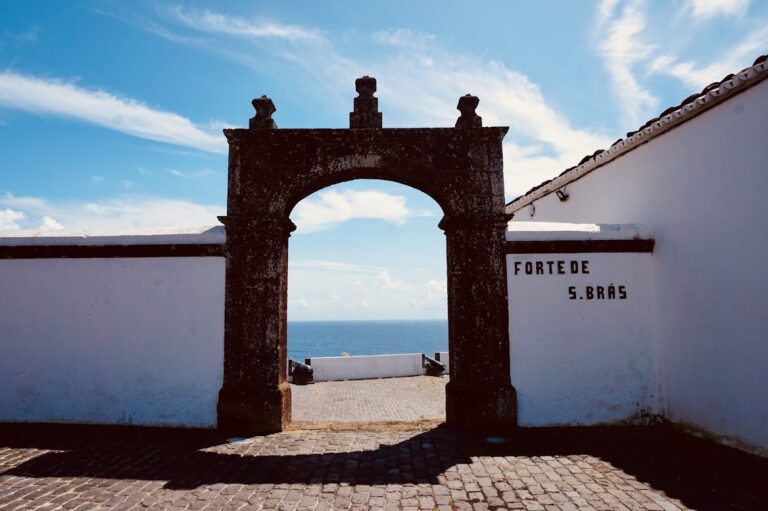
By the end of the twentieth century, two artillery pieces remained on the abandoned battlements beside the ruined fort. The municipality planned to recover them and transfer them to the Museum of Santo Espírito, but their arrival there has not been established. They may instead have been added to the group at the Fort of São Brás in Vila do Porto. A storm on 27–28 September 2011 brought winds exceeding 85 kilometres per hour, heavy rain, and waves along Santa Maria’s southern coast. Landslides affected the fort and the adjacent ravine, accelerating the deterioration of the remaining structure.
Remains
The Fort of São João Baptista is a ruined basalt defensive work on the western edge of Praia Formosa, at the mouth of the Ribeira da Praia on Santa Maria’s southern coast. Its position at the anchorage gave it a direct defensive purpose, while its remaining battlements preserve the character of a small maritime fortification. The structure is in an advanced and continuing state of degradation, and landslides linked to the 2011 storm affected both the surviving fabric and the neighbouring ravine.
Fortification and surviving structures
The remaining fort is built of basalt and includes abandoned battlements. The two artillery pieces that stood beside the ruin near the end of the twentieth century formed part of the visible defensive setting, although their later whereabouts are uncertain. The high barracks and kitchen mentioned in 1862 indicate the practical facilities once contained within the castle. The surviving masonry and battlements now form the principal physical evidence of the fort’s defensive role and prolonged decline.