Burgruine Leonstein: Medieval Castle Ruins in Austria


Site at a Glance
- Rating
- 4.4
- Popularity
- Very Low
- Country
- Austria
- Primary era
- Medieval
- Eras represented
- Medieval, Early Modern
- Civilizations
- Holy Roman Empire
- Site type
- Military
- Remains
- Castle
On this page10 sections
History
Burgruine Leonstein is a medieval hilltop castle in Austria, located in Pörtschach am Wörthersee, Carinthia, and dated to 1166. That year, it was recorded as being held by the Leonsteiner family, members of the ministerial class, a legally distinct group of service nobles who performed administrative and military duties for higher-ranking lords.
The Leonsteiner Possession
The castle later passed from the Leonsteiners to the families of Erolzheim and Peuscher. In 1431, Thomas and Ludwig von Rothenstein bought the property, briefly placing it in the hands of the Swabian noble family of Rothenstein.
Ludwig von Rothenstein died at Leonstein in 1482. His remains were taken to his home town of Grönenbach. By the seventeenth century, the medieval castle had fallen into ruin, a condition shown in a depiction made by Johann Weichard von Valvasor, a seventeenth-century Carniolan nobleman and chronicler, in 1680.
The Later Leonstain Building
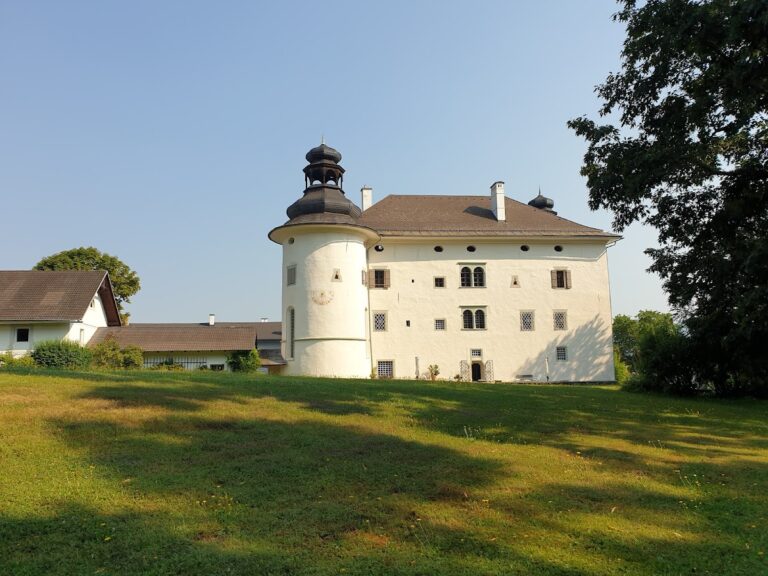
A roadside building called the Stöckl, or Leonstain Castle, was erected around 1550. The Leonsteiner line had died out by that time, so the later building is understood to have adopted the name of the former Leonsteiner possession. The spelling used in the early seventeenth century was Leonstain, which Valvasor also applied to this later castle around 1688.
Remains
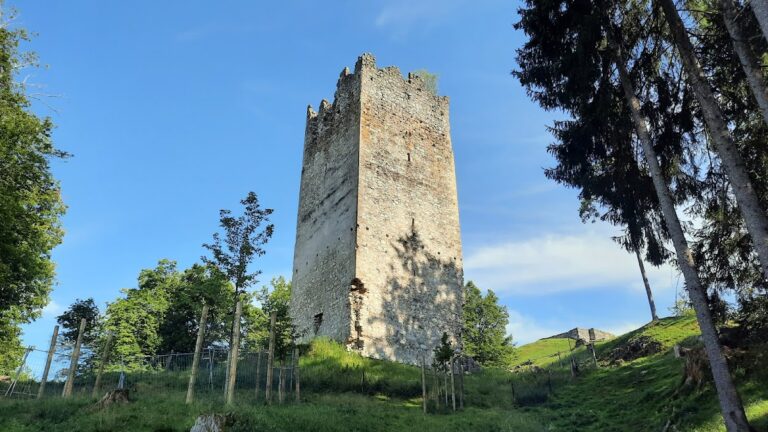
The main castle occupies an elongated rocky plateau northwest of Pörtschach. An irregular ring wall, partly dating from the twelfth century, encloses two courtyards. The approach enters from the north and follows the northern section of this enclosing wall. On the southern side, an elongated rock outcrop supports the oldest part of the complex, a four-storey late-Romanesque fortified tower with an attached residential building.
Castle Courtyards and Towers
Late-Romanesque Tower
The southern tower is a late-Romanesque bergfried, the principal fortified tower of a medieval castle, generally used as a defensive strongpoint rather than as a permanent residence. It rises four storeys above the rocky outcrop and is joined to a residential building.
East Courtyard Buildings
Remains of late-Gothic buildings occupy the east courtyard. Dating from the fourteenth or fifteenth century, they were arranged along the northern ring wall, adding a later building phase within the earlier enclosure.
West Courtyard Chapel
The southeast corner of the west courtyard contains the remains of a chapel from the fifteenth century. Its surviving position preserves the relationship between the religious building and the castle’s internal courtyard layout.
Ministerial Tower
On the western side of the west courtyard stand the remains of a late-Romanesque ministerial tower. Its eastern half was incorporated into the ring wall, linking this earlier tower with the defensive boundary of the main castle.
Service Courtyard and Seeburg
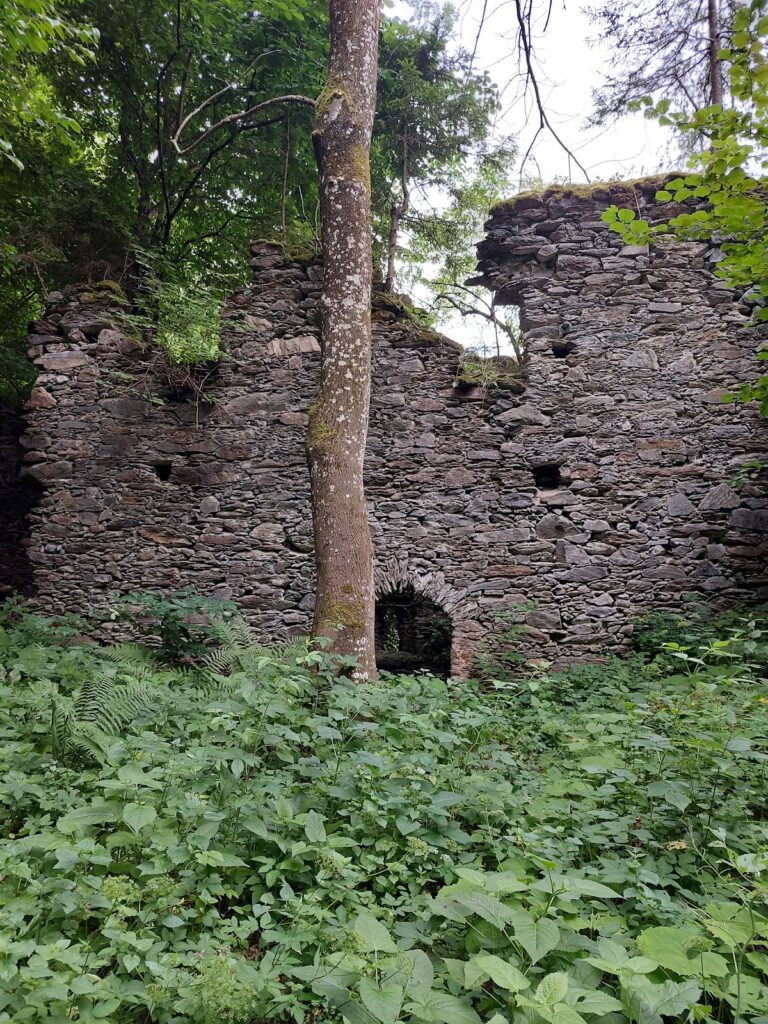
Immediately north of the main castle lies a spacious service courtyard dating from the late medieval to early modern period. South of the castle, at its foot, stood a former Seeburg, or lakeside castle. It was recorded in 1202, and fragmentary wall remains survive from it.