Burg Wildstein: A Medieval Hilltop Castle in Germany


Site at a Glance
- Rating
- 4.8
- Popularity
- Very Low
- Country
- Germany
- Primary era
- Medieval
- Eras represented
- Medieval
- Civilizations
- Electoral Palatinate, Holy Roman Empire
- Site type
- Military
- Remains
- Castle
On this page9 sections
History
Burg Wildstein is a medieval hilltop castle in Germany, at the summit of Wildstein near Teunz in Bavaria. It was first mentioned in the early fourteenth century, and its listed construction date is 1355. The castle administered territory, helped control medieval routes leading east, and contributed to the defence of newly settled areas in the surrounding Nordgau, the historical name for central and northern Upper Palatinate.
Settlement and Early Records
From around AD 1000, land clearance and colonization gradually expanded settlement across the Nordgau. Castles such as Wildstein were established within this changing territorial landscape. Their elevated positions supported the administration of surrounding land and helped protect routes and settlements from incursions from the east.
A document issued at Wildstein on 28 October 1355 recorded the sale of three unoccupied holdings at Nesseltoch. Egid Paulsdorfer of Tännesberg and his wife sold them to their uncle, Konrad Kräzlein of Wildstein. A Heinrich of Wildstein mentioned around 1300 is associated with a different Wildstein near Skalná, close to Eger, and cannot securely be connected with this castle.
Territorial Lords and Feudal Change
Wildstein’s territorial sovereignty and high justice were disputed during the 1350s. High justice meant authority over serious criminal cases, including offenses that could incur the death penalty. On 4 October 1356, Landrichter Otto Zenger of Schwarzeneck, a judicial official responsible for a land court, decided in favor of Count Palatine Ruprecht the Younger.
After Konrad Kräzlein died, Elspet Kräzlein transferred the knightly estate to Landgrave Johann of Leuchtenberg on 27 March 1373. In 1379, Andre Zenger of Fronhof was recorded as the castle’s administrator. Johann of Leuchtenberg sold the castle to Hermann Frankengruner on 1 July 1409. Frankengruner then granted it as a fief to Count Palatine Johann. A fief was property held from a superior lord in return for obligations, and this transaction placed Wildstein within the Palatine feudal system.
Jörg Rabe inherited half of the castle from his cousin Nikolaus Rabe in 1476. By 1488, Georg and Fritz Holzschuher of Nuremberg had acquired Wildstein from Albrecht and Hans Rabe. As owners of the estate, they were required to provide military service to the Palatine territorial lord when needed.
The Ochs and Machenwitz Families
On 23 July 1499, Wildstein passed from the Holzschuher family to Hainz Ochs. His brothers Utz and Hanns Ochs became owners in 1507 and divided the estate between themselves in 1520. Florian and Hanns Ochs were recorded in 1525. From 1548, Florian Ochs alone was listed as a landed subject of the territory, a member of the landed nobility under a territorial ruler. Jörg Ochs followed him.
On 19 October 1562, Hans Rüdiger and Hans Sigmund Machenwitz received half of Wildstein. The Machenwitz family was later placed under an imperial ban, a formal legal proscription that removed legal protection and could affect possession of a fief. On 12 September 1564, Wolf Satzenhofer of Fuchsberg was installed as feudal lord on behalf of Anna Ochs, Florian Ochs’s widow.
Anna Ochs died in 1583 without male heirs. Because the fief could not pass to female descendants, Wildstein was withdrawn and assigned to the Murach administrative district. The estate may already have reverted to Palatine authorities in 1562 because of the imperial ban against the Machenwitz family. A record from 1622 likewise stated that Wildstein, together with the villages of Kühried and Eppenrieth, had returned to the Electoral Palatinate as fiefs about sixty years earlier.
Ruination and Archaeological Investigation
A map of the Murach district from 1589 still showed Wildstein as a complete castle. By 1793, a map of Pullenried parish depicted the building as a ruin. Treasure digging took place on the site around 1850, adding to the long-standing local interest in the remains.
The castle site was declared an archaeological monument in 1905. In May 1998, members of the Society for Archaeology in Bavaria began excavations. Bernhard Klier of Wildstein and Harald Schaller of Pfreimd worked in their free time for three years to expose the remains and record the results. The work clarified the surviving structures and included protective measures for the tower ruins. Wildstein is now recorded both as the medieval castle site called “Wildstein” and as a protected architectural monument in Bavaria.
Remains
Hilltop Setting and Layout
The castle site stands at an elevation of 744 metres on the summit of Wildstein, a hill southwest of the village of Wildstein in the municipality of Teunz, Schwandorf district, Upper Palatinate, Bavaria. It occupies the highest point in the municipality. The summit contains several rocky outcrops. The hill slopes gently northeast toward Wildstein village, while its southern side falls steeply toward Kühried and its western side is also steep.
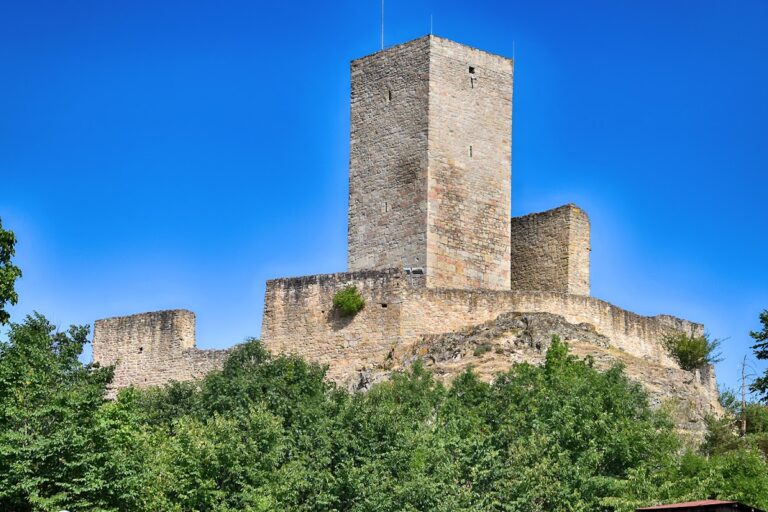
Today Burg Wildstein is a Burgstall, meaning the archaeological site or ruin of a former castle whose superstructure has largely disappeared. The terrain indicates the wider extent of the former complex. Only limited structural remains survive, principally the excavated ruin of a tower and sections of the surrounding wall.
Late-Medieval Flanking Tower
Excavation revealed a late-medieval flanking tower dating from the first half of the fifteenth century. A flanking tower projected from a fortification wall, allowing defenders to observe and attack areas alongside the wall. The tower therefore formed part of the castle’s defensive system rather than standing as an isolated building.
The tower remains are preserved as a ruin. During the 1999 work, excavators identified a fire or destruction layer. In 2000, another fire layer was exposed west of the tower, and protective measures were undertaken on the tower ruins. These layers provide physical evidence of destructive events in the castle’s history.
Surviving Walls and Local Traditions
Parts of the castle wall survive alongside the tower remains. Together, these fragments and the shape of the summit allow the former arrangement of the hilltop complex to be inferred, although the visible fabric is limited. The surviving masonry represents the principal physical evidence of the castle after its transformation into a ruin.
Several local treasure traditions are associated with Wildstein. They include stories of the White Lady of Wildstein, the Sunday Child, the Venetians, and the Earth Mirror. These traditions, together with treasure digging around 1850, form part of the later cultural history attached to the ruined castle.
Nearby sites