Schloss Guteneck: A Medieval Castle Complex in Germany


Site at a Glance
- Rating
- 4.7
- Popularity
- Medium
- Country
- Germany
- Primary era
- Medieval
- External website
- Open
- Eras represented
- Medieval, Early Modern, Modern
- Civilizations
- Electoral Palatinate, German, Holy Roman Empire
- Site type
- Domestic
- Remains
- Castle
On this page12 sections
History
Schloss Guteneck is a castle complex in Germany whose Gothic masonry dates it to the twelfth century. Guteneck is first mentioned in the same period, and the site developed within a long-standing unit of ownership and jurisdiction with nearby Weidenthal.
Medieval Origins and the Murach Family
Guteneck and Weidenthal were joined under one lordship from the thirteenth century onward. The noble Weidenthal family held Weidenthal from 1147 until the end of the thirteenth century, after which the Murach family appeared there around the turn of the fourteenth century.
On 10 June 1315, Ludwig the Bavarian, a fourteenth-century ruler of Bavaria and the Holy Roman Empire, granted Jordan von Murach properties at Wohlfest and Kulz together with the bailiwick of Weidenthal. A bailiwick was an office carrying delegated legal or administrative authority. Members of the Murach family later appear in regional offices and property transactions connected with Guteneck and Weidenthal.
Konrad von Murach at Guteneck served as a co-sealer in 1377 and 1378. Götz von Murach of Guteneck was associated with bailiwick rights at Illschwang in 1394, while Jordan Murach of Guteneck transferred meadows and farmsteads at Weidenthal to his brother Ulrich before 1390. Other members of the family held judicial and administrative positions at Nabburg and Lengenfeld. In 1477, Albrecht Murher of Guteneck received an Electoral Palatinate fief that included further properties at Altfalter and Nabburg.
After Konrad Muracher of Guteneck, who was also an official and judge at Lengenfeld, died in 1488, the estate passed to his underage sons Jörg, Albrecht, and Hans. Christoph Zenger of Schwarzenfeld issued a feudal acknowledgement on their behalf in 1502. Albrecht von Murach was identified in 1518 as a landed nobleman of the Upper Palatinate, a regional noble who held estates and owed associated feudal obligations. The family’s roughly three-century association with Guteneck and Weidenthal ended under his son, Wolff Albrecht von Murach.
Transfer to the Kreuth Family
Wolff Albrecht von Murach sold the estate at Neusath, which belonged to Guteneck, in 1578. He was unable to settle his debts and sold Guteneck and Weidenthal in 1593 to his brother-in-law, Hans Adam von Kreuth.
The estates suffered devastation by troops during the Thirty Years’ War, the European conflict of 1618–1648 that brought widespread military destruction to territories in the German lands. Wolff Wilhelm von Kreuth, a non-Catholic nobleman, was forced into exile in 1629. His requests between 1629 and 1648 for permission to visit his estates were rejected, although he eventually received at least the income from compulsory labor obligations.
His son Johann Friedrich von Kreuth inherited the property and rendered homage as a landed nobleman of the Upper Palatinate in 1652. Because Johann Friedrich and his wife were Lutherans, Elector Ferdinand Maria expelled them from the territory in 1660.
Eighteenth-Century Succession and Jurisdiction
After Johann Friedrich’s death and the early death of his eldest son, Wilhelm Christian, Guteneck and Weidenthal passed to four underage sons: Hanns Friedrich, Johann Ludwig, Aloys Bonaventura, and Johann Wilhelm. Their uncle Veit Ludwig, a canon of Regensburg, acted with them in the administration of the inheritance. A canon was a cleric attached to a cathedral or collegiate church.
Veit Ludwig was summoned in 1707 to fulfil the obligations of a landed nobleman and was represented by Baron von Plettenberg. The Kreuth family had gained imperial count status in 1694, meaning that it held a count’s title within the Holy Roman Empire, and used the designation “at Guteneck, Weidenthal, and Gleiritsch.”
After Aloys Bonaventura Count von Kreuth, who served as caretaker and rent official at Nabburg, died, the estates passed to Franz Anton von Kreuth. His representative, Bösenecker, performed the required obligation for Guteneck, Weidenthal, Gleiritsch, and Willhof on 29 August 1777. Franz Anton received the properties together as a single fief in 1778. Following his death, his widow Adelheid and their children transferred the properties to their younger son Sigmund in return for a substantial payment. Sigmund performed the obligation on 28 October 1793.
Fire, Rebuilding, and Modern Ownership
In 1813, the count who had become commissioner-general of the Lower Danube District applied to establish a second-class seigneurial court at Guteneck, but received only restricted jurisdiction. Adelheid Countess von Kreuth and her children renewed the application in 1819 for a second-class patrimonial court, a lordly court exercising jurisdiction over an estate. A decree of 10 October 1821 authorized the court.
The castle was completely destroyed by a village fire in 1822. The chapel and the castle building attached to it were rebuilt first. In 1894, Count Franz von Spreti added a residential wing on medieval foundations and incorporated surviving Baroque wall remains.
In the same year, the childless imperial countess Franziska von Kreith sold Schloss Guteneck and its associated farm estate to her brother, Count Franz von Spreti. He sold it in 1923 to a Nuremberg property agent, who transferred it in 1937 to Hereditary Prince Johann Leopold of Saxe-Coburg and Gotha. Count Albrecht Beissel von Gymnich acquired the castle and 30,000 square metres of land in 1961 and moved into it in 1963. His son, Burkhard Count Beissel von Gymnich, has owned it since 2001.
Schloss Guteneck is protected as an architectural monument under record number D-3-76-133-1. The archaeological remains of the medieval and early-modern periods around the castle, on the site of an earlier medieval fortress, are protected separately under record number D-3-6539-0179. The complex has since undergone extensive revitalization, including the adaptation of parts of the buildings as holiday apartments and use as a wedding, conference, and seminar venue.
Remains
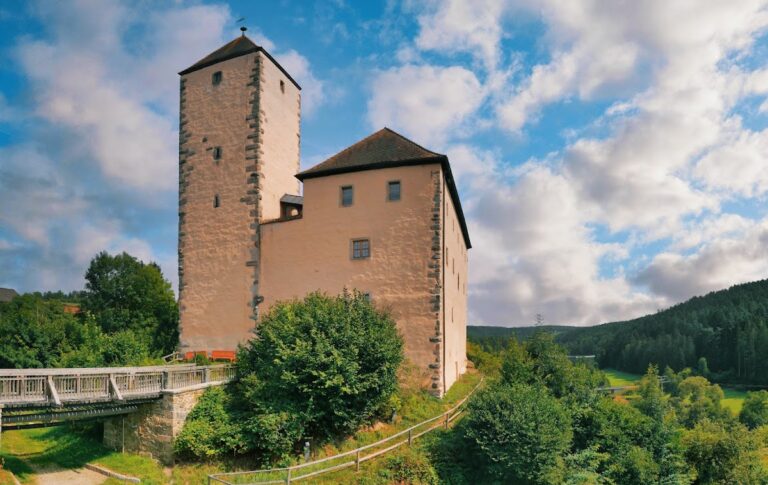
Schloss Guteneck survives as a three- to four-sided complex whose fabric brings together medieval foundations, later masonry, and nineteenth-century additions. Its recorded remains include the castle courtyard, the chapel, residential and ancillary buildings, a former brewery, and archaeological material from the medieval and early-modern periods.
Castle Complex and Courtyard
Courtyard and Residential Wing
The complex includes an arcaded courtyard added in the nineteenth century. Its arcade arches are represented in the arms of the municipality of Guteneck. The residential wing added by Count Franz von Spreti in 1894 stands on medieval foundations and incorporates surviving Baroque wall remains, linking the rebuilt castle to earlier phases of the site.
Castle Chapel of Saint Catherine
The Castle Chapel of Saint Catherine originated in the fourteenth or fifteenth century. The 1822 fire destroyed it, after which it was rebuilt in a modified form. A roof turret, a small tower rising from the roof, carries an onion dome, a bulbous dome form.
Swiss House and Former Schoolhouse
A so-called Swiss house forms part of the building complex. Its ground floor contains vaulted rooms. A former schoolhouse is also incorporated into the group of buildings.
Former Brewery
The former brewery dates from 1571. It was rebuilt after the 1822 fire as a building with a half-hipped roof, whose sloping end sections do not extend fully to the eaves.
Archaeological Setting
The castle area occupies the site of an earlier medieval fortress and contains archaeological remains from the medieval and early-modern periods. These remains form part of the protected archaeological monument associated with the castle grounds.
Nearby sites