Neu-Thierstein Castle: A Medieval Seat of Authority in Switzerland


Site at a Glance
- Rating
- 4.2
- Popularity
- Very Low
- Country
- Switzerland
- Primary era
- Medieval
- Eras represented
- Medieval
- Civilizations
- Holy Roman Empire
- Site type
- Military
- Remains
- Castle
On this page5 sections
History
Neu-Thierstein Castle is a ruined medieval castle in Switzerland, founded around 1100 as the seat of a noble lay advocate’s office connected with Beinwil Monastery. Built on a rocky promontory between Büsserach and Erschwil, it became a landmark of the Lüssel Valley and the Schwarzbubenland.
Foundation and the Counts of Thierstein
The Counts of Saugern-Pfeffingen established the castle around 1100. It was initially known as Bello and served a lay advocate’s office, a secular institution through which a noble authority protected a monastery while exercising related administrative and legal rights. An earlier interpretation placed the castle’s origin around 1180–1190, when Count Rudolf of Thierstein inherited the former Saugern counts’ possessions in the middle and lower Birstal. The Counts of Thierstein then took control of the castle and its associated lay advocacy.
A new building was constructed around 1294–1295. After 1350, the Counts of Thierstein divided into two lines. One acquired Farnsburg, while the other took Pfeffingen. Neu-Thierstein passed to the Pfeffingen line, whose members generally lived at Pfeffingen and repeatedly pledged the castle. The name Thierstein is recorded for the castle by 1400.
Solothurn Rule and Later History
Solothurn occupied Neu-Thierstein in 1445 after the Battle of St. Jakob and returned in 1467. It also took the castle during the Swabian War of 1499, a conflict between the Swiss Confederacy and forces associated with the Habsburg-backed Swabian League. When the death of Count Heinrich of Thierstein ended the dynasty, Solothurn acquired Neu-Thierstein in 1522.
From that year, the castle served as the seat of Solothurn’s bailiwick of Thierstein. After the Helvetic Republic, the centralized Swiss state created in 1798 during a period of French revolutionary influence, put the castle up for auction for demolition, private owners protected the ruin from further destruction during the nineteenth century. The Basel section of the Swiss Alpine Club, a Swiss mountaineering organization, acquired it in 1894 and established a clubhouse within the ruin.
Building and exploratory investigations took place in 1985. On 2 March 1997, part of the ruin collapsed unexpectedly, sending approximately 20 cubic metres of stone onto the Passwang road. The municipality of Büsserach subsequently purchased the ruin from the Swiss Alpine Club, and its collapsed southwestern corner was rebuilt in concrete.
Remains
Spur Castle and Surviving Ruin
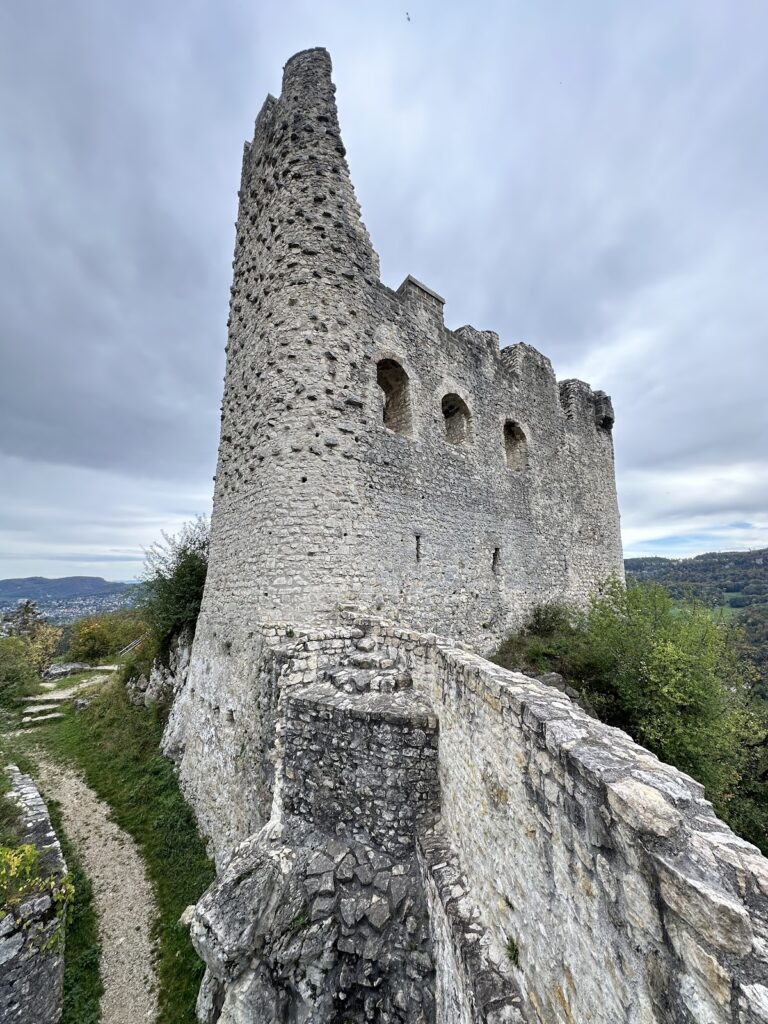
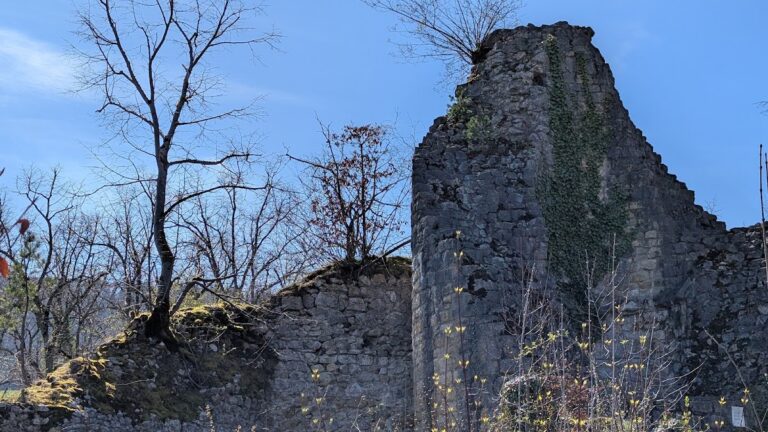
Neu-Thierstein survives as a hill castle in a spur position, set on a rocky promontory in the municipality of Büsserach. Its ruined fabric occupies the elevated spur between Büsserach and Erschwil, while the reconstructed southwestern corner shows where the 1997 collapse altered the surviving structure. That corner was rebuilt in concrete after debris from the collapse obstructed the Passwang road. The ruin also retains the evidence of its later clubhouse use, established by the Basel section of the Swiss Alpine Club after it acquired the site in 1894.
Nearby sites