Burg Hohenschelklingen: A Medieval Hilltop Castle in Germany

Site at a Glance
- Rating
- 4.1
- Popularity
- Very Low
- Country
- Germany
- Primary era
- Medieval
- External website
- Open
- Eras represented
- Medieval
- Civilizations
- Holy Roman Empire
- Site type
- Military
- Remains
- Castle
On this page8 sections
History
Hohenschelklingen Castle is a high-medieval hilltop castle in Germany, situated above the town of Schelklingen. First mentioned in 1127 as Castro et villae Schälkalingen, it belonged with the settlement to the noble brothers Rüdiger, Adalbert, and Walter of Schelklingen. Members of this family are also thought to have built the castle. Its surviving keep largely represents a major rebuilding carried out around 1265.
The Schelklingen family and the counts of Berg
Walter of Schelklingen still held the castle and settlement shortly before 1184. In the early 13th century, his heiress Adelheid transferred the inheritance through marriage to Count Heinrich of Berg. Heinrich III of Berg ruled the castle and town from approximately 1210 to 1241. During his rule, Schelklingen is credited with gaining town status, while the castle’s outer bailey was probably enlarged.
Heinrich III was followed by his son Ulrich II of Berg, who ruled from 1248 to 1266 and was first recorded in 1248 as Count of Berg-Schelklingen. After Urspring, now a district of Schelklingen, was destroyed in 1246 or 1247, Hohenschelklingen Castle is presumed to have come under siege. The castle was fundamentally modernized in the period that followed, and its keep was built in its present form around 1265.
Residence and administrative center
Under Count Konrad of Berg-Schelklingen, who ruled from 1319 to 1346, Schelklingen and its castle reached their greatest prosperity. The town served as the counts’ residential city and administrative center. In 1343, Konrad and his only daughter, Luitgard, sold Schelklingen and the castle complex to the Austrian dukes Albrecht, Friedrich, Leopold, and Rudolf. The castle remained the principal residence of the counts of Berg until their line ended with Konrad’s death in April 1346. Schelklingen then lost its central administrative role, and the castle ceased to serve as the counts’ residence.
Pledge-holders, destruction, and ruin
After the lordship of Schelklingen was pledged, the castle became the seat of the person who temporarily controlled the lordship as security for an obligation. Konrad of Reischach held it until 1396, when the lordship passed to Duke Ulrich of Teck. Burkhard of Stadion became pledge-holder in 1438, and around 1507 King Maximilian I sold the pledged lordship to Lutz of Freyberg. By that time, only watchmen lived at the castle permanently. In 1530, Konrad of Bemelberg, also known as Konrad of Boyneburg, became lord of the town and castle.
People from Blaubeuren destroyed the castle during a march through the area in 1633. Between May 1650 and 1653, the remaining buildings were demolished, and their stones were reused in the construction of the Franciscan monastery in Ehingen. The surviving fabric was left to decay as a ruin.
Ownership and conservation
The ruin remained in lordly ownership until 1893, when the town of Schelklingen purchased 1,100 Morgen of forest within its municipal territory and fishing rights in the Ach from Friedrich Kaulla, owner of the Oberdischingen estate since 1851. In autumn 1896, Schelklingen and the Swabian Alb Association, a regional hiking and heritage organization, carried out conservation work. They removed rubble that had partly filled the keep, created an entrance at ground level, and installed an interior staircase.
Konrad Albert Koch excavated the site in 1910 to establish its ground plan and produced the first plan of Hohenschelklingen Castle. Castle researcher Stefan Uhl examined the complex again in 1990, after which the town undertook further renovation work. The ruin is protected as a historic monument and appears in Schelklingen’s register of architectural monuments.
Remains
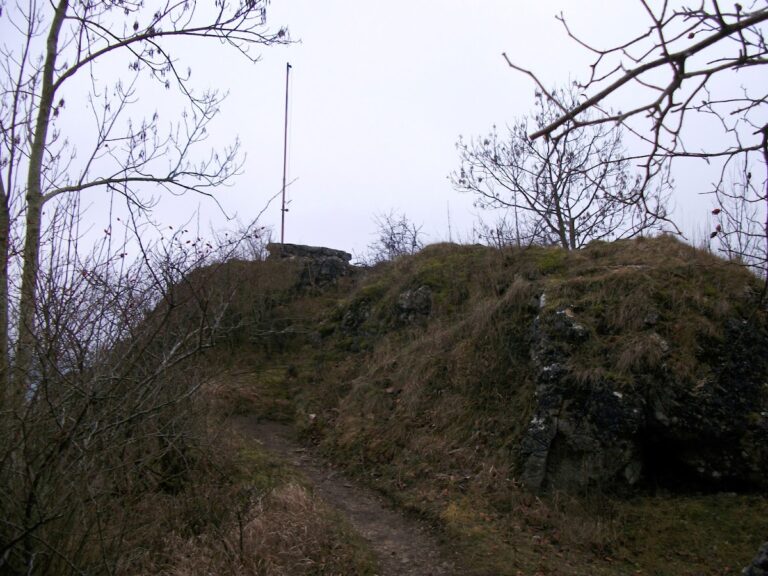
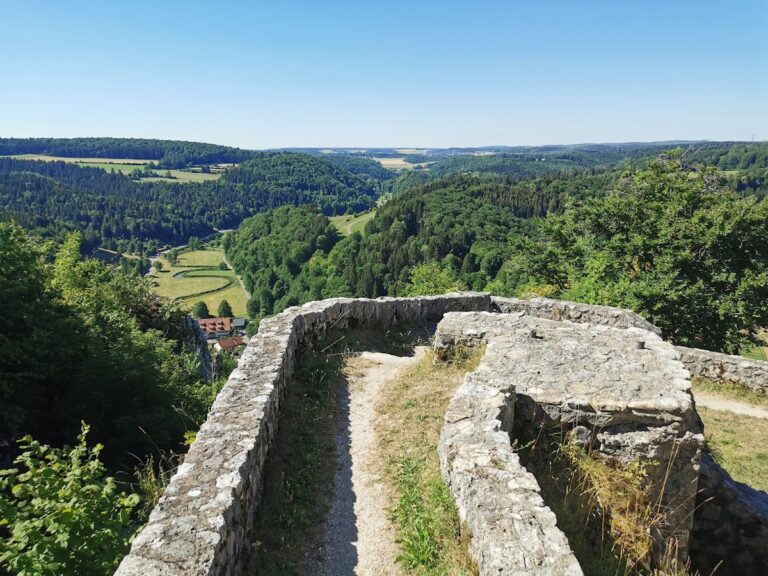
Hohenschelklingen Castle occupies a mountain spur of the 685-metre-high Schlossberg, at an elevation of 621.5 metres above sea level. The spur lies between the valley formed by the former course of the Danube to the west and the Längental to the east, with Schelklingen below the ruin to the south. The surviving complex consists chiefly of the keep and the remains of the outer bailey, whose ground plan was established through the 1910 excavation.
Surviving tower and castle layout
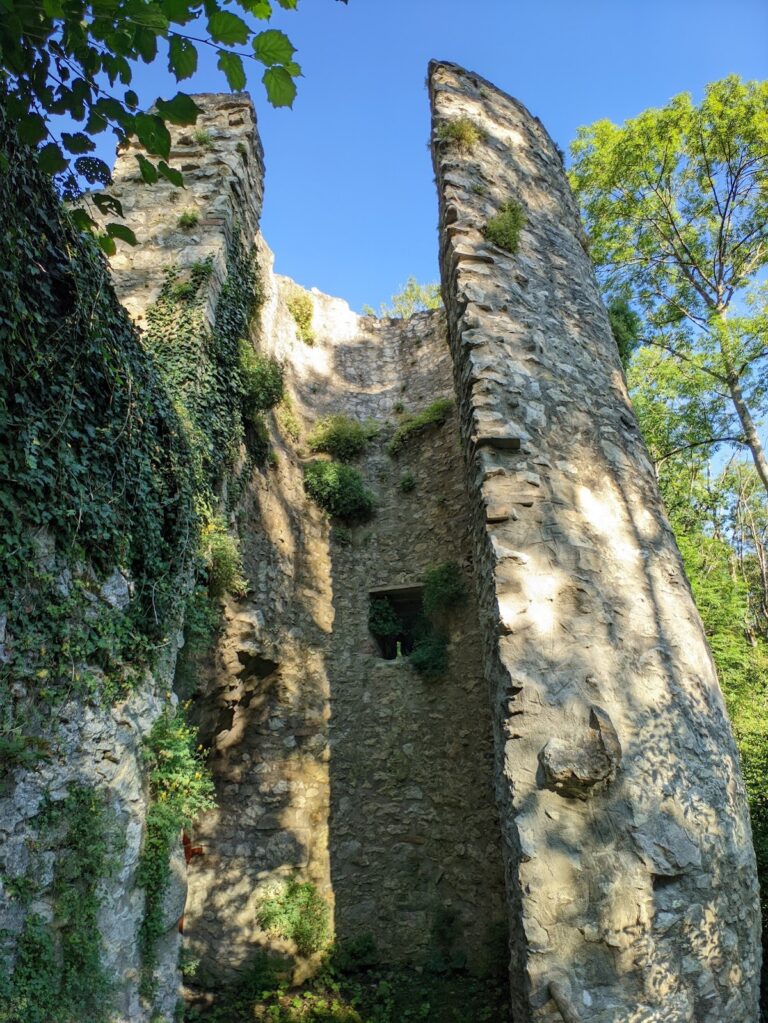
The 22-metre-high keep, also called the Castle Tower, survives as the principal standing structure. Built in its present form around 1265, it is the main defensive tower of the medieval castle and now serves as a viewing tower on designated days. The outer bailey, probably enlarged during the rule of Heinrich III of Berg, forms part of the wider castle plan identified by Koch’s excavation. Together, these remains preserve the principal elements of the hilltop layout.
Reused building material
The demolition of the castle between 1650 and 1653 removed much of its built fabric. Building stone from Hohenschelklingen was incorporated into the Franciscan monastery at Ehingen, while the material that remained on the mountain spur continued as a ruin. The keep’s lower section was later exposed during the 1896 conservation work, which also made ground-level access possible and added an internal staircase.