Fürstenwalde Castle: A Gothic Frontier Fortress in Czechia


Site at a Glance
- Rating
- 4.2
- Popularity
- Very Low
- Country
- Czechia
- Primary era
- Medieval
- Eras represented
- Medieval
- Civilizations
- Holy Roman Empire
- Site type
- Military
- Remains
- Castle
On this page11 sections
History
Fürstenwalde Castle is a ruined Gothic castle in Czechia above Vrbno pod Pradědem, established in the early fourteenth century by the Opava branch of the Přemyslid dynasty. Its first known mention dates to 24 August 1348, when Duke Mikuláš II of Opava authorized Jan Bruxer to restore or establish the settlement of Gesenek and its judicial office below Fürstenwalde. The castle occupied an important frontier position opposite the Piast Duchy of Opole. Tradition also associates Mikuláš II with plans for the site as a hunting and retreat residence.
Opava and Jägerndorf
After the Duchy of Opava was divided in 1377, Fürstenwalde was assigned by lot to Mikuláš II’s son, Duke Jan I of Ratibor. It appeared first among the possessions of the Duchy of Opava and, together with the Freudenthal lordship, became part of the Duchy of Jägerndorf granted to Jan I.
Financial pressures soon altered its ownership. In 1384, Jan II of Opava was forced by debt to sell the Krnov region, including Fürstenwalde, to Duke Vladislaus of Opole. Their later disputes led Margrave Jobst to purchase the region in 1390 for 29,000 marks of groschen. He immediately resold part of it, including Fürstenwalde, to Jan II.
Expansion and late medieval decline
A new palace was built at the beginning of the fifteenth century. In 1405, Mikuláš IV of Bruntál, another member of the Opava Přemyslids, became a co-owner. After his early death, the castle passed to his elder brother Jan II. Its garrison then reportedly numbered eight men.
Following Jan II’s death, his wife Helena Korybutovna became Fürstenwalde’s administrator and owner. A minor battle with the Hussites is traditionally said to have occurred below the castle in 1428, ending with a Hussite defeat. Under Jan II’s son, Mikuláš V of Krnov, Fürstenwalde became less important than the castle at Bruntál, although it remained inhabited. After Mikuláš V died, Fürstenwalde and the Bruntál region passed in 1465 to his son, Jan IV of Krnov.
The castle was probably destroyed during the Bohemian-Hungarian Wars of 1468 to 1478, conflicts connected with the struggle for the Bohemian crown. The damage may have occurred during the 1474 campaign of Matthias Corvinus, king of Hungary and a claimant to that crown, in Silesia. Finds from Fürstenwalde end in the late fifteenth century, and the castle was no longer mentioned when the Bruntál estate, then held by the Lords of Vrbno, was entered in the land registers in 1523. A later legend claims that it continued to be used during the Thirty Years’ War.
Fürstenwalde is a protected cultural monument of the Czech Republic.
Remains
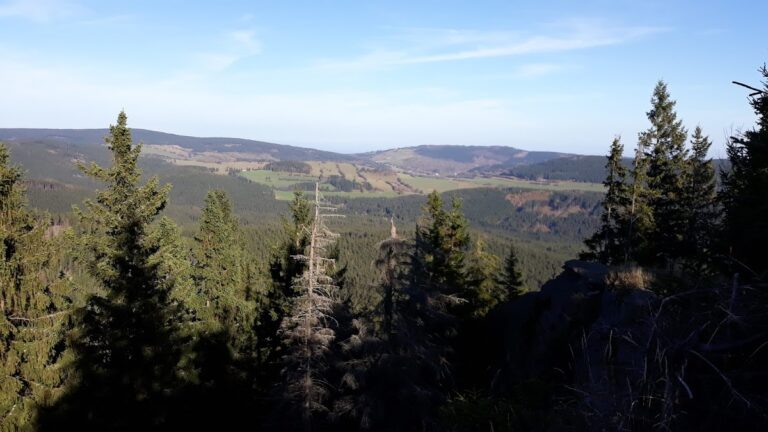
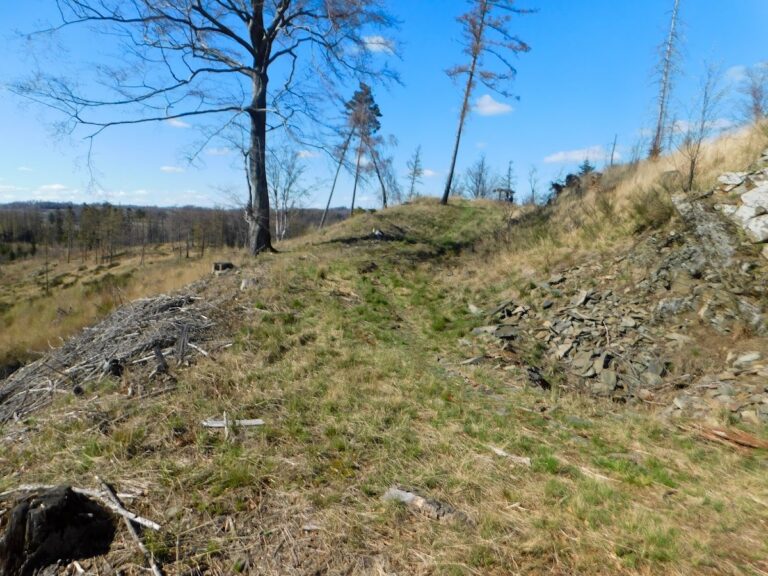
The ruins occupy the summit of Zámecká hora at an elevation of 854 metres, above the confluence of the Střední Opava and Bílá Opava, which form the Opava. The castle had three courtyards arranged within defensive walls, with the approach entering from the west and passing through two gates. Another gate stood on the eastern side. Surviving masonry was laid in mortar, while the present remains comprise small sections of the palace, tower, and curtain wall, together with altered ground levels and rubble mounds.
Castle core
Main tower
The highest point probably carried a massive tower that may also have provided residential space. It had an irregular quadrilateral plan, with a sharp edge directed toward the approach, and rose at least three storeys. Only relatively small remains of the tower survive.
Palace
A two-room palace stood on the opposite side of the courtyard from the tower. Built before the fifteenth century, it was enlarged at the beginning of that century. Small portions of the palace remain among the visible masonry and rubble.
Outer defences
Gates and curtain wall
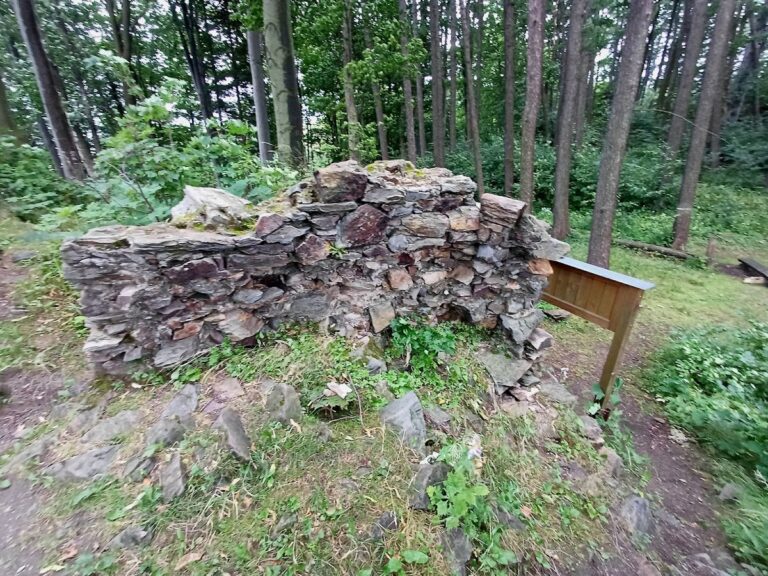
The castle core was enclosed by a curtain wall, the main defensive wall surrounding a castle. The western approach crossed two gates, while a further entrance occupied the eastern side. A surviving section of the curtain wall stands beside the tower, linking the remaining masonry to the castle’s former enclosure.
Northern guard position
A probable guard tower stood at the northern end of the castle. On the platform before it are remains of an unfinished fortification and a ditch that was never completely dug. These earthworks form part of the surviving terrain modifications around the ruined buildings.
Surviving fabric
High walls were still recorded at Fürstenwalde in 1833. The remains visible today are much smaller, consisting of fragments of the palace, tower, and adjacent curtain wall. Ground alterations and mounds of collapsed stone preserve further evidence of the former castle layout.