Church of the Assumption: A Neo-Renaissance Parish Church in Jeseník, Czechia


Site at a Glance
- Rating
- 4.6
- Popularity
- Very Low
- Country
- Czechia
- Primary era
- Modern
- External website
- Open
- Eras represented
- Medieval, Early Modern, Modern
- Civilizations
- Habsburg, Holy Roman Empire
- Site type
- Religious
- Remains
- Church
On this page17 sections
History
The Church of the Assumption is a Roman Catholic church in Jeseník, Czechia, rebuilt in the Neo-Renaissance style in 1882–1883. Its dedication commemorates the Roman Catholic belief and feast of the Assumption of the Virgin Mary, meaning Mary’s being taken into heavenly glory at the end of her earthly life. The church belongs to the Moravian ecclesiastical province, the Diocese of Ostrava-Opava, the Jeseník deanery, and the Jeseník parish.
Medieval origins and early fires
Jeseník was indirectly mentioned as a town in 1267. A church or chapel probably already stood there, since the area was administered by the Bishopric of Wrocław, which was responsible for the religious care of the population. The first written mention of the church dates from 1418. At that time, it apparently resembled the later cemetery church at Javorník.
The medieval building was repaired and enlarged in 1457. It was altered again in later centuries, but repeated fires caused severe damage in 1638, 1696, and 1737. The vaults survived each blaze. The parish and municipal archives, kept above the sacristy, were destroyed in one of the fires, removing contracts and legal documents that had been stored there alongside church records.
Rebuilding and parish change
After the fires, parish priest Adam Florian Girdwill directed the repair and re-equipping of the church. During the tenure of Ignác von Runtzler, from 1771 to 1792, the archpriesthood was transferred from Vidnava to Jeseník. An archpriesthood was an ecclesiastical office or jurisdiction generally overseeing several parishes or clergy. Under parish priest Jan Rother, who served from 1792 to 1819, the cemetery surrounding the church was abolished.
By the late nineteenth century, the existing church could no longer accommodate its congregation. In 1880, Jeseník had 10,680 Catholics, along with 180 Protestants and four Jews. Parish priest Josef Peiker obtained 36,000 gulden from a bequest by Bishop Förster intended to support poor churches, despite a dispute with the town over control of the money. Architect Rudolf Zelenka designed the rebuilding, which extended the earlier plan toward the presbytery and was completed in June 1883.
The construction was troubled by poor workmanship. The new roof leaked and had to be rebuilt. A contractor from Neisse accepted payment for a new high altar but did not deliver it, so Peiker commissioned the woodcarvers Antonín and Rajmund, sons of the sculptor Bernard Kutzer, to make the altar instead. Zelenka paid for the tower clock and arranged for its installation during the rebuilding.
Peiker also brought the Ursuline order to Jeseník in 1881. The Ursulines were a Catholic religious order especially associated with educating girls and women, and their girls’ educational institute attracted students from across Central Europe. Peiker’s successor, Josef Neugebauer, served from 1893 to 1926 and commissioned ceiling paintings showing scenes from the life of the Virgin Mary. He also arranged repairs to the side altars and pulpit.
Twentieth-century changes
In 1937, Cardinal Bertram elevated the church to a provostry, a church institution headed by a provost, whose office may carry administrative or jurisdictional responsibilities within a diocese. A commemorative plaque at the entrance records the elevation. It was made by Professor Kytka of the State School for Marbleworking in Supíkovice.
During the interwar period, when about 98 percent of the population of then-Frývaldov was German-speaking, a war memorial was installed inside the church in 1934. It consisted of a large wooden cross and votive panels naming 250 local citizens who had died in the First World War. A light was illuminated beside each name on the anniversary of the person’s death. The sculptor Josef Lux of Stará Červená Voda created the memorial.
In 1945, during postwar anti-German destruction, the panels were removed and probably destroyed. Quotations from the Bible now occupy their place. A second memorial erected outside near the Water Fortress was also destroyed during the same campaign after complex negotiations. From 1946 to 1950, Alois Eineigel served as the first Czech parish priest in postwar Jeseník. He helped obtain a linden-wood statue of Saint Wenceslas with Czech motifs, donated by the Kočí couple in 1947. The statue commemorates postwar reconciliation between the Czech- and German-speaking inhabitants of former Frývaldov.
Parish priest and Jeseník dean Josef Wencl served for 34 years. During his tenure, the church received a new slate roof in 1962 and a new facade in 1971. Because the slate was poor quality, the roof was removed in 1987 and replaced with aluminum sheeting. In 1991, under parish priest Vojtěch Glogar, the interior was repainted for the first time in almost a century. A general facade repair began in 2002 but remained unfinished because funds were insufficient.
The Church of the Assumption is a protected cultural monument under registration number 18540/8-939. Before the town hall was built on the square, the municipal council met in the church sacristy, where important contracts and legal documents were also kept.
Remains
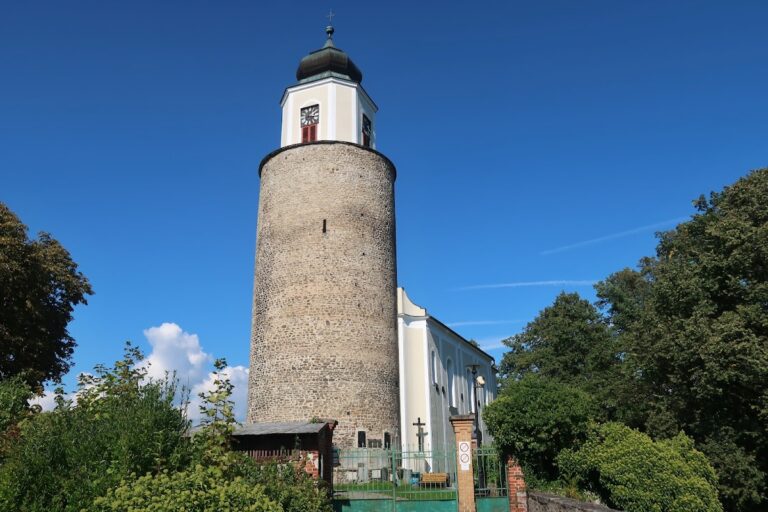
The present church is an oriented, masonry, three-aisled Neo-Renaissance building with a polygonal chancel termination and a tower incorporated into the west facade. The altar faces east. A rectangular sacristy stands north of the presbytery, while a chapel projects from the center of the south facade of the nave. The 1882–1883 rebuilding lengthened the earlier ground plan toward the presbytery, leaving the rear section as the oldest surviving part. A walled-up Gothic window from the fifteenth century was found there during the rebuilding.
Exterior and vaulted structure
Facade and roof
The chancel ends in three semicircular-arched windows, with circular windows above them. The five-bay side facades have two rows of openings, consisting of tall arched windows below and circular windows above. Pilaster-like ashlar rustication, which imitates carefully laid stone blocks, articulates the facades of the nave and presbytery. The presbytery has a half-hipped gable roof, while the nave has a gable roof. Both were originally covered with slate, which was replaced by aluminum sheets in 1987.
West tower
The square-plan west tower rises 38 meters and has four rectangular storeys. Its entrance is set into the west facade, which is framed by fluted pilasters with Ionic capitals, an entablature, or horizontal element above the pilasters, and a winged triangular pediment. The space beneath the tower has a cross-vaulted ceiling. Circular openings with clock faces mark the bell storey, while corner lesenes, narrow projecting strips that articulate a wall without acting as columns, divide the exterior. The tower is topped by a pyramidal roof.
The facade sections beside the tower contain semicircular-arched windows with circular windows above them. Another circular window is placed in the triangular gable. A mortuary chamber was built in the tower beneath the gallery in 1799. A cord linked its bell to the sacristan’s house, allowing a person who had appeared dead but regained consciousness to call for help.
Interior vaults
The presbytery has one bay of cross vaulting formed with triangular vault cells. The rectangular nave contains three square cross-vaulted bays, and each side aisle has three rectangular cross-vaulted bays. The west gallery is supported by three bays of cross vaulting. The sacristy has a flat ceiling, while the chapel has a barrel vault, a continuous tunnel-like ceiling.
Furnishings and memorial features
Crypt
A Baroque brick crypt lies beneath the church and is closed by a slab of Supíkovice marble. An examination in 2008 found the remains of 15 to 20 individuals. Because the bones were scattered, they were respectfully placed in a coffin.
Organ
The first organ was built in 1782 by Antonín Finkler of Javorník and repaired in 1799 by Joseph Sebastian Staudinger, an organ builder from Andělská Hora. The repair cost 450 gulden, a currency used in the Habsburg lands and other parts of Central Europe. In 1876, Peiker commissioned a new organ from the Rieger firm in Krnov for 3,400 gulden. It remains in the church and has 15 stops, 1,200 pipes, and two manuals. Stops control different sound qualities, pipes produce the tones, and manuals are the keyboards played by the organist.
Side altars
The side altar now dedicated to Saint Joseph was originally dedicated to Saint Hedwig, the patron saint of Silesia. It dates from the early 1750s, and its sculptural decoration was made by Kristián Keller of Vápenná, later based in Skorošice. Eliáš František Herbert painted its 1763 image of the Death of Saint Joseph. The altar contains relics of Saint Boniface. Saint Hedwig appears in the upper image, with Saints Barbara and Notburga beside it and Saints Sebastian, Monica, Francis Xavier, and John the Evangelist around the principal painting. The painting bears a quotation from the Gospel of Luke beginning, “Nunc dimittis servum tuum Domine, secundum verbum tuum in pace.”
The side altar now dedicated to Saint Anne was originally dedicated to Saint Andrew. It also dates from the early 1750s and has sculptural decoration by Keller. Herbert painted its 1763 image of the Death of Saint Anne. Saint Florian appears in the upper image, flanked by Saints Apollonia and Rosalia, while Saints Catherine of Alexandria, Charles Borromeo, Roch, and the archangel Michael surround the principal painting. That painting bears a quotation from the Gospel of Luke meaning, “Into your hands I commend my spirit.”
Paintings and stained glass
The ceiling paintings date from 1895 and were made by the Viennese professor Schüller. Three large stained-glass windows represent Saints Louis and Ludmila and Saint Hedwig. The window of Louis and Ludmila was donated by the Viennese lace manufacturer Louis Damböck, who dedicated Ludmila’s image to his mother, who had died at a spa. Josefina Kutschrová, the wife of a local rent collector, paid for the Saint Hedwig window.
Four smaller stained-glass windows were made in 1883 by the Tiroler Glasmalerei firm. Women of Jeseník donated three windows representing the Trinity, while parish priest Peiker donated the window depicting the Virgin Mary. The remaining windows in the side aisles and on the gallery date from 1909 and were made by Richard Schlein’s firm in Hrádek in Bohemia. A votive cross decorated with oak-leaf motifs stands opposite the statue of Saint Wenceslas.
Bells
Historic Assumption bell
After the 1737 fire, three bells were installed in the tower during the eighteenth century. The largest was the 1,008-kilogram Assumption bell, cast at Neisse by Jan Jiří Poseck in 1737. Another, dedicated to Saint John the Baptist, weighed 224 kilograms and was cast in Olomouc by Wolfgang Straub in 1794. The third weighed 168 kilograms, was dedicated to Saints Barbara and Francis Xavier, and was cast at Neisse by Poseck in 1738 for the noblewoman Hedvika Františka Hundová.
Only the Assumption bell survives from that group. Its rim measures 118 centimeters across. A Latin inscription states that citizens of Frývaldov had it recast after an accidental fire melted it on the feast of Saint Andrew. The inscription describes its renewed voice as comforting the living, mourning the dead, driving away harm, lamenting the lost, and dispersing clouds. A motor operates the bell, and electric ringing had already been installed during the interwar Czechoslovak First Republic.
Later bells and clock chime
A second bell has hung in the tower since 1947. Wolfgang Straub cast it in Olomouc in 1767. It had hung until 1942 in the chapel at Buková near Bernartice, and after the war it returned to the Jeseník region but remained at Jeseník. It bears reliefs of Saint Florian and Calvary and measures 42 centimeters in diameter. Two bells cast in 1922, weighing 390 and 220 kilograms, were melted down during the war. The tower also contains a 75-kilogram clock chime, 60 centimeters in diameter, cast in 1931.