Edelštejn: A Medieval Border Castle in Czechia


Site at a Glance
- Rating
- 4.1
- Popularity
- Very Low
- Country
- Czechia
- Primary era
- Medieval
- Eras represented
- Medieval
- Civilizations
- Holy Roman Empire
- Site type
- Military
- Remains
- Castle
On this page8 sections
History
Foundation and Border Conflicts
Edelštejn is a medieval hilltop castle near Zlaté Hory in Czechia, constructed in the second half of the thirteenth century, probably by the bishops of Wrocław. It stood in the border region between Moravia and Silesia, where it helped defend the bishops’ lands and settlements connected with gold mining and the extraction of other precious metals. The castle also watched over the trade route from Wrocław through Nysa, Głuchołazy, and Bruntál toward Moravia.
The identity of Edelštejn’s founder is not known. The Opava princes and King Přemysl Ottokar II have also been proposed as possible builders. The castle was first mentioned on 2 September 1281, during a conflict between Opava Duke Nicholas I and Wrocław Bishop Thomas II Zaremba. At that time, it was occupied by the robber knights Ota and Oldřich of Linava.
Edelštejn soon became involved in a wider dispute between Wrocław Duke Henry IV the Righteous and Bishop Thomas II over control of the Jeseník mines. Henry’s victory in 1285 brought the castle into the Duchy of Opava. In 1339, Opava Duke Nicholas II transferred Edelštejn and its gold mines to King John of Luxembourg, the fourteenth-century king of Bohemia. His son and successor, Charles IV, returned the possessions to Nicholas II in 1361.
Hussite Stronghold and Destruction
In 1440, Opava Duke Wenceslaus II pledged Edelštejn to Bolko V, Duke of Opole and a supporter of the Hussite movement. The Hussites were a religious and political reform movement from Bohemia whose opposition to aspects of the established Catholic Church led to conflicts across the region. The castle burned in 1445 for an unknown reason, and Bolko V ordered it to be rebuilt quickly.
During the Hussite Wars, Edelštejn became an important Hussite stronghold on the frontier of Catholic Silesia. In 1465, Bolko V’s successor, Nicholas I of Opole, sold the castle to the Bohemian king George of Poděbrady, who placed it in the care of John of Žerotín. John was an Utraquist, a Hussite tradition that supported communion for laypeople in both bread and wine, further linking Edelštejn with the Hussite side of the regional struggles.
On 14 July 1467, Wrocław Bishop Jodok, also known as Jost I, of Rosenberg captured Edelštejn and installed a garrison. He then ordered its demolition so that it could not again serve as a base for his opponents. In 1474, the destroyed castle passed definitively to the Principality of Nysa, a Silesian territory governed by the bishops of Wrocław.
Ruins and Later Interpretation
The ruin lies near Zlaté Hory in the Olomouc region and remains associated with the medieval gold-mining settlements of the surrounding area. A proposal made in the early twentieth century to rebuild Edelštejn in the Romantic style was abandoned because of its cost. The surviving remains continue to express the castle’s role in the contested borderlands between Silesia and Moravia.
Remains
Hilltop Layout and Defenses
Castle Enclosure
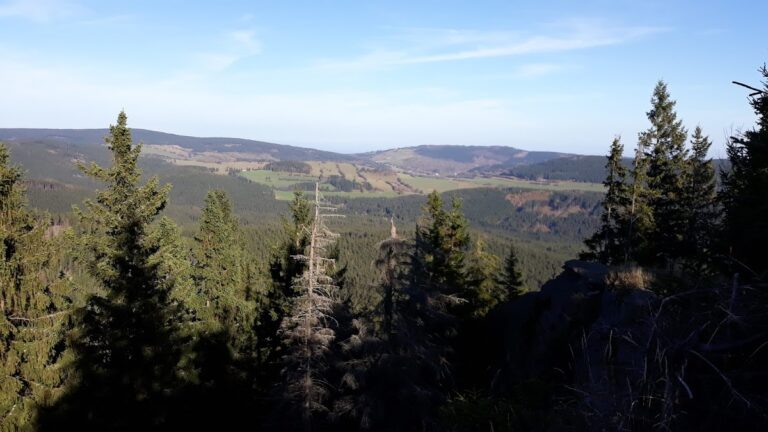
Edelštejn occupies rocky ground at approximately 695 metres above sea level on a spur of the long Příčná ridge between Zlaté Hory and Heřmanovice. Its elevated position provided a broad view over the surrounding area and placed the castle above the medieval route connecting Wrocław, Nysa, Głuchołazy, and Bruntál with Moravia. After its reconstruction, the complex measured approximately 120 by 65 metres and was one of the most imposing fortresses in Silesia as well as the largest castle in the Jeseníky Mountains.
The castle was divided into two sections by a ditch. This division remains legible in the terrain, where the enclosure, ramparts, and moats preserve the basic organization of the stronghold. Numerous unfortified farm buildings formed part of the wider castle complex, adding domestic and working spaces to the fortified areas.
Walls and Towers
Surviving masonry includes numerous fragments of the castle walls, part of a corner bastion, and a section of a round tower. Together with the ramparts and moats, these remains show how the fortress used the rocky hilltop and artificial defenses to control access across the ridge. The surviving features are fragmentary, but the division of the site and the surviving defensive elements still make its original structure readable.
The Černé jezero Nature Reserve lies west of the castle. Its position forms part of the wider landscape in which Edelštejn stood above mining settlements and the route across the Silesian-Moravian borderlands.
Nearby sites