Calaf Castle (Castell de Calaf): A Medieval Fortress in Spain


Site at a Glance
- Rating
- 3.9
- Popularity
- Very Low
- Country
- Spain
- Primary era
- Medieval
- Eras represented
- Medieval
- Civilizations
- Unclassified
- Site type
- Military
- Remains
- Castle
On this page6 sections
History
Calaf Castle is a medieval fortress in Spain, located above the town of Calaf in Barcelona. Its history emerged during the early eleventh-century repopulation of the Segarra frontier, after campaigns led by Almanzor, the military leader and de facto ruler of the Umayyad Caliphate of Córdoba, and his son Abd al-Malik had devastated the march of the County of Manresa.
Repopulation and feudal lordship
Between 1010 and 1015, Count Ramón Borrell and Countess Ermesenda granted the territory called Segarra to Bishop Borrell of Vic for repopulation. In 1015, the bishop granted the Segarra frontier to Guillermo de Oló, a church-affiliated lay holder responsible for castles and the castellan of Mediona and Clariana. The grant included the three hills of Calaf, Calafell, and Ferrera.
By 1038, the bishops of Vic were the territory’s overlords, while the Viscounts of Cardona held it as their feudal vassals and appointed successive castellans to administer and defend the castle. A family named Calaf, probably connected with the castle’s castellans, appears in records from the twelfth century.
Cardona administration and wartime importance
The castle became attached to the Viscounty of Cardona in 1318 and to the County of Cardona from 1375. In 1359, Calaf had 63 households counted for taxation and belonged to the medieval administrative district of Cervera. The House of Cardona was then lord of the town.
During the 1462 war between Catalonia’s governing institution, the Generalitat, and King John II, the castle was described as “very strong and defensive.” This assessment reflects its position within a frontier landscape where control of the town and surrounding routes had military value.
Religious use and decline
A chapel at the castle is mentioned in 1602. Visitation records from before 1630 repeatedly refer to the Church of Saint Peter of the Castle, indicating an established religious association within the fortified site.
By 1781, the castle had fallen into ruins. Recovery works were later undertaken. On 8 November 1988, Castell de Calaf was declared a monument of cultural interest and entered Spain’s national heritage register.
Remains
Hilltop fortification
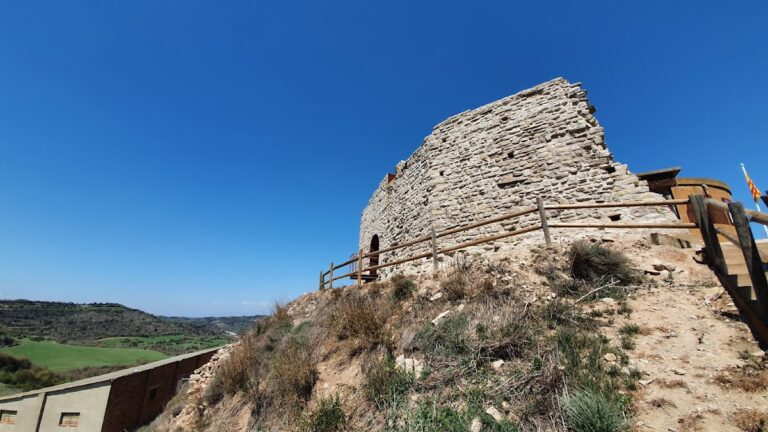
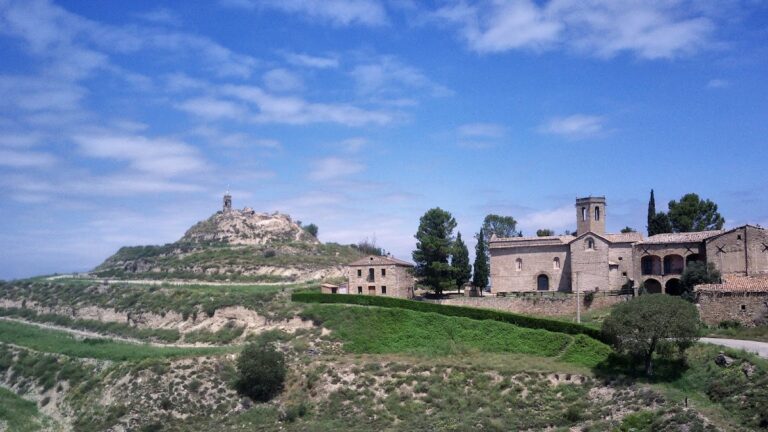
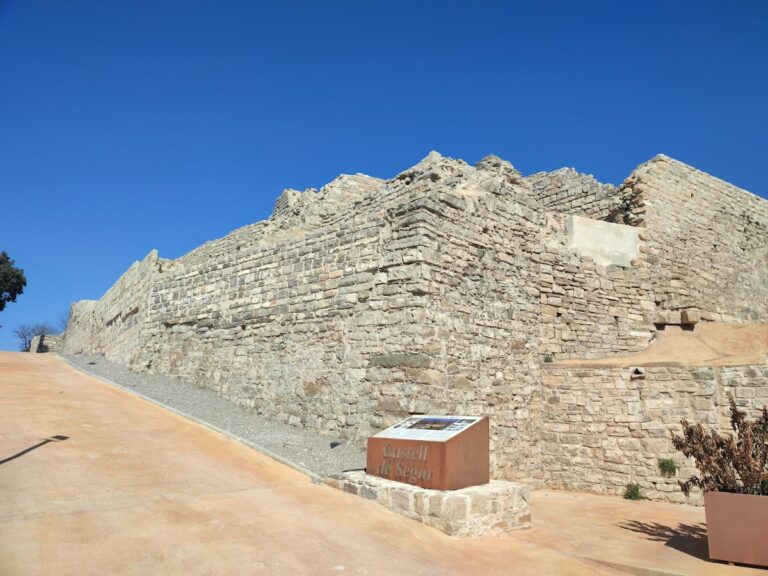
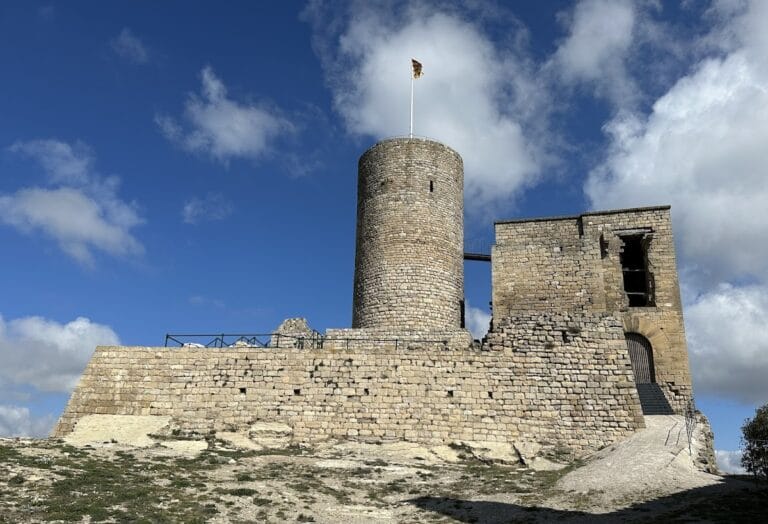
The castle occupies the summit of a hill in the upper part of Calaf. From this position, it controlled the town and the surrounding plain, across which several important communication routes passed. The surviving fortress has a polygonal plan with five sides of slightly different lengths, measuring approximately 28 metres in both width and length. It is regarded as one of the important fortifications in its district and can be considered alongside other polygonal-plan buildings, including the nearby Castle of Mirambel.
The perimeter walls are between 270 and 300 centimetres thick, and their surviving height exceeds 10 metres in some sections. They are formed from large, carefully squared stone blocks, approximately 30 by 35 centimetres, laid with their long faces along the wall in orderly courses. The entrance is on the southern side, facing the town. A circular structure once occupied the northeastern angle, but it has completely collapsed.
Nearby sites