Fort of El Desnarigado: A Coastal Military Fort in Ceuta


Site at a Glance
- Rating
- 4.6
- Popularity
- Low
- Country
- Spain
- Primary era
- Modern
- External website
- Open
- Eras represented
- Early Modern, Modern
- Civilizations
- Spanish
- Site type
- Military
- Remains
- Fort
On this page5 sections
History
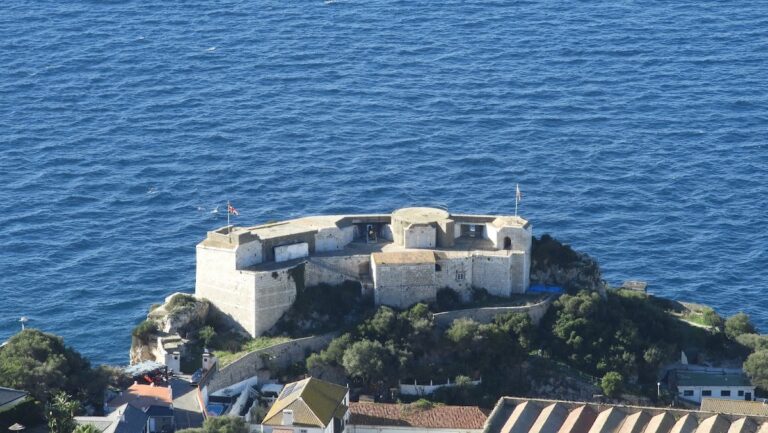
The Fort of El Desnarigado is a nineteenth-century military fort in Ceuta, Spain, built on the coastal edge of Monte Hacho. Its military architecture replaced earlier defensive structures on the site and remained active until the beginning of the twentieth century.
Seventeenth-Century Origins
A small fortification was planned here in the late seventeenth century, although only scant remains of that work survive. The name El Desnarigado refers to a Berber slave who escaped from the mines of the Rif, the mountainous region of northern Morocco, after his nose was amputated during captivity. He and other escaped slaves reached Portuguese Ceuta and landed on a small beach that took his name. They later settled on a nearby hill used as a hideout after pirate raids in the Strait of Gibraltar.
Nineteenth-Century Fort and Later Use
The present fort was constructed in the nineteenth century and continued in military service until it was progressively abandoned, becoming permanently unused at the beginning of the twentieth century. It was later rehabilitated and converted into a military museum, which opened in 1984. The museum assembled military objects associated with the history of Ceuta.
In the late 1990s, Spain’s Ministry of Culture listed the fort as a protected heritage site under registration number RI-53-0000500-00015.
Remains
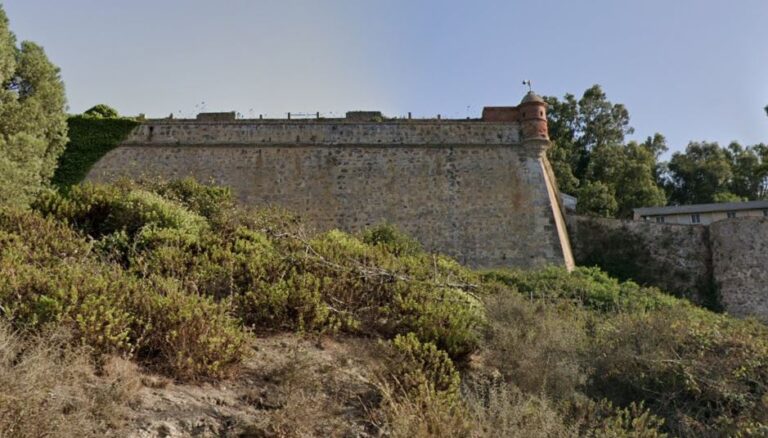
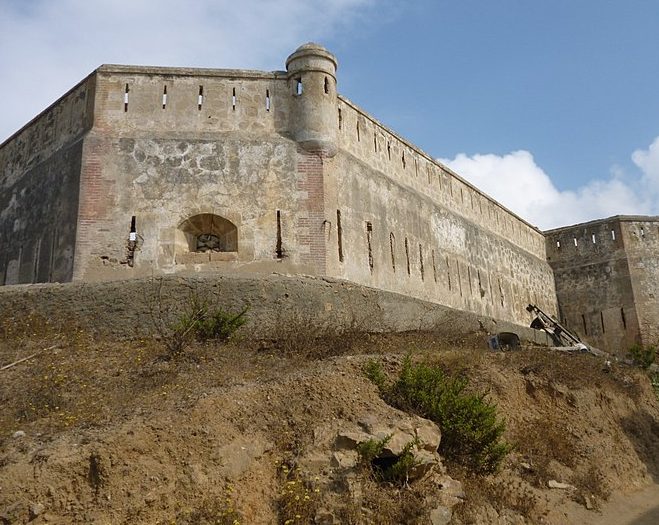
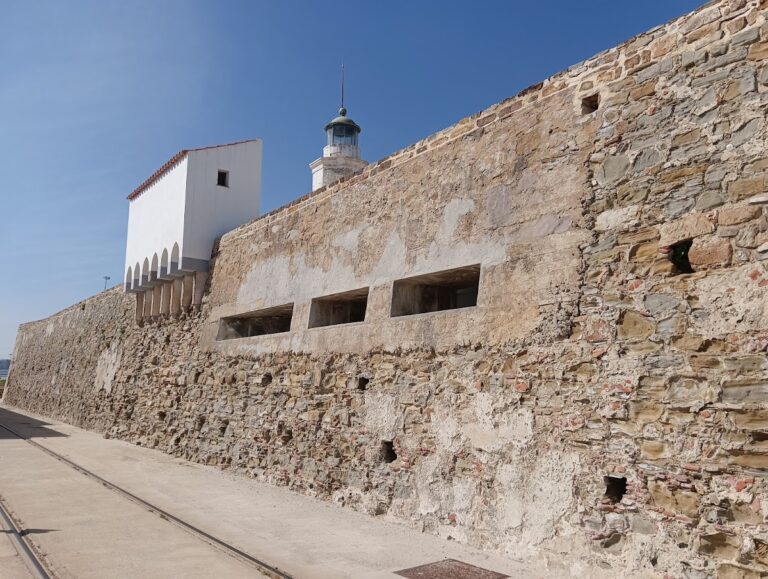
The Fort of El Desnarigado occupies approximately 1,280 square metres on the southern coastal edge of Monte Hacho, a prominent mountain and headland on Ceuta’s eastern side. The surviving complex is a single-storey nineteenth-century military work arranged in a front section with two side wings running parallel to the coast.
Entrance and Defensive Structures
Two towers, each six metres high, flank the entrance. Their tops carry battlements, the raised and regularly spaced projections used along defensive walls and towers. The entrance also bears a reproduction of the coat of arms of the Habsburg monarchy, the dynasty whose Spanish branch ruled Spain through much of the sixteenth and seventeenth centuries. The remains of the earlier seventeenth-century fortification are barely preserved.