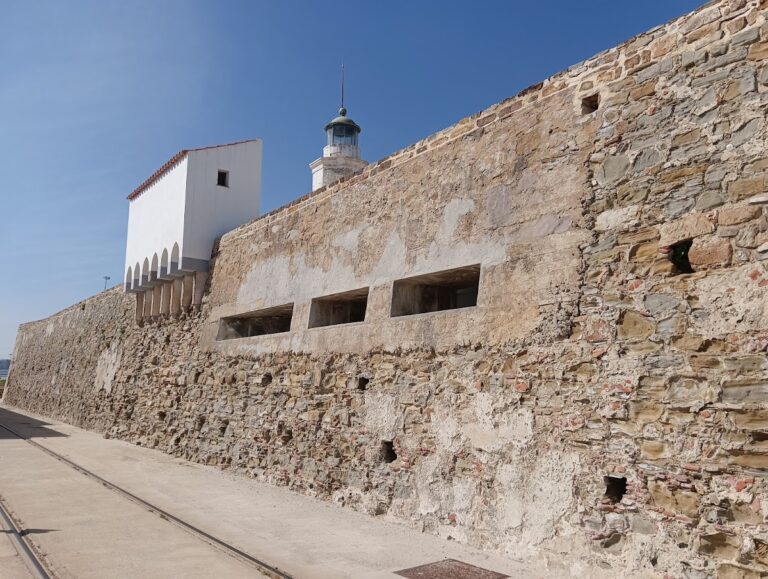
Fort of Monte Hacho, Ceuta: A Historic Fortress and Military Garrison


Site at a Glance
- Rating
- 4.2
- Popularity
- Very Low
- Country
- Spain
- Primary era
- Early Modern
- External website
- Open
- Eras represented
- Classical, Medieval, Early Modern, Modern
- Civilizations
- Byzantine, Roman, Spanish, Umayyad
- Site type
- Military
- Remains
- Fort
On this page8 sections
History
Ancient and Umayyad origins
The Fort of Monte Hacho is a historic fortress in Spain, with origins probably Roman or Byzantine. The Byzantine Empire was the eastern Roman Empire, whose territories included parts of the western Mediterranean and North Africa during late antiquity. A Byzantine garrison already occupied the site in AD 534.
The fort reached its greatest dimensions during the Umayyad conquest. The Umayyad period was the rule of the first hereditary caliphate, which expanded across North Africa and the Iberian Peninsula during the seventh and eighth centuries. At that time, no populated settlement stood beside the fort.
Portuguese and Spanish rule
Under Portuguese and Spanish rule, Monte Hacho may have served as a citadel or as a final refuge if Muslim forces captured the port and city. The growing effectiveness of artillery later made it more difficult to defend Ceuta from the mountain.
In 1597, Iñigo de Arroyo Santisteban, the corregidor, or Spanish administrative official, of Gibraltar arranged for the engineer Cristóbal de Rojas to visit Ceuta. Rojas was instructed to inspect the castle and reform the city’s port.
The eighteenth-century fortress and later use
The present fortress was built in 1773 after a proposal by the fortification planner Juan Caballero. His plan included forty towers, a barracks for 200 soldiers, and a powder magazine, a building for storing gunpowder, with a capacity of 200 quintals. A quintal was a traditional unit of weight whose exact value varied by place and period.
In 1870, the fortress became a prison. This change followed the Prison Law of 1849, which required people sentenced to life imprisonment to serve their terms in Ceuta and other minor African penal settlements. The fort was later enlarged with additional enclosures as its requirements changed. Its prison function has ended, and the complex now serves as an anti-aircraft artillery garrison, a military facility equipped to defend against aircraft.
The Fort of Monte Hacho has Spain’s generic protection for historic castles and was declared an Asset of Cultural Interest in 1997 in the category of Monument. An Asset of Cultural Interest is Spain’s formal heritage-protection designation for historically, artistically, or archaeologically important properties.
Remains
Fortified enclosure
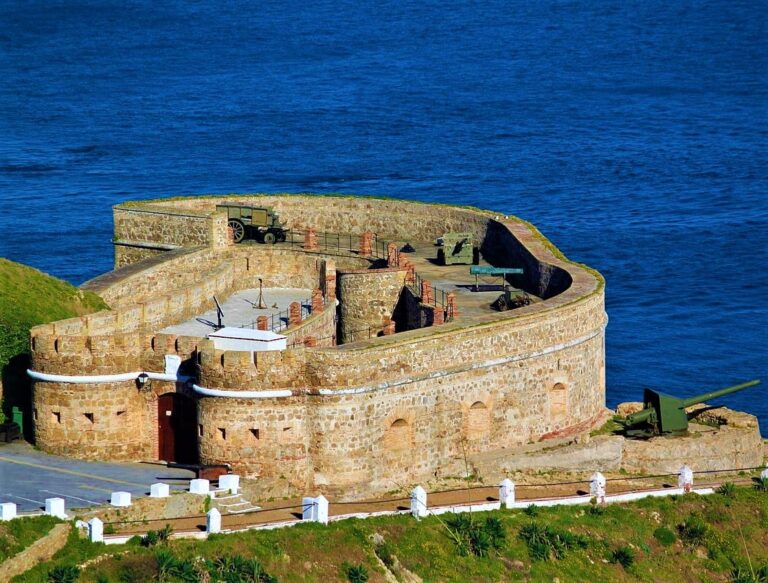
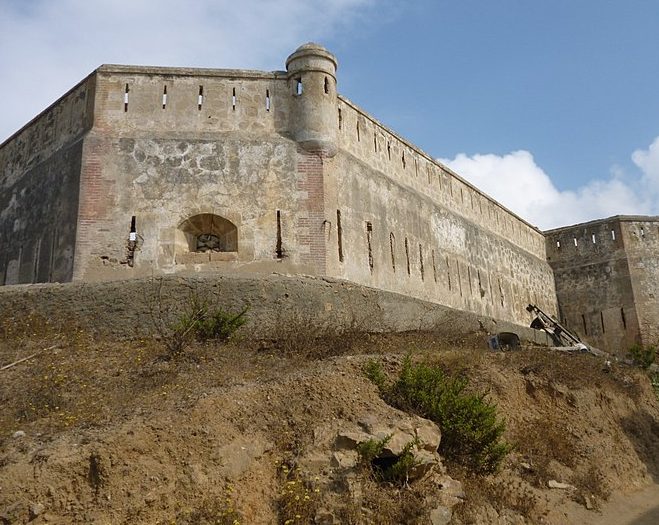
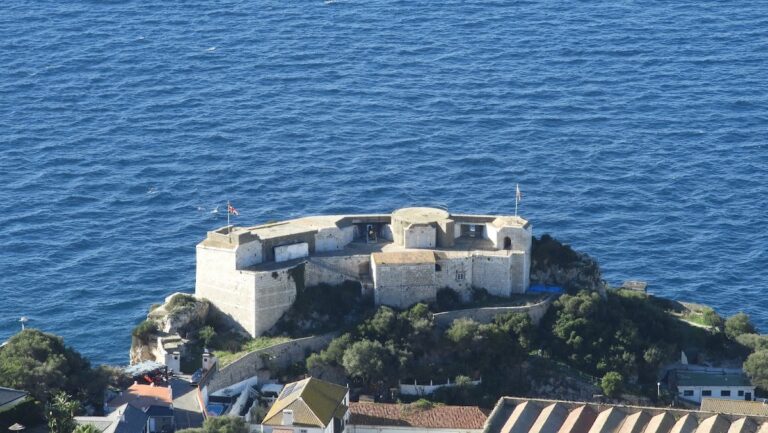
The fortress stands on Monte Hacho at approximately 190 metres above sea level and about 800 metres from Ceuta’s urban centre. Its fortified enclosure covers approximately 10 hectares. Towers, artillery bastions, and curtain walls organize the complex. A bastion is a projecting part of a fortification that allows artillery and defenders to cover adjoining walls, while a curtain wall is a fortified wall linking towers or other defensive works.
More than forty circular towers from the Umayyad period form part of the enclosure. Five eighteenth-century artillery bastions were built at the Puerta de Málaga, San Antonio, San Amaro, Tenaza, and Fuentecubierta. Each could accommodate four medium-sized cannon.
Named defensive works
The Tenaza consists of two bastions set at a 90-degree angle. The bastions contain sentry boxes, and some also carry a modern bunker on top. Other named defensive components include the Tenaza and its Pastel, the Puerta de Ceuta, the San Amaro and San Antonio bastions, the Málaga bastion, the Puerta de Málaga with its guardhouse, and the Fuentecubierta bastion.
Interior buildings
Within the enclosure are the Casa del Vigía, the prison barracks with a cistern, a barracks building, and other smaller structures. A cistern stores water, while the guardhouse at the Puerta de Málaga accommodated guards.
Nearby sites