Parson’s Lodge Battery: A British Coastal Fortification at Rosia Bay, Gibraltar


Site at a Glance
- Rating
- 4.5
- Popularity
- Very Low
- Country
- United Kingdom
- Primary era
- Modern
- External website
- Open
- Eras represented
- Early Modern, Modern
- Civilizations
- British
- Site type
- Military
- Remains
- Fort
On this page18 sections
History
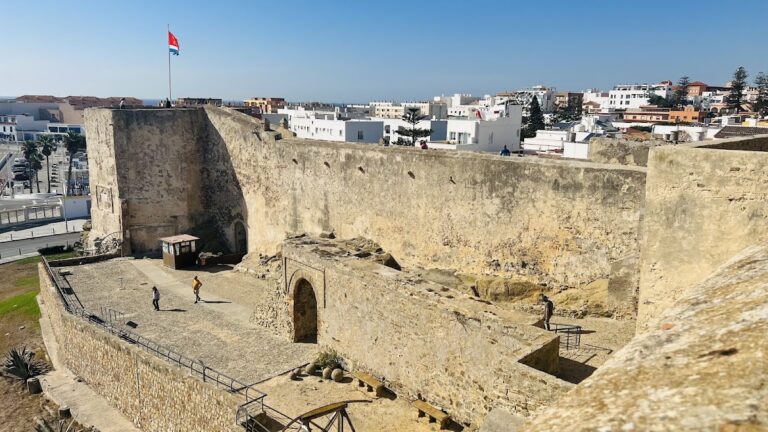
Parson’s Lodge Battery is a British coastal battery and fort at Rosia Bay in Gibraltar, United Kingdom, built in limestone to defend the harbour and its maritime approaches. The British took possession of Gibraltar in 1704, after more than 250 years of Spanish occupation. By 1720, the defences at the site included two 18-pounder guns and two 12-pounder guns.
From Rosia Battery to Parson’s Lodge
The installation was originally known as the 9th Rosia Battery. The name Parson’s Lodge first appears in 1761 and is traditionally linked to the dwelling of the parson attached to St. John the Green, a church and hermitage. Rosia Bay was Gibraltar’s only natural harbour, and its defensive importance increased as more guns were placed around it. By 1744, more than 20 guns protected the bay.
An eighteenth-century gun position at the battery covered Camp Bay from about 1725. It remained in use until 1840, when a much larger battery was constructed to its left. Another position also covered Camp Bay and formed part of the earlier defensive arrangement.
The nineteenth-century expansion
Major-General John Thomas Jones, a senior British Army officer responsible here for inspecting and advising on Gibraltar’s fortifications, arrived in October 1840. He remained until June 1841 and recommended improvements to Parson’s Lodge Battery. A larger installation was built in about 1842 and initially carried eight guns.
The battery reached a major phase of military development by 1873, when it was adapted for three 18-ton, 10-inch rifled muzzle-loading guns. These guns were loaded from the front and used grooves inside their barrels to improve the stability and range of their projectiles. They fired 400-pound shells over approximately 4 kilometres. From 1873 to about 1892, the guns stood in shielded embrasures protected by layered iron and teak mantlets known as Gibraltar Shields.
Twentieth-century defence and later use
Parson’s Lodge Battery served during both World Wars. In 1941, anti-aircraft and anti-tank guns, together with searchlights, were installed. Other positions were arranged to cover possible landing areas in Camp Bay and Little Bay. The battery was abandoned for military use in the 1950s.
Gibraltar Heritage Trust extensively restored the site in 1994. Its grounds now include a field centre belonging to the Gibraltar Museum. Under the Gibraltar Heritage Trust Act, a wall extending from the battery to Buena Vista Barracks and the Machicouli Gallery above Camp Bay are protected List A assets. The Act transferred these and many other heritage assets to the Gibraltar Heritage Trust in 1989.
Remains
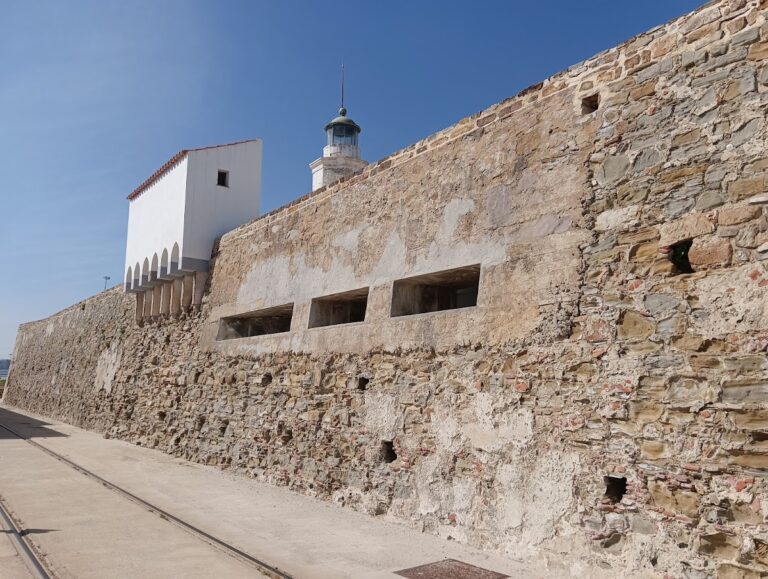
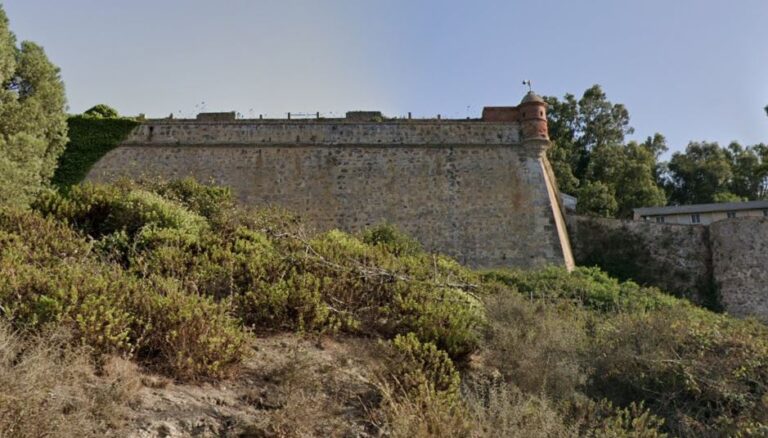
Parson’s Lodge Battery is a substantial limestone coastal fortification at Rosia Bay and survives in good condition. Its remains combine the principal nineteenth-century battery with earlier gun positions, underground spaces, ammunition stores, searchlight installations, wartime defences, and supporting structures. A narrow tunnel beneath the fort now serves as a road tunnel. It formerly carried a one-metre-gauge railway and was one of two tunnels built in the 1880s to move quarried stone from Camp Bay to the harbour’s South Mole.
The principal battery
Gun positions and Gibraltar Shields
The principal limestone battery replaced the earlier positions in about 1842. By 1873, a corridor in front of the gun emplacements served three positions for 10-inch rifled muzzle-loading guns. Manufactured at Woolwich, the 18-ton guns fired 400-pound projectiles to about 4 kilometres. Their protective Gibraltar Shields consisted of thick iron layered around teak planks. The shielded embrasures remained in use from 1873 until about 1892.
Shell and cartridge storage
A shell store held 400-pound, 10-inch solid armour-piercing projectiles, while one position had earlier served as a side-arms store, effectively a tool shed. Two cartridge stores contained 44-pound and 70-pound charges in bags and tins. A cartridge hoist at the end of the corridor, together with another in an associated position, raised cartridges and shells to the guns above.
Lighting arrangements
A lighting passage allowed the cartridge stores to be illuminated safely. Its fittings included spark-free copper components, rope shoes, and passages or niches fronted with plate glass for the lamps used to light the magazines. An oil-lamp room provided space to store and service the lamps.
Earlier and wartime positions
Eighteenth-century Camp Bay positions
The earlier position covering Camp Bay from about 1725 was at one stage equipped with a 24-pounder smooth-bore gun. It fired solid shot to approximately 1.8 kilometres. A second eighteenth-century position overlooking the same bay was at one stage armed with a 9-pounder gun, whose shot had a range of about 1.3 kilometres.
Landing-defence positions
Two 6-pounder positions were intended to oppose landings in Camp Bay and Little Bay. Their guns rested on concrete blocks rather than the pedestal mounting used at the earlier position. The threshold of one records that the work was completed on Christmas Eve 1941 by the Somerset Light Infantry.
Lower Parsons
The underground position known as Lower Parsons housed a 6-pounder gun from April 1941 until the end of the Second World War. It covered landing places in Rosia Bay and fired a 6-pound shell to a range of about 3.7 kilometres.
Machine-gun defences
A medium-machine-gun position accommodated a Vickers weapon firing .303-inch ammunition at approximately 500 rounds per minute. Flanking positions were intended for riflemen equipped with .303-inch Short Magazine Lee-Enfield rifles. A shaft led to another underground defensive position containing two medium machine guns and two rifle apertures in the cliff face overlooking possible landing areas in Camp Bay and Little Bay.
Searchlights, magazines, and boundary features
Coastal-artillery searchlights
Between 1898 and 1956, buildings at the battery housed 90-centimetre coastal-artillery searchlights. Each produced 200 million candlepower and projected a concentrated beam three degrees wide for about 4,600 metres, allowing ships or landing areas to be illuminated at night.
Expense magazines
Four limestone expense magazines stored cartridges and projectiles ready for use. The northernmost contained shell-hoisting equipment and was later topped by a Bren-gun position during the Second World War; that position has since been removed. The second magazine had a cartridge hoist and later supported a 90-centimetre anti-aircraft searchlight. The third carried a 3-inch anti-aircraft rocket projector installed on 16 October 1942, which has also been removed. The fourth still carries a Bofors 40-millimetre light anti-aircraft-gun position completed on 16 November 1941.
Personnel shelters and the Admiralty marker
Several corrugated-iron personnel shelters protected staff who were not manning the firing positions. Their form gave them the nickname “elephant shelters.” An Admiralty boundary marker is set into a wall that marked the physical division between the Royal Artillery battery and the Royal Naval Victualling Yard, a naval supply installation built in 1808.
Nearby sites