Fort VII: A Prussian Artillery Fort and Wartime Internment Camp in Toruń


Site at a Glance
- Rating
- 4.4
- Popularity
- Low
- Country
- Poland
- Primary era
- Modern
- External website
- Open
- Eras represented
- Modern
- Civilizations
- German, Kingdom of Prussia
- Site type
- Military
- Remains
- Fort
On this page10 sections
History
Fort VII is a former Prussian artillery fort in Toruń, Poland, built between 1880 and 1883 as part of the nineteenth-century Toruń Fortress, a defensive system of forts and military installations. It was the last major fort constructed in the fortress and became one of its principal artillery positions.
Construction and Prussian modernization
The site was initially designated Fort IV and later named Fort Friedrich der Grosse. Construction began in 1879 and cost 2,410,568 German marks. During the 1890s, the fort was adapted to withstand fire from 150 mm artillery. Its underground masonry structures received a one-metre concrete covering, while armored shutters were installed in the living quarters. An electrical supply was added in 1898, and in 1911 vegetation and barbed wire further concealed and protected the fort.
Polish administration and wartime conversion
After 1920, when the fort was renamed Fort Tadeusz Kościuszko, it had been heavily damaged by departing Prussian troops. The Polish Fortress Administration converted it into a hospital for venereal diseases and later adapted it for barracks and storage. The work was limited. Electrical installations were repaired, while the gates, bridge, and surrounding fence were repainted rather than comprehensively renovated.
Internment camp under German occupation
Around 15 October 1939, during the German occupation of Poland, Fort VII became an internment camp for civilians. Wehrmacht soldiers, the German armed forces, initially guarded the site, while the SS and police retained unrestricted access. On 26 October, the Selbstschutz, a German paramilitary organization involved in the persecution and imprisonment of Polish civilians, formally assumed control. Karl Friedrich Strauss, a local German carpenter, became commandant, with Bronisław Schönborn as his deputy.
The first prisoners were Poles transferred from the cells of Toruń prison at 53 Piekary Street, popularly called the Roundhouse. After 17 October, a large-scale operation against residents considered politically unreliable brought between 600 and 1,200 people from Toruń and the surrounding district into the fort. Prisoners were also sent from the Chełmno, Lipno, Wąbrzeźno, Brodnica, and Rypin districts, making Fort VII the central prison for the entire Second Selbstschutz Inspectorate.
Estimates of the number held at one time range from 700 to 1,000–1,200 people, with some estimates reaching 1,500. Approximately 3,000 prisoners passed through the Toruń camp altogether. Cells intended for six to twelve soldiers commonly held 50 to 80 prisoners. They slept on thinly scattered straw and generally used their own coats as blankets. Poor sanitation led to widespread lice infestation and scabies. Meals consisted of black coffee and coarse bread in the morning, fat-free barley soup with a small amount of potatoes at midday, and black coffee in the evening. Family parcels provided the main safeguard against starvation.
Guards frequently abused prisoners, and Strauss became particularly notorious for physical and psychological violence. From the camp’s first days, a special commission of Gestapo officers and local Selbstschutz members decided the fate of each prisoner. The Gestapo was Nazi Germany’s secret state police. The commission relied on interrogations, often accompanied by beatings, as well as questionnaires and autobiographical statements prepared by the prisoners.
Executions, deportations, and later uses
At least 600 prisoners were shot in the nearby Barbarka forest between 28 October and 6 December 1939. The Selbstschutz was dissolved on 26 November, after which mass executions largely gave way to deportations to concentration camps. Prisoners from the Chełmno and Wąbrzeźno districts who arrived after the dissolution consequently avoided execution.
On 8 January 1940, approximately 100–200 prisoners were taken from the fort to a transit camp in Gdańsk’s New Port. After several days, almost all were transferred to Stutthof concentration camp, a Nazi camp established near Gdańsk in occupied Poland. Fort VII was empty by 10 January. By the end of that month, the internment camp had moved to nearby Fort VIII, where it continued until its final liquidation in July 1940.
After the Second World War, Fort VII housed a wine-bottling plant. In 1976, the left shoulder caponier became the site of the Wall of Death national memorial, commemorating prisoners held at the fort who were later murdered at Barbarka. The interior and courtyard of the caponier were cleaned in 2019, and its facade was cleared of graffiti in autumn 2021.
Remains
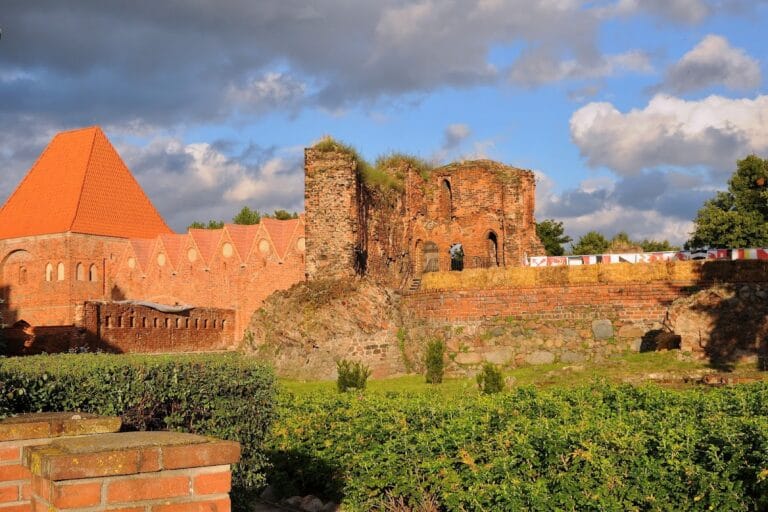
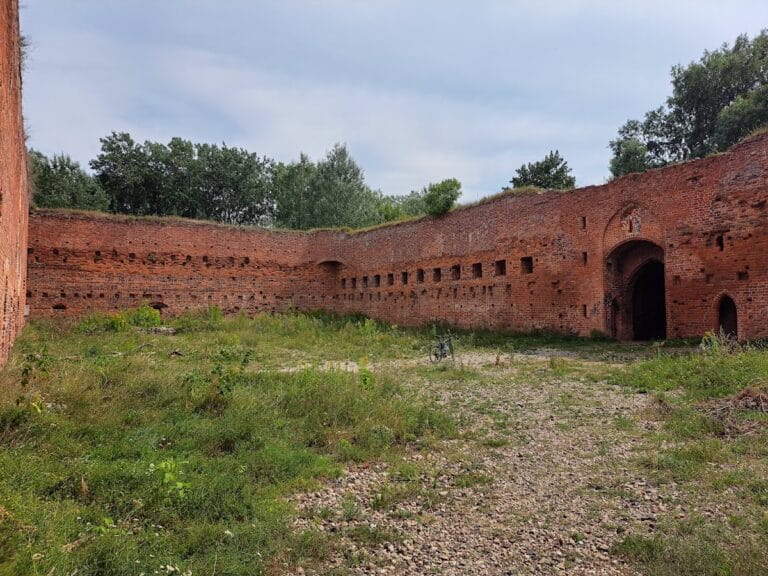
Fort VII occupies 4.2 hectares and follows a pentagonal plan. Its layout substantially altered the earlier concept of a complete artillery fort. The design replaced the planned extensive earthen ramparts with a different arrangement of masonry and protected spaces, while the main entrance was approached across an iron drawbridge.
Fortified layout and defensive structures
Magazines and gorge barracks
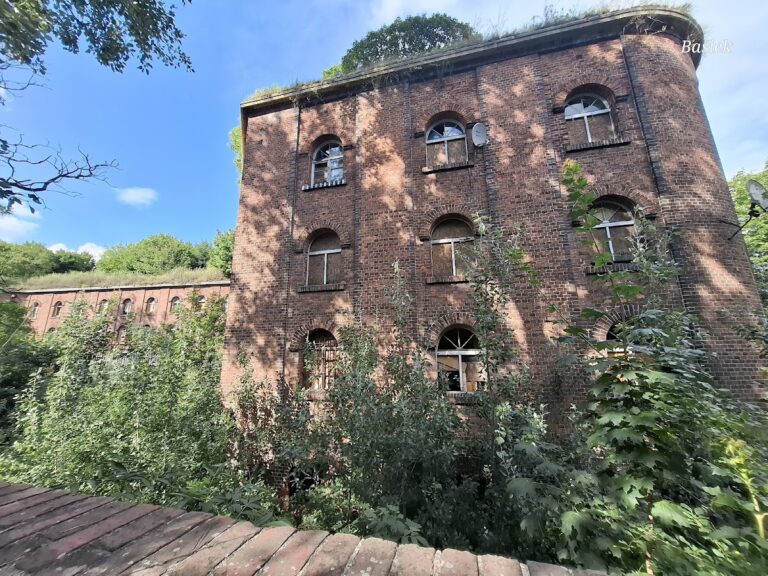
The powder magazine was moved from the fortress’s left shoulder to a magazine beside the main postern, a concealed or secondary passage through a fortification. Two-storey barracks were built along the gorge, the rear side of the fort. The plan also omitted passageways with firing slits, and the blockhouse, a strongly fortified military structure protecting an entrance or defensive work, was repositioned.
Modernized underground works
During the 1890s modernization, the underground masonry structures were protected by a one-metre layer of concrete. The living quarters were fitted with armored shutters. The fort’s artillery could reach the area around Olek, linking its surviving defensive arrangement to the wider military landscape of the Toruń Fortress.
Left shoulder caponier and memorial
The left shoulder caponier, a fortified structure projecting into or protecting a defensive ditch, contains the Wall of Death memorial established in 1976. Its interior and courtyard were cleaned in 2019, while the facade was cleared of graffiti in 2021. Nearby, the Glorious Stones monument commemorates soldiers of the 5th Prussian Infantry Regiment from 1915.
Nearby sites