Schloss Wilhelmsthal: A Baroque Summer and Hunting Residence in Germany


Site at a Glance
- Rating
- 4
- Popularity
- Low
- Country
- Germany
- Primary era
- Early Modern
- External website
- Open
- Eras represented
- Early Modern, Modern
- Civilizations
- German, Holy Roman Empire
- Site type
- Domestic
- Remains
- Palace
On this page16 sections
History
Schloss Wilhelmsthal is a former summer and hunting residence in Germany, located in the Elte valley near Eisenach in Thuringia. Developed by the dukes of Saxe-Eisenach between 1698 and 1719, it combined Baroque pavilions, terraced gardens, hunting facilities, and a lake within a princely landscape. Its concert hall also became associated with the premieres of works by Georg Philipp Telemann.
From hunting ground to ducal residence
The settlement was first mentioned in 1349 as Wintershusen. Its forests and meadows later served as a hunting ground for the high nobility. After the Thirty Years’ War, the few forest farmers who returned were moved to neighboring settlements because their work disturbed the game. Only an inn and a forester’s station were allowed to remain.
The place received the name Wilhelmsthal in 1699, honoring Duke Johann Wilhelm of Saxe-Eisenach. From 1698 to 1719, the hunting establishment grew into a residential complex with sixteen multi-storey Baroque pavilions. Between 1709 and 1715, the architect Johann Mützel reshaped it as a summer residence with animal enclosures and terraced gardens.
The original arrangement centered on a formal axis and included a body of water created by damming the Elte. A direct road from Eisenach through the Hohe Sonne hunting lodge improved access to the residence, and its course is still followed by Federal Highway 19.
Rococo transformation and musical life
When the Saxe-Eisenach line ended in 1741, its territories passed to the related Saxe-Weimar line and became part of Saxe-Weimar-Eisenach. Duke Ernst August then commissioned his court architect Gottfried Heinrich Krohne to remodel Wilhelmsthal. Several of the Baroque pavilions were replaced or altered in the Rococo style, an eighteenth-century style known for lighter forms, curved ornament, and elaborate decoration.
Between 1716 and 1725, Georg Philipp Telemann’s music was performed in the palace concert hall. Seven serenade performances for members of the ducal family are recorded, with ensembles of between 25 and 30 musicians. Telemann had served at Johann Wilhelm’s court from 1706 to 1712, and a 1717 agreement required him to continue sending sacred and secular compositions to Eisenach while reserving them for that court. Wilhelmsthal is regarded as the last surviving secular venue where his works received their premieres.
Landscape garden and nineteenth-century use
A landscape garden replaced the earlier formal park arrangement around 1800. Grand Duke Carl Alexander had the grounds redesigned between 1852 and 1855 according to ideas by Hermann von Pückler-Muskau, a German aristocrat and landscape designer associated with naturalistic parks. The landscape designers Hermann Jäger and Eduard Petzold worked on the project, which focused especially on the outlines of wooded areas and meadows. Pückler’s proposed extension toward Eisenach and the Wartburg through the Thuringian Forest was never completed.
Wilhelmsthal received distinguished guests, including Franz Liszt and Emperor Alexander I of Russia. Grand Duchess Maria Pavlovna spent summers there and organized literary gatherings. Johann Wolfgang Goethe visited several times. An anecdote says that he toppled park statues he disliked during a stay in the 1770s. Goethe’s novel Elective Affinities was later written at Wilhelmsthal, and tradition also connects him with the Italianate façades facing the lake.
Changing ownership and postwar uses
The grand-ducal family retained the property until 1941, when it was sold to the Thuringian Ministry of Finance. The Wehrmacht, the armed forces of Nazi Germany from 1935 to 1945, requisitioned the complex between 1942 and 1945 and used it as a military hospital.
After the Second World War, Wilhelmsthal became a children’s home and remained in that role until 1993. The Wilhelmsthal Children’s Village opened on 27 September 1947 under the Volkssolidarität, a state-affiliated social-welfare organization in the German Democratic Republic, and state administration. It housed war orphans and was later renamed the Ernst Thälmann Children’s Home. The new use altered the complex, and the Telemann Hall became a dining hall.
A bungalow village for the Young Pioneers’ Maxim Gorky holiday camp opened near the palace in summer 1964. The Young Pioneers were the GDR’s state youth organization. After the children’s home closed, the vacant buildings deteriorated. The former holiday-camp area now contains a vocational training center.
Protection and restoration
The listed palace and garden complex was offered for sale by the state of Thuringia from 2001 without success. The Foundation of Thuringian Palaces and Gardens acquired it in June 2009 and began securing and restoring the monument.
Work included repairs to part of the landscape park in 2011, the central stable building and its clock tower in 2014, and the lake dam and other grounds in 2015. The southern part of the New Palace and the exterior of the Telemann Hall were repaired, while interior restoration of the hall began in 2020. Some additions from the GDR period beside the stable building were removed, and a visitor parking area was created.
Remains
Schloss Wilhelmsthal occupies the Elte valley as a connected palace, garden, hunting, service, and water landscape. The principal Baroque plan used a central axis lined with pavilions, with terraced gardens and animal enclosures accompanying a formal lake formed by damming the Elte. Later Rococo rebuilding, nineteenth-century landscape design, and twentieth-century additions have all shaped the surviving arrangement.
Palace and concert buildings
Telemann Hall
The oval ceremonial and concert hall was inaugurated in 1714 and is now known as the Telemann Hall. Regarded as one of Europe’s oldest free-standing concert halls, it was large enough for ensembles of 25 to 30 musicians. Its historic stucco ceiling was once considered acutely threatened by collapse. The exterior was restored in 2015 with new windows and shutters, a white finish modeled on its appearance around 1910, and a renewed roof. Interior restoration began in 2020.
New Palace and Neoclassical pavilion
A Neoclassical pavilion opposite the Telemann Hall was enlarged by the architect Littmann by 1913 to create modern living quarters for the grand-ducal family. Neoclassicism revived the formal architectural vocabulary of ancient Greece and Rome. The future Karl August, the last Hereditary Grand Duke of Saxe-Weimar-Eisenach, was born there in 1912.
The southern part of the New Palace, including the Telemann Hall, received exterior repairs in 2015. The work renewed the roof and windows and restored the building’s white exterior treatment.
Gardens and water
Landscape garden
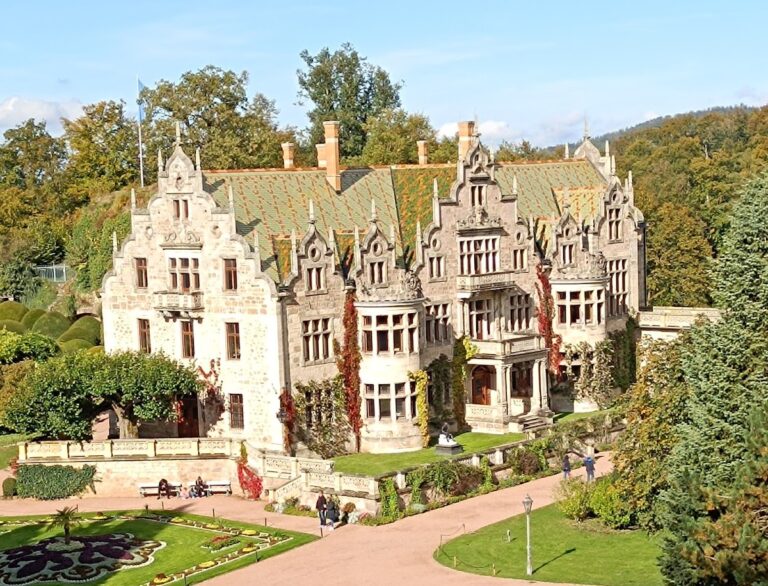
The landscape garden contains broad meadows, wooded margins, a flower island, and ornamental plantings. Its nineteenth-century redesign concentrated on the contours of the woodland edges and meadow spaces, giving the grounds a form distinct from the earlier terraces and formal water arrangement.
Lake and dam
The lake was created by damming the Elte as part of the original residence. It later served as a boating and recreation pond. The dam was repaired during restoration work in 2015.
Stables and service buildings
Stable complex
The stable complex was enlarged with an additional wing and a remise, a building or wing for carriages and transport equipment. Its central section contains a clock tower. Restoration of the central section and tower took place in 2014, while some later additions beside the building were removed.
Swiss House and Waldhaus
The ensemble included the Swiss House and other service buildings. The Swiss House dates to 1802. The Waldhaus, built around 1780, served as a guesthouse. The Princess House and Prince House were also part of the wider group of buildings associated with the residence.
Nearby sites