Schloss Ponitz: A Renaissance Manor Castle in Germany


Site at a Glance
- Rating
- 4.6
- Popularity
- Low
- Country
- Germany
- Primary era
- Early Modern
- External website
- Open
- Eras represented
- Medieval, Early Modern
- Civilizations
- Holy Roman Empire
- Site type
- Domestic
- Remains
- Castle
On this page10 sections
History
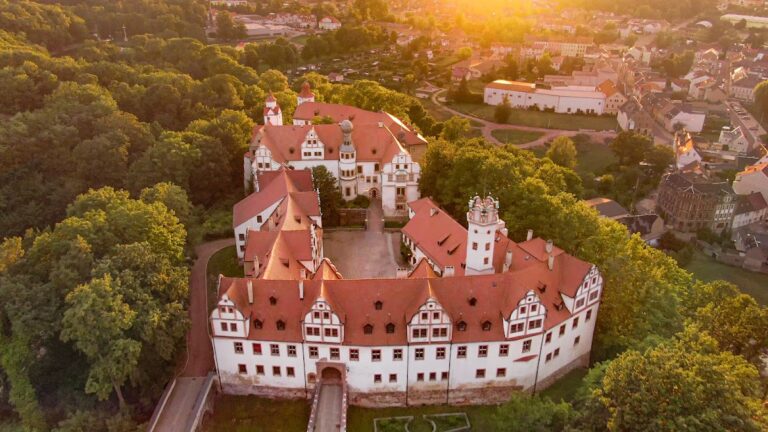
Schloss Ponitz is a former moated castle in Ponitz, Germany, extensively rebuilt in the Renaissance style between 1568 and 1574. Its first recorded owner was Fridericus de Ponicz, who was named in 1254 while witnessing a donation. The castle later formed part of a manor whose authority and ownership shifted among noble families and the ruling houses of Saxony and Thuringia.
Medieval Lordship
A church and manor farm were recorded at Ponitz in 1349. During 1349 and 1350, the Bohemian Schönburg-Pirsenstein lords Friedrich XIII and Albrecht I held the castles of Ponitz and Lichtenstein. The Schönburg-Pirsenstein family was a Bohemian noble house with estates and lordships in the region.
By 1418, the lords of Ende owned the Ponitz manor. The Schönburg family apparently controlled the lordship, and perhaps the castle, by 1525. That year, Ernst II von Schönburg ordered the arrest and imprisonment of the sacristan Georg Droßdorf in Glauchau after Droßdorf had preached in German instead of allowing the parish priest to preach. Droßdorf was later mutilated by having both ears cut off.
Manorial Disputes and Renaissance Rebuilding
In 1531, the Ponitz manor included all or parts of Ponitz, Hainichen, Schönhain, Kauritz, Runsdorf, Tautenhain, Gieba, Köthel, Gablenz, and Waldsachsen. From 1531 to 1533, Ernst II von Schönburg engaged in a lengthy legal dispute with the Wettins over the feudal authority governing the manor. The Wettins were a major German ruling dynasty whose branches governed several Saxon and Thuringian territories.
Abraham von Thumbshirn purchased the manor in 1568 and commissioned the extensive rebuilding of the medieval moated castle. The work, completed by 1574, transformed the older fortified residence into the Renaissance castle that established its present form.
Wolfgang Conrad von Thumbshirn and Later Owners
Wolfgang Conrad von Thumbshirn was born at Ponitz in 1604 and died in Altenburg in 1667. As a diplomat of the Duchy of Saxe-Altenburg, he co-signed the peace treaty that ended the Thirty Years’ War in 1648 and played a major role in the negotiations. The war was a European conflict fought from 1618 to 1648, and its conclusion was formalized through the Peace of Westphalia. In connection with the achievement, the Peace Lime Tree was planted at Dreierhäuschen in 1650. From 1653, von Thumbshirn served as princely Saxe-Altenburg chancellor, the senior official coordinating the administration of the duchy.
His daughter Dorothea Felicitas von Thumbshirn married Volkmar Dietrich von Zehmen in 1675. Von Zehmen sold the manors of Weißbach and Nöbdenitz, including their castle, and moved to Schloss Ponitz. He died there in 1713, and a monument commemorates him.
In 1728, the Ponitz manor passed to Dorothea Elisabeth von Schönberg and Christiane Sibylle von der Planitz, both born von Zehmen. Together they donated the Silbermann organ for the inauguration of Ponitz’s new village church in 1734. Christiane Sibylle had married Carl August Edlen von der Planitz at Ponitz in 1700, and they had twelve children.
Later owners came from the von Weißenbach, von Ende, von Göchhausen, von Tümpling, von Uechteritz, and von Beust families. Ownership then passed to the bourgeois Stölzel family of Eibenstock and the factory-owning Schmieder family of Meerane. The Mälzer family of Frankenhausen were the last private owners and retained the estate until 1945.
Administrative Change and Modern Preservation
For centuries, Ponitz, its castle, and its manor belonged administratively to the Wettin Amt Altenburg under changing Saxon-Thuringian duchies. After the reorganization of the Ernestine duchies in 1826, Ponitz, the manor, and the castle again became part of the Duchy of Saxe-Altenburg. The Ernestine duchies were the Thuringian-Saxon territories ruled by the Ernestine branch of the Wettin dynasty.
In 1945, under the Soviet Military Administration in Germany, the Mälzer family was dispossessed without compensation and expelled from the 200-hectare manor and castle. The Soviet occupation authority governed the Soviet occupation zone after the Second World War, and its land reform brought the expropriation of many private estates. Since then, the municipality of Ponitz has owned the manor and Schloss Ponitz.
By the end of the German Democratic Republic period, the castle had deteriorated badly, with rainwater penetrating several floors. Building authorities closed the ballroom in 1987 because of structural danger. Restoration began in the 1990s, and the ballroom reopened in 2000. The castle later housed a library for a period and now serves as an events venue. The association Renaissanceschloss Ponitz supports its use and preservation. Schloss Ponitz is included in the list of cultural monuments of Ponitz.
Remains
The surviving site retains the character of a Renaissance residence developed from a medieval moated castle. Its principal architectural identity comes from the rebuilding carried out between 1568 and 1574, while the ballroom preserves painted sixteenth-century coffered ceilings. A coffered ceiling is divided into recessed geometric panels, here enriched with painted decoration.
Castle Interior and Associated Features
Ballroom
The ballroom is the castle’s best-known interior feature. Its painted sixteenth-century coffered ceilings belong to the Renaissance rebuilding and give the room its distinctive historical character. Structural deterioration made the ballroom unsafe by 1987, particularly as rainwater had entered several floors of the building. Restoration work enabled it to reopen in 2000, preserving its use as part of the castle’s renewed public function.
Monument to Volkmar Dietrich von Zehmen
A monument at or associated with Schloss Ponitz commemorates Volkmar Dietrich von Zehmen, who moved to the castle after selling his manors of Weißbach and Nöbdenitz and died at Ponitz in 1713. The monument preserves the connection between the building and one of its later owners.
Peace Lime Tree
The Peace Lime Tree at Dreierhäuschen is an explicitly associated natural feature. It was planted in 1650 in connection with Wolfgang Conrad von Thumbshirn’s diplomatic role in the treaty that brought the Thirty Years’ War to an end in 1648. Together with the castle, it forms part of the historical landscape associated with von Thumbshirn and his career.
Nearby sites