Heiligenburg Castle: A Medieval Hilltop Fortress in Germany
Site at a Glance
- Rating
- 4.7
- Popularity
- Low
- Country
- Germany
- Primary era
- Medieval
- Eras represented
- Iron Age, Medieval, Early Modern, Modern
- Civilizations
- French, German, Holy Roman Empire
- Site type
- Military
- Remains
- Castle
On this page10 sections
History
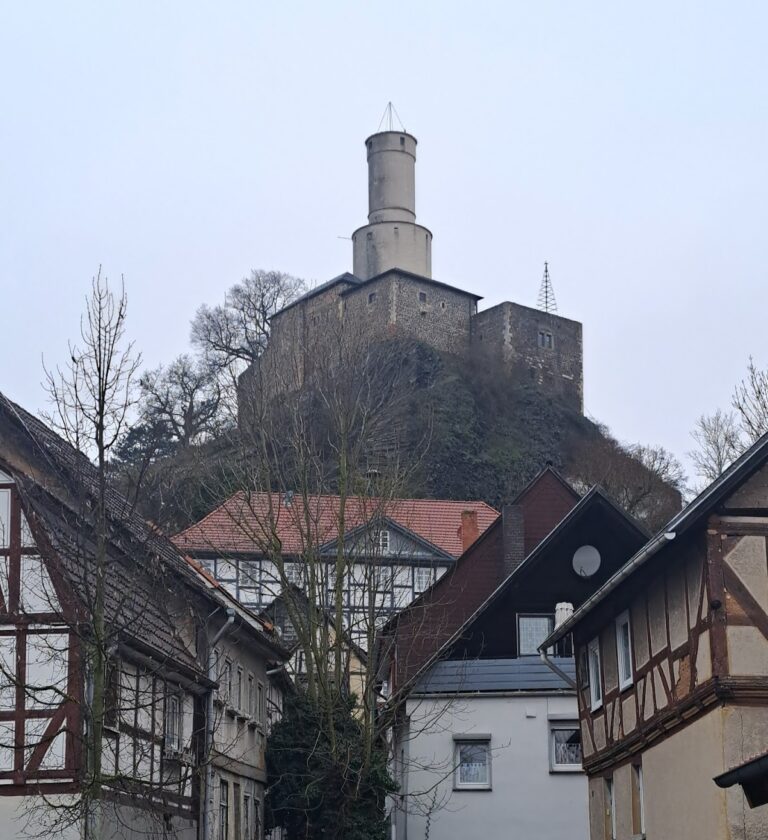
Heiligenburg Castle is a ruined medieval hilltop fortress in Germany, situated on the Heiligenberg above Gensungen in the Felsberg area of northern Hesse. The Archbishopric of Mainz built the stronghold between 1180 and 1186 on a strategically positioned basalt hill to defend its interests against Louis III, Landgrave of Thuringia. From this position between Felsberg, Gudensberg, and Melsungen, the castle threatened Fritzlar, the centre of Mainz power in northern Hesse and an important place within the Landgraviate of Hesse.
Before the medieval castle
The hill may already have been fortified during the La Tène period, an Iron Age archaeological culture of central and western Europe. Excavations have revealed a possible wall, pottery from the advanced La Tène B phase, and two bow fibulae dating from La Tène A/B. An early Christian chapel probably also stood on the summit. Its existence is suggested by an old bell clapper found on the hill, although the chapel is securely documented only from the fifteenth century, when it was described as a mountain chapel.
Before the castle was constructed, the hill belonged to local nobles, particularly the viscounts of Felsberg, who lived at nearby Felsburg. During the twelfth century, the Thuringian and Hessian landgraves disputed control of the site with the Archbishops of Mainz. Archbishop Conrad I of Mainz responded by building the fortress to strengthen Mainz’s position in the region.
Mainz and the landgraves
The new castle contributed to armed conflict between Mainz and the landgraves. The dispute reached King Henry VI’s court assembly at Erfurt on 26 July 1184, but no settlement followed. The meeting was overshadowed by the collapse of an Erfurt latrine, which caused many deaths.
Heinrich von Heiligenberg appears in the historical record in 1193 and was probably descended from the nobles of Uttershausen. From 1196 until the family’s extinction in 1263, members of the Isfried von Heiligenberg family served as Mainz castellans. A castellan, or castle official, defended and administered a stronghold on behalf of the Archbishopric of Mainz.
In 1232, Conrad of Thuringia, who administered the Hessian lands of the Thuringian landgraves, conquered and destroyed Fritzlar and Heiligenburg Castle. Mainz castellans from Wolfershausen rebuilt the fortress in 1247. Henry I, Landgrave of Hesse, destroyed it again in 1273, after which the castle was not immediately rebuilt and remained in ruins.
Later medieval use
Landgrave Hermann II built a smaller castle on the hill between 1401 and 1403. In 1471, his nephew, Landgrave Louis II, transferred it to the nearby Eppenberg Charterhouse, a Carthusian monastery whose monks followed a secluded, prayer-centred form of Christian monasticism. Louis required the monks to pray weekly in a chapel that was to be built on the hill for the salvation of his soul. The castle walls and chapel nevertheless fell into decay.
The earliest demonstrable pictorial representation of Heiligenburg Castle appears in the chronicle of Thuringia and Hesse by Wigand Gerstenberg, a late-medieval German chronicler. The image provides an early record of the ruined stronghold within the region’s historical tradition.
War, reforestation, and memorial plans
During the Seven Years’ War, a mid-eighteenth-century conflict involving several European powers, the Heiligenberg saw several small engagements. French troops camped on the hill for seven weeks in 1761, while allied troops camped at Felsburg. Two entrenchments on the slope remain associated with the French camp.
From around 1860, Forester Faber began reforesting the Heiligenberg. A refuge hut and service building were built, and the Heiligenberg Society was founded to protect the site and its buildings. A larger refuge hut followed in 1885 and was soon expanded with a small restaurant. A wooden lookout tower stood on the summit from 1902 to 1922.
In 1933, the Melsungen branch of the Nazi Party, led by district leader Heinrich Reinhardt, revived plans for a district war memorial that had originated during the Weimar Republic. The Nazi regional leadership in Kassel subsequently designated the Heiligenberg as a regional memorial site. From 1935 to 1939, the ruins were excavated and partly restored under government building inspector Georg Textor, following plans begun in 1934. An open staircase was added during this work.
Post-war restoration and protection
A bell was installed in the castle gate in 1952 and dedicated to people displaced as a consequence of the Second World War. The Heiligenberg Society continued restoration between 1954 and 1960. A hotel and restaurant had been established at the festival grounds in 1940, adding modern facilities to the hill’s developing cultural use.
Systematic restoration of the castle complex took place from 2002 to 2012 through cooperation between the Heiligenberg Society and Hessian heritage authorities. The work included repairs to the castle tower in 2008. The Heiligenberg has been a 23.5-hectare landscape conservation area since 1950 and has also formed the 17.8-hectare Heiligenberg east of Gensungen FFH site since 2008. An FFH site is a protected area established under the European Union Habitats Directive to conserve important habitats and species. In 2002, the Ars Natura sculpture trail was established around the hill with works by local artists.
Remains
The hilltop fortress
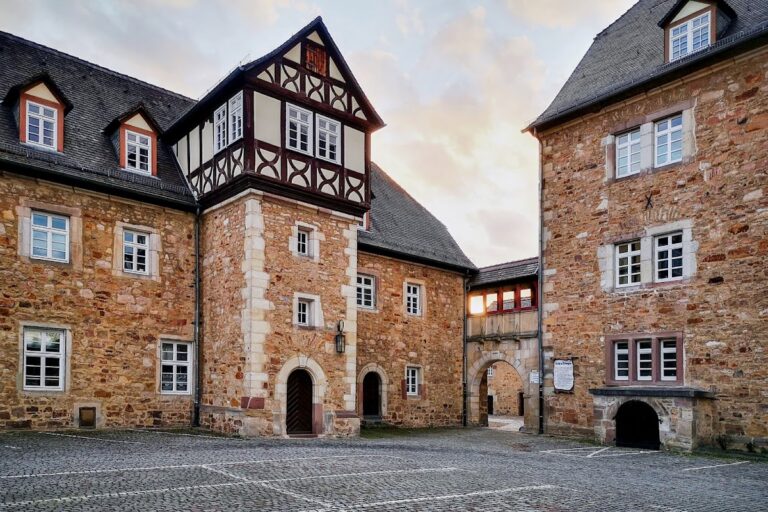
Heiligenburg Castle occupies the summit of the 393.3-metre Heiligenberg, a basalt cone east of Gensungen above the Eder. The hill is the surviving volcanic neck of an extinct Miocene volcano, with basalt filling the former volcanic conduit. The medieval fortress was built mainly from sandstone and basalt. Its remains include ruined walls, ramparts, a castle gate, and a tower.
The summit area also preserves traces of a prehistoric ring wall. Its southeastern section remains visible, while medieval construction has obscured the section around the summit toward the northwest. Excavations in the hilltop area produced the two La Tène A/B bow fibulae, La Tène B pottery, and a possible Iron Age wall structure, linking the surviving landscape to occupation before the medieval fortress.
The gate, tower, and chapel site
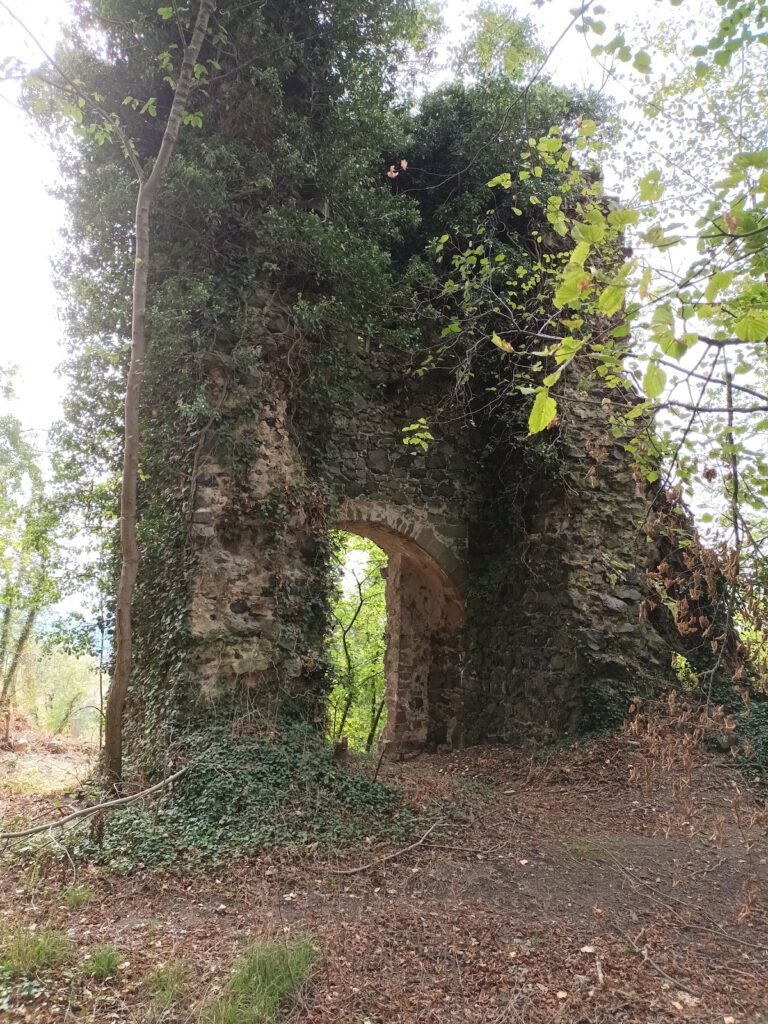
The castle gate contains the bell installed in 1952 in memory of people displaced after the Second World War. The open staircase added during the 1935 to 1939 restoration provides another surviving element of the modern treatment of the ruins.
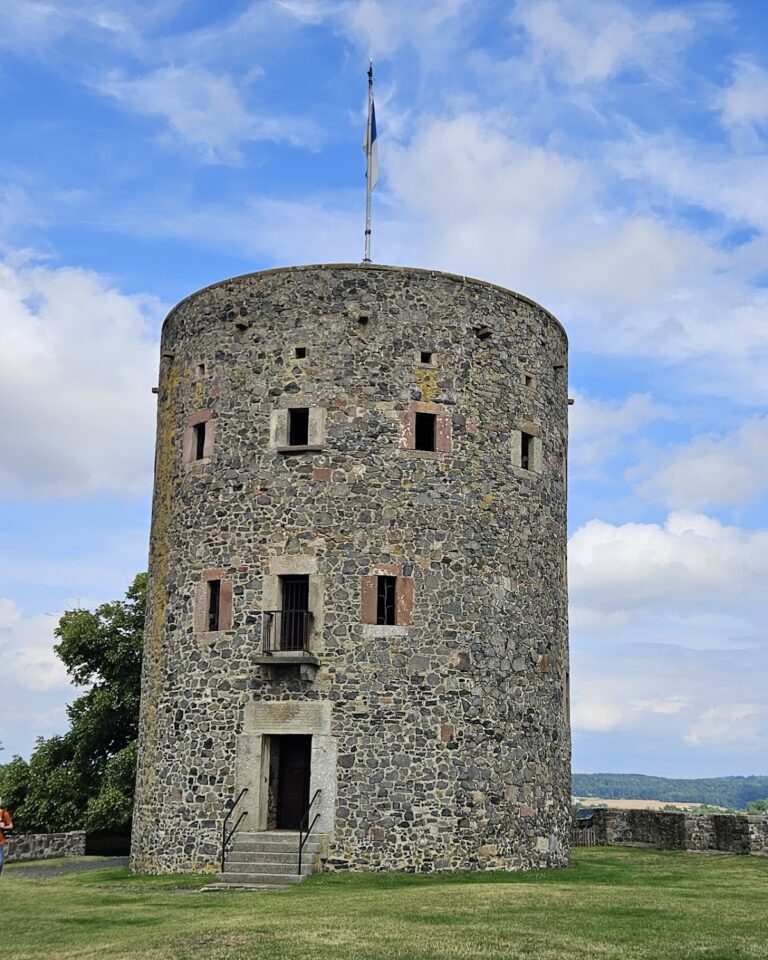
The castle tower was repaired in 2008 and functions as a lookout tower. Its elevated position provides extensive views across the surrounding area. The chapel associated with the castle stood on the hill and was later known as a mountain chapel. An old bell clapper found at the site may have belonged to the earlier Christian chapel, while the chapel’s remains eventually decayed along with the castle walls.
Military and modern features
Two entrenchments on the slope survive as physical remains associated with the French camp of 1761. They belong to the hill’s later military history rather than to the medieval castle itself.
The modern landscape around the ruins includes the refuge hut, service building, restaurant, hotel, and festival grounds added during the nineteenth and twentieth centuries. The Ars Natura path, established in 2002, runs around the hill and incorporates works by local artists, extending the site’s present cultural use beyond the medieval remains.