Pfeffingen Castle: A Medieval Hill Castle in Switzerland


Site at a Glance
- Rating
- 4.7
- Popularity
- Low
- Country
- Switzerland
- Primary era
- Medieval
- External website
- Open
- Eras represented
- Medieval, Early Modern
- Civilizations
- Holy Roman Empire
- Site type
- Military
- Remains
- Castle
On this page12 sections
History
Pfeffingen Castle is a medieval hill castle in Switzerland, standing on the Blauen ridge in the municipality of Pfeffingen. It is dated to about 1135, when Notker von Pfeffingen was first mentioned, and its later development was closely tied to the noble families and territorial powers of the Basel region.
Origins and Thierstein residence
The area around Aesch and Pfeffingen had earlier contained a Franconian royal court, an administrative and residential estate associated with royal authority. The castle’s own history begins in the twelfth century, when Notker von Pfeffingen, probably related to the Count of Saugern, entered the historical record.
At the end of the twelfth century, inheritance brought Pfeffingen into the possession of the Counts of Thierstein. Together with Dorneck Castle, it became a center of their lordship. The castle was prepared as a residence for Thierstein ministerials, dependent officials or retainers who could serve their lord in military, administrative, or residential roles. The Schaffner family of Pfeffingen, who lived at the castle, was first mentioned in 1212.
A comprehensive rebuilding took place in the mid-thirteenth century. After this work, members of the Thierstein family themselves resided at Pfeffingen, reinforcing its position within their territorial network.
Conflicts with Basel and the fourteenth-century rebuilding
In the early fourteenth century, Pfeffingen became a fief of the Bishopric of Basel. This institution was both an ecclesiastical authority and a territorial lordship ruled by the Bishop of Basel. The reasons for the change remain unclear, and relations between the bishop and the Thiersteins became strained. In 1335, the Bishop of Basel besieged Pfeffingen but failed to take it.
The Basel earthquake of 1356 damaged the castle. A local tradition tells of the miraculous rescue of Walram of Thierstein-Pfeffingen during the disaster. Pfeffingen was soon rebuilt and enlarged. The work added a western zwinger, an outer defensive area beyond the main fortification, as well as an outer gate and the Hexenturm.
By about the middle of the fourteenth century, the Thierstein family had divided into two lines. One thereafter occupied Farnsburg, while the other held Neu-Thierstein and Pfeffingen. Conflict between the Thierstein-Pfeffingen counts and the city of Basel led to a successful Basel siege in 1376, during which the castle was burned. It was later restored. A further feud in 1406 brought Basel’s troops to Pfeffingen, although the dispute was settled through Thüring von Ramstein.
Wars, occupation, and the end of the Thiersteins
The counts subsequently aligned themselves closely with Habsburg Austria, the Austrian branch of the Habsburg dynasty, and traded with Basel’s enemies during the Old Zürich War, a fifteenth-century conflict involving Swiss forces and neighboring powers. Basel besieged and captured Pfeffingen in April 1445. During Carnival in 1446, the Austrian bailiff Peter von Mörsberg retook it in a surprise attack. Basel laid siege again but failed to recover the castle. The conflict ended in 1449 through an agreement involving Basel, Count Hans of Thierstein-Pfeffingen, and the pro-Austrian nobility.
In 1464, Hans’s son, Count Oswald I of Thierstein-Pfeffingen, entered the Burgrecht of Solothurn, a legal relationship that placed him under the town’s protection in return for specified obligations. Solothurn was Basel’s principal enemy, and the agreement renewed tensions with both Basel and the Bishopric of Basel. Oswald’s sons, Wilhelm and Oswald II, later dissolved the arrangement.
During the Swabian War of 1499, a conflict involving Swiss forces, Austria, and neighboring territories, Wilhelm and Oswald II supported Austria. They conducted a prolonged small-scale war against the neighboring Solothurn lordship of Dorneck. After the Battle of Dornach, the Swiss Confederates took positions before Pfeffingen, but the two counts did not surrender under the pressure.
The deaths of Oswald II in 1513 and Wilhelm in 1519 brought the Thierstein-Pfeffingen family to an end. Basel occupied the castle in 1520, while Solothurn also claimed it. The inheritance dispute was settled in 1522, when Pfeffingen was awarded to the Bishop of Basel, who installed a bailiff. Basel received the municipality of Riehen in compensation.
Early-modern decline and conservation
Repeated wars had left Pfeffingen so damaged that it was difficult to maintain. In 1571, a new residential wing replaced the earlier residential tower. A tower-defended gate and a bridge were also built in the eastern part of the complex.
Swedish troops under Bernhard of Saxe-Weimar occupied Pfeffingen in 1637 during the Thirty Years’ War, the major European conflict fought from 1618 to 1648 amid religious, dynastic, and political struggles. When the castle was handed back to the bishop eleven years later, it was in very poor condition.
Around 1750, the Blarer family of Wartensee abandoned Pfeffingen and moved its official seat to Aesch Castle. A hermit later lived at the site for a time. In 1761, the castle was auctioned for demolition, after which it rapidly deteriorated into a ruin.
Clearing, restoration, and conservation began in 1931. The canton of Basel-Land acquired the ruin in 1941. Between 2013 and 2017, the canton carried out a major conservation campaign to repair damage, stabilize vulnerable sections, and protect the historic fabric. The initial focus was the residential tower, including the sealing of its coping. Pfeffingen Castle is a Swiss heritage site of national significance.
Remains
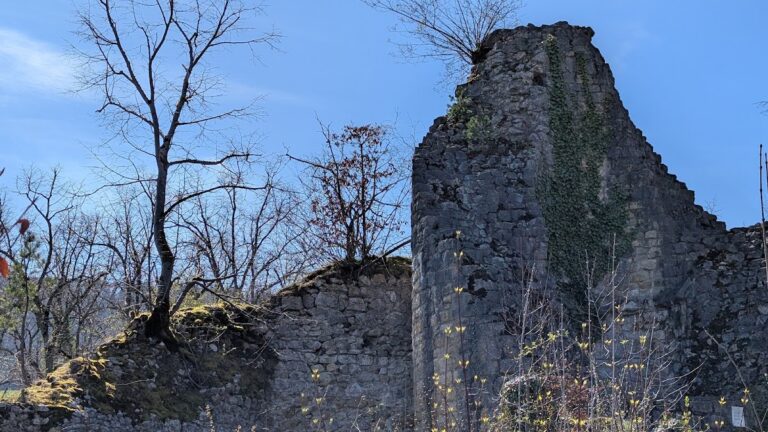
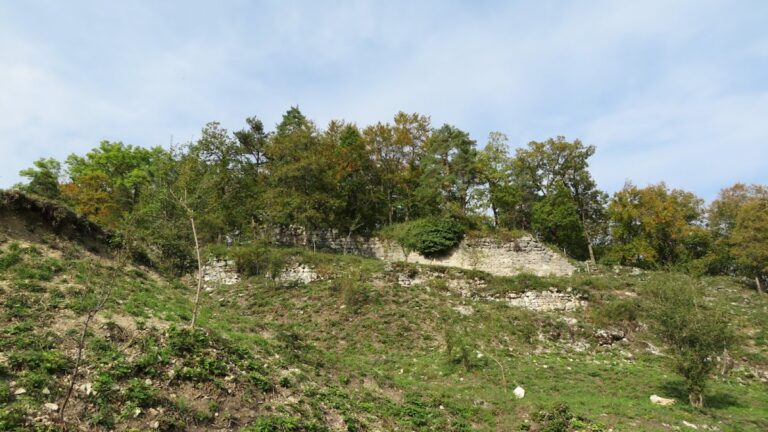
Pfeffingen Castle occupies the ridge of the Blauen as an extensive hilltop ruin. Its surviving fabric includes the large residential tower, northern defensive walls, additional towers, gates, a bridge, and other buildings arranged within a ring wall. The ruin is visible from the Birseck and from the Angenstein gorge.
Medieval core
Residential tower
The central feature is the remains of a powerful residential tower incorporated into the northern enclosure. It dates from the comprehensive rebuilding of the mid-thirteenth century and was the largest and most seriously damaged part of the complex. The tower preserves the medieval residential character of Pfeffingen, alongside the later residential wing that replaced it in 1571. Sections of the tower have been restored or conserved, including its coping, which was sealed during the conservation work of 2013 to 2017.
Northern defenses
The thirteenth-century northern defenses include a shield wall and a curtain wall, or enclosing defensive wall. Other surviving elements include several additional towers, gate structures, and the ring wall. Together, these remains define the fortified enclosure around the residential and service buildings.
Later fortifications and buildings
Western additions
The rebuilding after the 1356 earthquake extended the western side of the fortress with a zwinger, an outer defensive area beyond the principal fortification, an outer gate, and the Hexenturm. These additions formed part of the castle’s later medieval defensive arrangement.
Eastern gate and residential wing
The eastern part of the complex retains the tower-defended gate and bridge built in 1571. The same campaign produced a new residential wing in place of the earlier residential tower, leaving the ruin with physical evidence of both its medieval residential complex and its early-modern replacement.
Pfeffingen is now a ruin, but restored and conserved sections preserve the residential tower, shield wall, enclosure walls, towers, gates, bridge, and other buildings as parts of one fortified complex.
Nearby sites