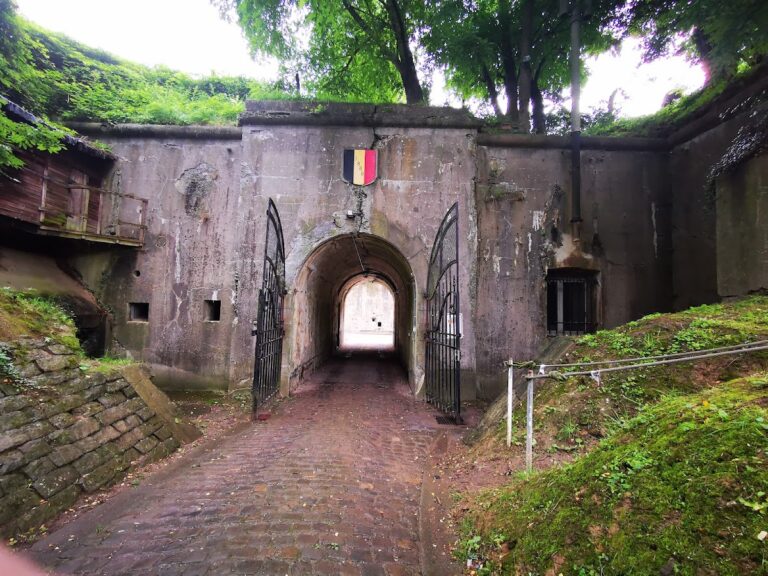
Fort de Battice: A Belgian Interwar Fortress of the Fortified Position of Liège


Site at a Glance
- Rating
- 4.3
- Popularity
- Low
- Country
- Belgium
- Primary era
- Modern
- External website
- Open
- Eras represented
- Modern
- Civilizations
- Belgian
- Site type
- Military
- Remains
- Fort
On this page15 sections
History
Fort de Battice is a Belgian reinforced-concrete fortress built east of Battice between 1934 and 1937 as part of the interwar Fortified Position of Liège. It formed part of PFL I, the newer outer ring of forts nearer the German frontier, while the twelve nineteenth-century forts around Liège belonged to PFL II. Designed to protect Liège’s eastern approaches, roads, and railway connections, the fort became one of the Belgian positions that resisted the German invasion in May 1940.
Construction and defensive planning
Plans for Fort de Battice date from 1931, and construction began on 1 April 1934. The principal works were completed by May 1937, although finishing continued into 1940. The fort was intended to reinforce the older defenses around Liège and incorporated lessons drawn from the First World War, especially the destruction of Fort Loncin. Its designers used heavily reinforced concrete, separated combat blocks, deeply buried galleries, improved ventilation, protected ammunition magazines, and more carefully arranged troop facilities.
The selected site on the eastern edge of the Herve Plateau contained a water-bearing geological layer. This forced the underground galleries to be placed higher than originally planned. The Aachen–Liège main road and the Montzen–Liège railway also shaped the design, and the road was rerouted during construction. The completed fortress formed a compact defensive perimeter rather than the more dispersed arrangement associated with the Maginot Line, France’s interwar system of fortified works.
The May 1940 campaign
In 1940 the fort was commanded by Captain Guéry of the 5th Battalion of the Liège Fortress Regiment. Major Bovy commanded the battalion, but after returning to the fort on 10 May following hospitalization for heart problems, he died of a heart attack that morning. On the same day, German forces attacked the outer forts of Liège after an airborne assault had largely neutralized Fort Eben-Emael, a major Belgian fortress near the German frontier.
Battice used its artillery to support Forts Tancrémont and Aubin-Neufchâteau. It also fired on Fléron and Evegnée and shelled bridges and roads in an effort to obstruct the German advance. German 305 mm mortars bombarded the fort on 12 May without causing major damage, while infantry attacks began on 13 May. After Belgian forces withdrew, German troops isolated Battice and Aubin-Neufchâteau, but both forts continued to disrupt German supply routes.
German forces worked to neutralize Battice’s artillery observers. Once this had been achieved on 19 May, the fort was restricted to pre-recorded target data and barrage fire. Its guns nevertheless fired almost continuously on 20 May to help repel an attack against Aubin-Neufchâteau. On 21 May, German Stuka aircraft dropped several 1,000-kilogram bombs on the fortress. One exploded directly in front of Block B.I, killing 26 Belgian personnel, while other combat blocks were severely damaged.
The air attack left five of the fort’s fourteen guns completely unusable and reduced seven others to limited operation. A bomb also struck the sally port of Block B.I. A nine-hour cease-fire allowed thirty dead and four survivors to be removed. After Aubin-Neufchâteau surrendered, Field Marshal Fedor von Bock demanded the capitulation of Battice and Tancrémont. Captain Guéry surrendered Fort de Battice at 3:00 a.m. on 22 May, after twelve days of fighting.
The garrison numbered about 900 personnel. Thirty-four defenders were killed in action, while another 36 died as prisoners of war and 17 were wounded. A memorial beside Block B.I commemorates the 36 defenders who died in captivity.
Testing, occupation, and preservation
At the end of 1941, German forces used the fort for weapons tests, including trials of the Röchling fin-stabilized shell. Developed as a concrete-penetrating projectile, it was fired from a 35.5 cm mortar at a distance of 7 kilometres. The projectile penetrated either the concrete combat blocks or the earth cover, approximately 30 metres deep, before entering the concrete-lined galleries.
American forces occupied the fort in 1944 after German troops withdrew without a fight. Much of its equipment and armament was removed during and after the Second World War. At the end of the 1950s, a scrap dealer largely stripped the installation. A private association later carried out extensive restoration, preserving underground accommodation, surface defenses, and other parts of the complex. Since June 2026, an observation tower has also provided views over the fort and its surroundings.
Remains
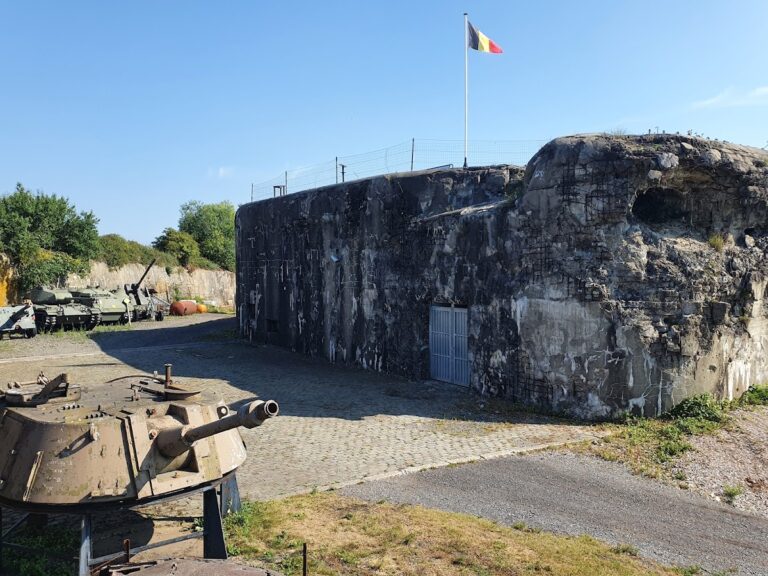
Fort de Battice is a roughly pentagonal reinforced-concrete complex north of the present-day E40 highway. Its surface area is about 13.5 hectares, while the overall installation is described as covering about 15 hectares within a wider site of approximately 47 hectares. At least twelve combat blocks were arranged around a defended perimeter, with the underground barracks and utility areas separated from the surface fighting positions.
Perimeter defenses and entrances
Defended ditch
A ditch surrounds most of the fortress, apart from the north side. Counterscarp positions, defensive works placed near the outer face of a ditch, and flanking works protected it with 47 mm guns, machine guns, and grenade launchers directed along the ditch. One of these positions was designated B.IVce. Additional ditch defenses and a flanking work survive within the restored complex.
Block B.I
Block B.I guarded the N648 road and a railway line. It contained two 60 mm guns, machine-gun positions, a grenade ejector, and a searchlight. The block also served as an entrance, with truck access along the railway grade. Its sally port was struck during the air attack of 21 May 1940, and the block became the site of the memorial to defenders who died as prisoners of war.
Access and ventilation blocks
Three blocks outside the defended perimeter, B.J., B.O., and B.W., provided access and air functions above the deeply buried galleries. B.W., positioned over the main living accommodation, was the combat entrance and carried machine guns. B.J. and B.O. served as emergency exits. Another entrance stood near the northeastern ditch, while a further access point and the main ventilator were located about 400 metres from the principal installation.
Artillery positions
Seventy-five-millimetre artillery blocks
Blocks A.Nord, B.IV, and B.VI were artillery blocks, each equipped with a retractable twin 75 mm gun turret. B.IV also had two armored machine-gun cupolas, known as cloches. The 75 mm guns had a range of approximately 10.1 to 10.5 kilometres. Blocks B.II, B.III, B.V, and B.VII were flanking casemates, protected chambers for weapons, positioned around the perimeter ditch to fire along it.
One-hundred-and-twenty-millimetre artillery blocks
Blocks B.Nord and B.Sud, also designated B.IX and B.X, each housed a twin 120 mm gun turret. With a range of approximately 17.5 kilometres, these weapons could provide artillery cover for Forts Tancrémont and Aubin-Neufchâteau and reach targets across a broad area east of Liège. Both turrets were later dismantled. Unlike Fort Eben-Emael, where some heavy guns were installed in casemates, Fort de Battice mounted all of its heavy artillery in turrets. The fortress also included a false 120 mm cupola.
Underground complex
Galleries and accommodation
Approximately 3.8 to 4 kilometres of underground passages lie about 20 to 30 metres beneath the surface. The galleries connected the troop accommodation, command post, ammunition magazines, power station, and other principal parts of the fortress. The underground barracks included sleeping rooms, a kitchen, sick bay, sanitary facilities, and washing rooms. Restored sections include a rest room and washroom.
Power and observation facilities
A power station containing six 175-horsepower engines supplied electricity for lighting, ventilation, lifts, and other systems. Six artillery observation posts were built in the wider surroundings of Battice, while additional observation positions form part of the preserved complex. The fortress was constructed with heavily reinforced concrete intended to resist shelling by weapons up to 520 mm in calibre, using a method designed to reduce weak joints between successive pours.
Nearby sites