Schönfeld Castle: A Renaissance Manor and Cultural Venue in Dresden, Germany


Site at a Glance
- Rating
- 4.4
- Popularity
- Low
- Country
- Germany
- Primary era
- Early Modern
- External website
- Open
- Eras represented
- Early Modern
- Civilizations
- Electorate of Saxony, Holy Roman Empire
- Site type
- Domestic
- Remains
- Castle
On this page9 sections
History
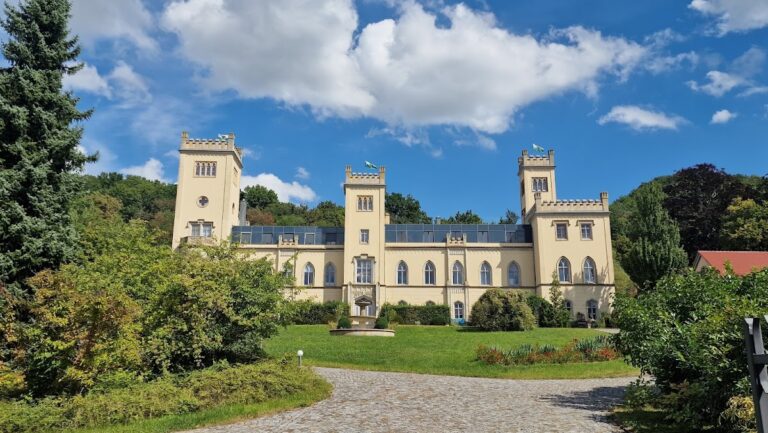
Schönfeld Castle is a Renaissance castle in Dresden, Germany, whose present form was created in 1573–1574 in the Saxon Renaissance style. It developed from a medieval water castle established in connection with the foundation of Schönfeld in the eleventh century, and is regarded as the best-preserved Renaissance castle in the Dresden region.
Medieval origins and manorial development
The original fortified residence was protected in part by surrounding water, making it a water castle. First recorded in 1315, it later became the centre of Schönfeld manor. By 1535, the manorial lordship included Cunnersdorf, Gönnsdorf, Malschendorf, Reitzendorf, Rochwitz, Rockau, Schullwitz, Ullersdorf, and Zaschendorf.
In 1543, Hans von Dehn-Rothfelser, a Saxon court master builder, acquired the castle. He arranged for the medieval fortress to be converted into a Renaissance castle, while also contributing substantially to the economic development of the surrounding upland.
Georg Cracow and the Renaissance castle
The Schönfeld manor passed in 1568 to Georg Cracow, an electoral chamber councillor and chancellor who was one of Elector August’s most influential advisers. Cracow was a sixteenth-century Saxon jurist and statesman, and under his ownership the present castle was built in 1573–1574.
Cracow’s position at the Saxon court collapsed in 1574 when he was branded a Philippist, a follower of the theological views associated with Philipp Melanchthon. These views differed from the stricter Lutheran orthodoxy then gaining influence at the court of Elector August, the sixteenth-century ruler of Saxony. Cracow lost his office and was arrested at Schönfeld on 13 March 1574. He died on 16 March 1575 in Leipzig’s Pleißenburg as a result of torture. His heirs were soon compelled to sell the castle.
Changing ownership and state administration
Over the following two centuries, Schönfeld Castle belonged to the electoral chamber master Gregor Schilling and to the families von Loss, von Friesen, von Callenberg, von Lüttichau, and Solms. In 1787, Elector Friedrich August III acquired the castle and manor. He combined them with the manors of Graupa, Jessen, and Pratzschwitz to create a chamber and state estate, meaning property administered for the territorial government rather than a private manor.
The estate administered Bonnewitz, Birkwitz, Graupa, Hinterjessen, Malschendorf, Neugraupa, Reitzendorf, Schönfeld, Vorderjessen, Wünschendorf, Zaschendorf, and part of Ullersdorf. In 1837, the castle became a court and prison. From 1856, it served as a fiscal court, an institution handling financial and tax-related legal matters. After the Schönfeld royal court office was dissolved in 1873, the banker Bernhard Gutmann acquired the castle in 1874.
From private manor to public and cultural use
The Schönfeld Luther Oak was planted in front of the castle pond for the four-hundredth birthday of Martin Luther, the theologian and reformer who initiated the Protestant Reformation in Germany. By about 1925, the property had again become a privately owned manor extending over 181 hectares, including land in Reitzendorf and Schullwitz.
In 1945, the property passed into public ownership. The former estate’s economic basis was lost when its land was divided among several new peasant holdings. During the German Democratic Republic period, the castle served, among other purposes, as the headquarters of a newspaper editorial office, a kindergarten, and the municipal library.
Renovation began in the early 1990s but advanced gradually because of insufficient funding and the long absence of a viable use concept. Interior work paused for several years and resumed from 2008. Since 2005, the Dresden-based Kunst- und Kulturverein Schloss Schönfeld, together with members of the Dresden Magic Circle “Bartolomeo Bosco,” has used the city-owned castle for public magic shows and as a museum of magic art. The museum displays original props associated with famous magicians, and the castle also contains rentable event rooms.
Remains
Building and water setting
Schönfeld Castle is a compact three-storey building standing immediately beside Schönfeld Church. A moat or castle pond surrounds it on three sides, preserving the water-protected character of the earlier fortress. The principal facade faces the service courtyard, while the roof is articulated by three full-height wall dormers.
Entrance tower and interiors
A hexagonal stair tower projects in front of the central wall dormer and becomes round toward its upper section. Its sandstone entrance portal carries the coats of arms of Georg Cracow and his second wife, Christina Funck, identifying them as the patrons of the castle’s construction.
The former living quarters on the upper floors retain numerous timber-beam ceilings from the construction period. These ceilings are painted with coats of arms and foliate ornament, while some other rooms received partial stucco ceilings in the eighteenth century. Remains of late Renaissance wall paintings have also been uncovered.
Modern alterations
A theatre hall with a stage and lighting equipment was installed for the castle’s modern cultural use. An elevator was also added. These interventions accompany the building’s present functions, while the castle itself has undergone no major structural alterations since its construction.
Nearby sites