Ergan kystfort: A German Coastal Battery in Norway


Site at a Glance
- Rating
- 4.3
- Popularity
- Low
- Country
- Norway
- Primary era
- Modern
- External website
- Open
- Eras represented
- Modern
- Civilizations
- German
- Site type
- Military
- Remains
- Fort
On this page6 sections
History
Ergan kystfort is a former German coastal battery in Bud, Norway, built during the Second World War as part of the Atlantic Wall, the German system of coastal fortifications intended to resist an Allied invasion. German forces reached Bud and Ergan in early May 1940 during the occupation of Norway. Construction of the four-gun battery began in spring 1941 and was completed in 1943, although further work continued until 1945. Positioned to protect the Romsdal coast and counter a feared seaborne landing, it formed part of a network of about 1,500 defensive installations along the Norwegian coast.
Construction and wartime operation
The Organisation Todt, a German state-controlled construction body responsible for major military and engineering projects during the Nazi period, directed the work with 40 personnel. The labor force also included 110 Polish prisoners of war housed in the schoolhouse and 40 Soviet prisoners of war housed in the prayer house. Their treatment contributed to tense relations between the battery and the local population.
About 90 personnel served at the battery, including two officers, 13 non-commissioned officers, 52 other crew members, 20 infantrymen, and eight air-defence soldiers. Maritime-defence radar stood at Kjeska, together with the communications staff responsible for it. Although the installation belonged to the German Army, its maritime operations were subordinate to the German Naval Commander at Molde, while its landward command came from the infantry division stationed at Dombås.
The battery was used operationally only once. Military requirements in 1942 and 1943 brought the demolition of 36 houses, eight barns, and several other coastal buildings, severely disrupting the civilians affected. Local people supported the prisoners of war, and some took part in civilian and military resistance activities. These included disputes involving the church and school systems and passive resistance by local authorities. No major resistance action or large-scale German reprisal followed.
Disbandment and museum history
After Germany’s capitulation, the battery was dismantled between May and November 1945. Its barracks and inventory were sold, while the weapons and ammunition were sunk in the sea. The protected remains are now operated as Museum Ergan Kystfort, which belongs to Romsdalsmuseet, a regional museum organization in Møre og Romsdal. Its exhibitions connect the wartime installation with local history and the coastal culture of the region, from the Stone Age to recent times.
Remains
Fortifications on Ergan hill
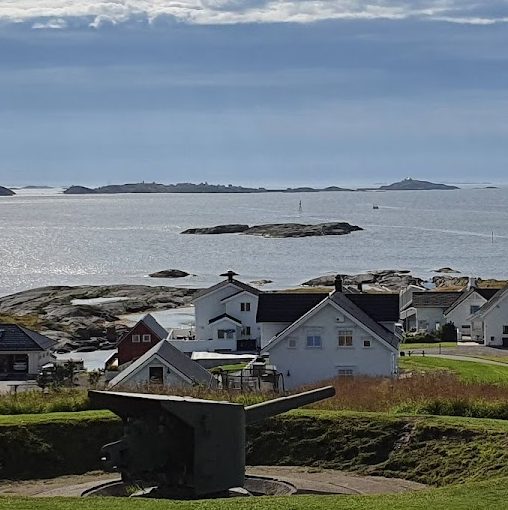
The battery occupies elevated Ergan hill in northern Bud, directly on the coast of the Norwegian Sea at the entrance to the Harøyfjord. Its rooms, including the command post, were excavated into the bedrock. The restored military installation is presented with weapons, equipment, technical details, and personal belongings associated with the battery. The site also contains the Bud standing stone, an upright commemorative or ritual monument erected in 1933. It was laid down during construction of the battery in 1941 and re-erected in 1946.
Museum building and coastal exhibitions
A museum building on the site contains a 100-seat lecture hall, meeting rooms, a cloakroom, and a kitchen. Displays cover the fishing village of Bud, underwater archaeology and wreck finds in Hustadvika, the development of the Ormen Lange gas field, aquaculture, cod and herring fisheries, production of klippfisk, and seaweed processing. Klippfisk is salted and dried fish traditionally produced in coastal communities and exported from Norway. A film explains the Storegga landslide, a massive prehistoric submarine landslide off the Norwegian coast that generated major tsunamis in the North Atlantic region. The dangers of the coast are also illustrated through the sinking of the DS Rokta at Gallerskjæra on 3 April 1938.